Gayophytum ramosissimum
Pinyon gayophytum
no rights reserved · CC0
Family: Onagraceae · Type: Herb · Native
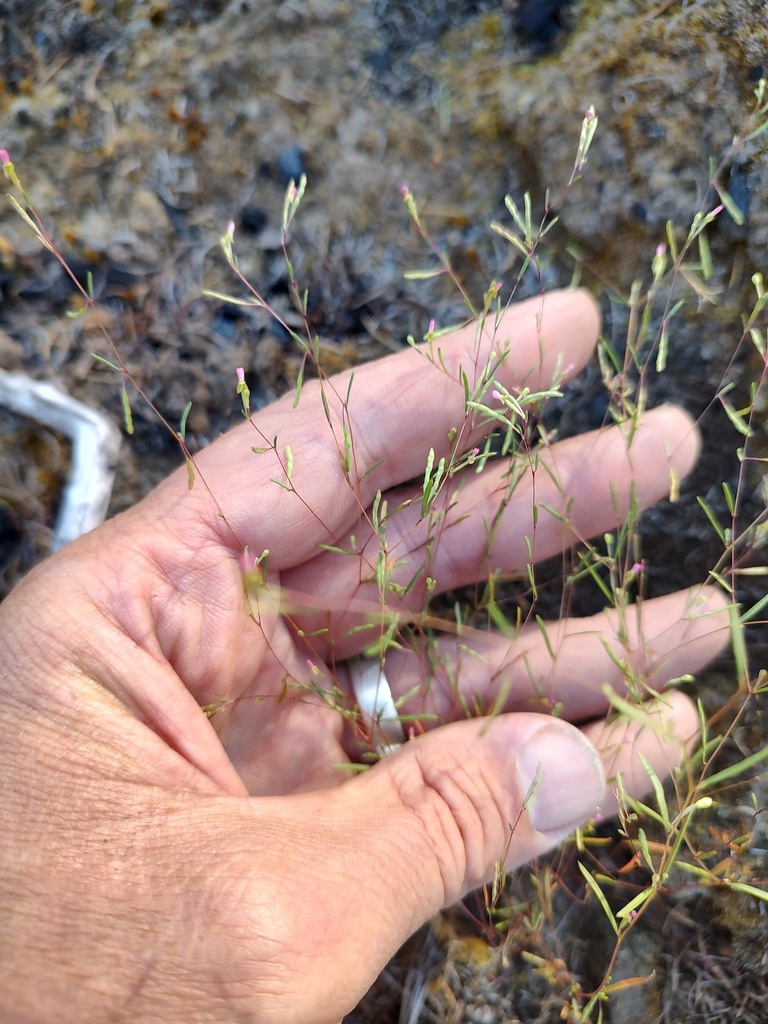
Gayophytum ramosissimum (Pinyon gayophytum) is a native California herb in the Onagraceae family, recognized by . Key features: extensively branched, tiny petals <1.5mm, fruit < pedicel.
Pinyon gayophytum is a California native annual found in northern Sierra Nevada, Great Basin, and northeastern California desert mountain regions in sagebrush scrub at elevations of 500 to 3,500 meters. Flowering from May to September, this delicate plant produces tiny white to pinkish flowers less than 1.5 millimeters long. Growing with slender branched stems less than 50 centimeters tall, the plant features multiple forked branches throughout its structure. Its leaves are relatively small, measuring 1 to 4 centimeters long and becoming progressively more reduced toward the stem's upper portions. The fruit is cylindric and slightly knobby, typically 3 to 9 millimeters in length.
Identification and appearance
Key characters: 7 sympatric species. Key features: extensively branched, tiny petals <1.5mm, fruit < pedicel
Habitat and range
Habitat: Sagebrush scrub
Elevation: 500-3500 m
Outside California: +- western United States.
Bloom period
Gayophytum ramosissimum blooms May-Sep.
How to tell it apart
vs Epilobium: Gayophytum is a wiry, much-branched annual with tiny flowers and short straight capsules whose seeds lack plumes; Epilobium has long linear capsules that split to release seeds tufted with hairs (coma).; vs Camissonia: Gayophytum has a very short or absent floral tube, so the petals appear to sit right on the ovary; the Camissonia group has a distinct floral tube above the ovary and generally yellow flowers.; vs Oenothera: Gayophytum is a slender diffuse annual with minute (1-2 mm) flowers; Oenothera (evening primrose) has large showy flowers on a long floral tube.; vs Clarkia: Gayophytum flowers are tiny with plain entire petals; Clarkia has larger, often lobed or clawed petals and 4-grooved capsules.; vs Eremothera: Gayophytum has a threadlike branching habit with short capsules held along the stem; Eremothera and Chylismia have basal rosette leaves and longer tubular-based flowers.
Frequently asked questions
Is Gayophytum ramosissimum native to California?
Yes. Gayophytum ramosissimum is native to California (recorded as native).
When does Gayophytum ramosissimum bloom?
Gayophytum ramosissimum blooms May-Sep.
What plant family does Gayophytum ramosissimum belong to?
Gayophytum ramosissimum is in the Onagraceae family, genus Gayophytum.
What habitat does Gayophytum ramosissimum grow in?
Gayophytum ramosissimum grows in Sagebrush scrub.
Related species
Other California species in the same genus, family, or bioregion.
- Gayophytum sp.
- Gayophytum decipiens — Deceiving gayophytum
- Gayophytum diffusum — Diffuse gayophytum
- Gayophytum diffusum subsp. diffusum
- Gayophytum diffusum subsp. parviflorum
- Gayophytum eriospermum — Coville's gayophytum
- Ludwigia grandiflora — Large-flowered primrose-willow
- Ludwigia hexapetala — Uruguayan primrose-willow
- Ludwigia palustris — Marsh purslane
Sources: Jepson eFlora · CalPhotos
Last updated 2026-10-07
Data from The California Species Project — 14,000+ California species with verified data from CNPS, CDFW, USFWS, Cal-IPC, and more.