Geranium dissectum
Cranesbill
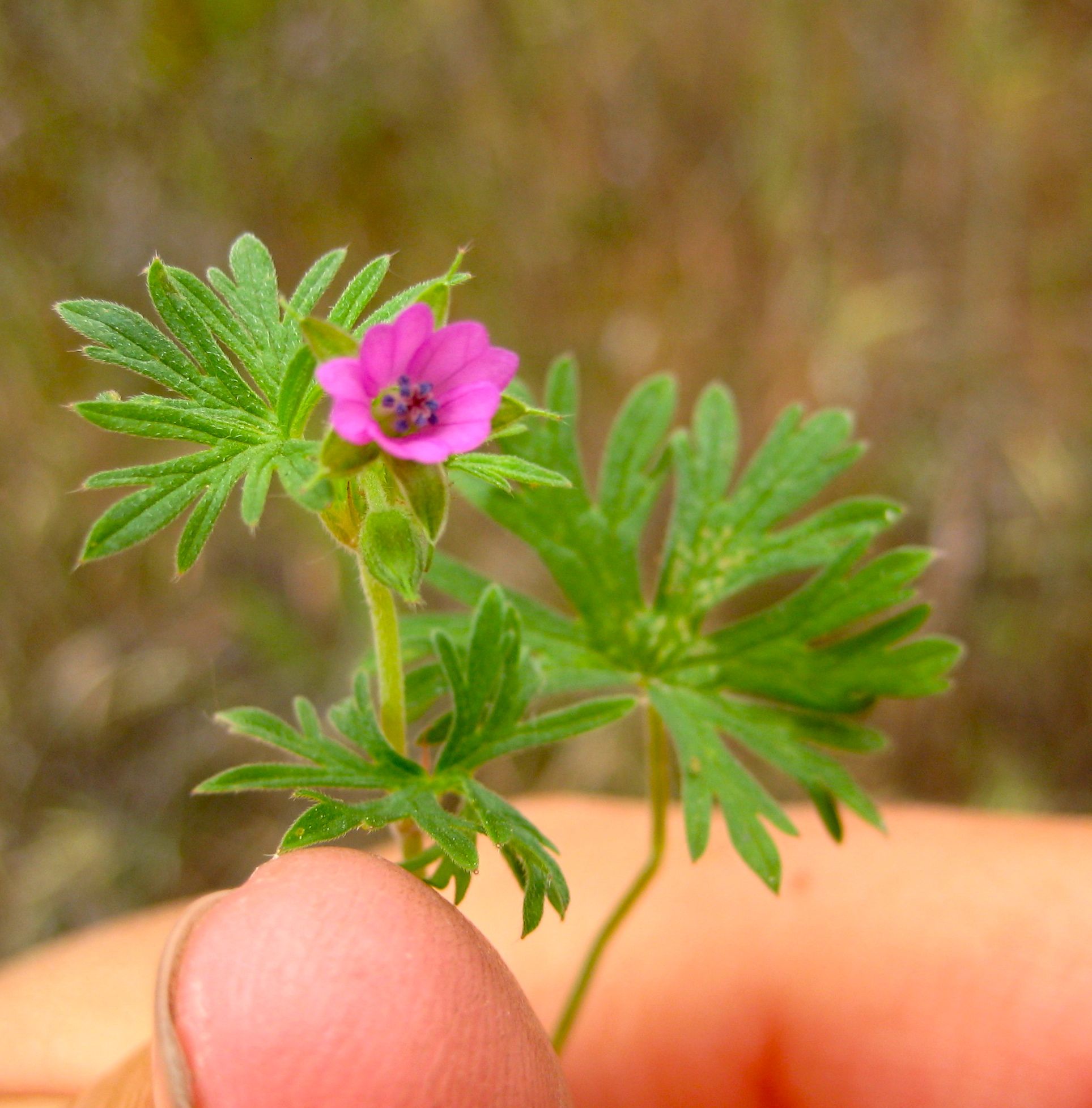
Photo by Chez Brungraber
Family: Geraniaceae · Type: Herb · Not Native
Conservation status: Cal-IPC Yes
Geranium dissectum (Cranesbill) is a non-native California herb in the Geraniaceae family, recognized by basal prong on capsule and deeply pitted seeds.
Cranesbill is a naturalized annual herb found in the California Floristic Province in open, disturbed sites at elevations below 1,300 meters. Flowering from March to July, this plant produces rose-purple flowers with petals approximately 3 to 6 millimeters long that are slightly notched at the tip. Growing with ascending to erect stems 7 to 70 centimeters tall covered in rough, spreading hairs, it has a distinctive growth habit. Its leaves are divided almost to the base, with 5 to 7 rhombic segments creating an intricate, lacy appearance. The fruit develops as a smooth mericarp with a narrow 11 to 14 millimeter beak, typical of the geranium family.
Identification and appearance
Key characters: 20 sympatric species; distinguished by basal prong on capsule and deeply pitted seeds
Habitat and range
Habitat: Open, disturbed sites
Elevation: < 1300 m
California counties: San Luis Obispo, Butte, Santa Cruz, Lake, San Mateo, San Francisco, Sonoma, Monterey, Mendocino, Alameda, Santa Clara, Marin, Fresno, Madera, San Diego, Riverside, Tulare, Humboldt, Santa Barbara, Ventura, Calaveras, Orange, San Bernardino, Amador, Yolo, Los Angeles, El Dorado, Placer, Colusa, Nevada, Napa, Solano, Yuba, San Joaquin, Sacramento, Sutter, Mariposa, Contra Costa, Tehama, Trinity, Glenn, Tuolumne, Del Norte, Stanislaus, Merced, Kern
Outside California: to eastern North America, native to Europe, northern Africa, western Asia, alien in some Caribbean islands, South America, New Zealand
Bloom period
Geranium dissectum blooms Mar-Jul.
Conservation status
Cal-IPC Yes
How to tell it apart
vs Erodium: Geranium leaves are palmately divided like spread fingers; Erodium leaves are pinnately divided like a feather.; vs Pelargonium: Geranium is herbaceous with symmetrical flowers; Pelargonium is shrubby with asymmetrical flowers.; vs Sidalcea: Geranium has deeply palm-divided leaves; Sidalcea has shallowly palmately-lobed leaves and stamens fused in a column.; vs Bowlesia: Geranium has deeply divided leaves and pink flowers; Bowlesia has shallowly lobed leaves and tiny white umbel flowers.; vs Malva: Geranium has deeply palm-divided leaves with narrow segments; Malva has shallowly palmately-lobed leaves and fused stamens.
Frequently asked questions
Is Geranium dissectum native to California?
No. Geranium dissectum is not native to California (recorded as not native).
When does Geranium dissectum bloom?
Geranium dissectum blooms Mar-Jul.
Where in California does Geranium dissectum grow?
Geranium dissectum occurs in San Luis Obispo, Butte, Santa Cruz, Lake, San Mateo, San Francisco, Sonoma, Monterey and other counties, at elevations of < 1300 m.
What plant family does Geranium dissectum belong to?
Geranium dissectum is in the Geraniaceae family, genus Geranium.
Is Geranium dissectum invasive in California?
Geranium dissectum is listed by Cal-IPC with an invasiveness rating of Yes.
Related species
Other California species in the same genus, family, or bioregion.
Sources: Jepson eFlora · Index of California Plant Names · CalPhotos
Last updated 2026-10-07
Data from The California Species Project — 14,000+ California species with verified data from CNPS, CDFW, USFWS, Cal-IPC, and more.