Geum triflorum var. ciliatum
Prairie-smoke
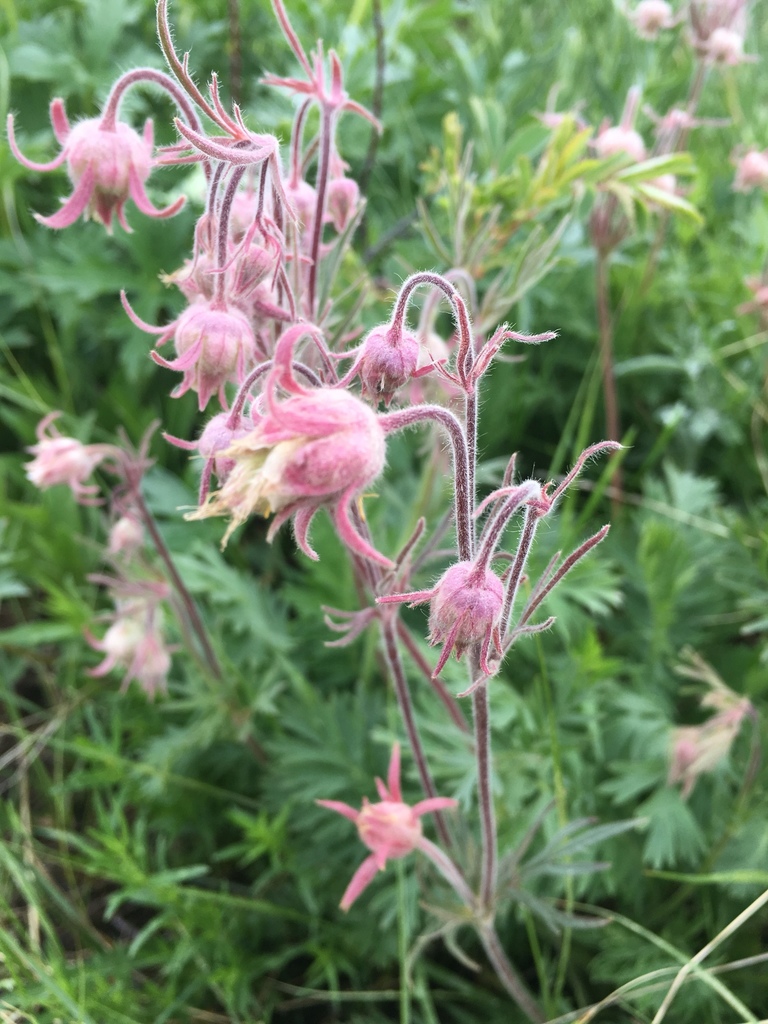
(c) Whitney Brook Matson, some rights reserved (CC BY), uploaded by Whitney Brook Matson · licence
Family: Rosaceae · Type: Herb · Native
Geum triflorum var. ciliatum (Prairie-smoke) is a native California herb in the Rosaceae family, recognized by nodding purplish flowers and plumose styles.
Prairie-smoke is a California native perennial found in the central Klamath Mountains, Cascade Range, northern and central Sierra Nevada, and Great Basin in dry meadow edges, sagebrush scrub, and open yellow-pine forest at elevations of 1,300 to 3,200 meters. Flowering from May to July, this plant produces cream to pale yellow flowers tinged with pink or purple-veined, nodding and cup-shaped with maroon or purple sepals. Growing in patches with rhizomes, it forms grayish-green stems 10 to 50 centimeters tall. Its compound leaves are 4 to 30 centimeters long, with 3 to 9 wedge-shaped leaflets on each side, typically divided into two or three deep lobes. The distinctive fruiting stage features a feathery plumose style extending 15 to 40 millimeters beyond the small fruit body.
Identification and appearance
Key characters: 2 sympatric species; key features are nodding purplish flowers and plumose styles
Habitat and range
Habitat: dry meadow edges, sagebrush scrub, open yellow-pine forest
Elevation: 1300-3200 m
California counties: Modoc, Siskiyou, Alpine, San Diego, Lassen, Mono, Placer, Shasta, Nevada, Plumas, El Dorado
Outside California: to British Columbia, Montana, Colorado
Bloom period
Geum triflorum var. ciliatum blooms May-Jul.
How to tell it apart
vs Potentilla: Geum achenes bear a persistent, hooked or feathery elongating style that catches on fur; Potentilla achenes are smooth and styleless.; vs Fragaria: Geum flowers nod and the fruit is a dry head of awned achenes; Fragaria fruit swells into a fleshy red strawberry studded with surface achenes.; vs Duchesnea: Geum has cup-shaped flowers over a bracted hypanthium and a dry awned achene head; Duchesnea has solitary yellow flowers and a spongy, tasteless red mock-strawberry.; vs Drymocallis: Geum leaves have a large terminal leaflet and achenes tipped with hooked or plumose beaks; Drymocallis is glandular-sticky with beakless, smooth achenes.; vs Agrimonia: Geum bears open cup-shaped flowers and a head of naked awned achenes; Agrimonia carries flowers in a long slender spike and encloses the fruit in a bur-like hooked hypanthium.
Frequently asked questions
Is Geum triflorum var. ciliatum native to California?
Yes. Geum triflorum var. ciliatum is native to California (recorded as native).
When does Geum triflorum var. ciliatum bloom?
Geum triflorum var. ciliatum blooms May-Jul.
Where in California does Geum triflorum var. ciliatum grow?
Geum triflorum var. ciliatum occurs in Modoc, Siskiyou, Alpine, San Diego, Lassen, Mono, Placer, Shasta and other counties, at elevations of 1300-3200 m.
What plant family does Geum triflorum var. ciliatum belong to?
Geum triflorum var. ciliatum is in the Rosaceae family, genus Geum.
What habitat does Geum triflorum var. ciliatum grow in?
Geum triflorum var. ciliatum grows in dry meadow edges, sagebrush scrub, open yellow-pine forest.
Related species
Other California species in the same genus, family, or bioregion.
- Geum aleppicum — Aleppo or yellow avens
- Geum macrophyllum — Large-leaved avens
- Geum macrophyllum var. macrophyllum — Largeleaf avens
- Geum macrophyllum var. perincisum — Largeleaf avens
- Geum sp.
- Heteromeles arbutifolia — Christmas berry
- Heteromeles sp. — Christmas berry
- Holodiscus discolor — Oceanspray
- Holodiscus discolor var. cedrorum — Cedars oceanspray
Sources: Jepson eFlora · Index of California Plant Names · CalPhotos
Last updated 2026-10-07
Data from The California Species Project — 14,000+ California species with verified data from CNPS, CDFW, USFWS, Cal-IPC, and more.