Gilia cana subsp. triceps
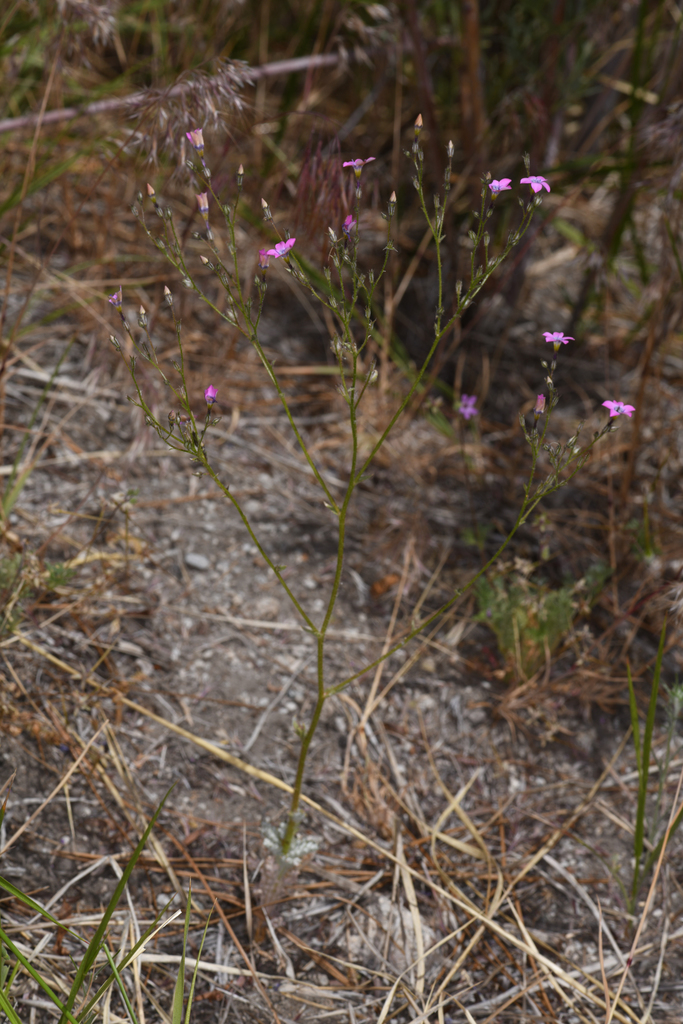
Photo: parent species Gilia cana · (c) Trevor Van Loon, some rights reserved (CC BY) · licence
Family: Polemoniaceae · Type: Herb · Native
Gilia cana subsp. triceps is a native California herb in the Polemoniaceae family, recognized by short tube and cup-shaped throat.
Gilia cana subsp. triceps is a California native annual found in southern Sierra Nevada, White and Inyo Mountains, western Transverse Ranges, and Mojave Desert in sandy limestone flats at elevations of 90 to 2,400 meters. Flowering from March to May, this plant produces delicate white to pale lavender flowers with cup-shaped throats 8 to 23 millimeters long. Growing with slender, spreading stems that are tufted and woolly-hairy, it forms low, compact clusters about 1 to 5 centimeters tall. Its basal leaves are densely covered in soft, woolly hairs, creating a distinctive grayish appearance with finely textured foliage. The fruit is widely ovoid to spherical, containing 12 to 18 seeds that contribute to its successful reproduction in arid desert landscapes.
Identification and appearance
Key characters: 35 sympatric species - distinguished by short tube and cup-shaped throat
Habitat and range
Habitat: Sandy flats, generally limestone
Elevation: 90-2400 m
California counties: Inyo, San Bernardino, Kern, Mono
Outside California: southwestern Nevada, western Arizona
Bloom period
Gilia cana subsp. triceps blooms Mar-May.
How to tell it apart
vs Saltugilia: Gilia has white cobwebby or sharply bent hairs; Saltugilia has translucent, barely glandular hairs.; vs Navarretia: Gilia has cobwebby/bent hairs; Navarretia has very short uniform glandular hairs and spiny flower heads.; vs Phacelia: Gilia has white cobwebby hairs; Phacelia has coiled flower clusters and straight bristly hairs.; vs Allophyllum: Gilia has white cobwebby or bent hairs; Allophyllum has long fuzzy glandular hairs.; vs Aliciella: Gilia has funnel-shaped flowers; Aliciella has wheel-shaped flowers with spreading lobes.
Frequently asked questions
Is Gilia cana subsp. triceps native to California?
Yes. Gilia cana subsp. triceps is native to California (recorded as native).
When does Gilia cana subsp. triceps bloom?
Gilia cana subsp. triceps blooms Mar-May.
Where in California does Gilia cana subsp. triceps grow?
Gilia cana subsp. triceps occurs in Inyo, San Bernardino, Kern, Mono, at elevations of 90-2400 m.
What plant family does Gilia cana subsp. triceps belong to?
Gilia cana subsp. triceps is in the Polemoniaceae family, genus Gilia.
What habitat does Gilia cana subsp. triceps grow in?
Gilia cana subsp. triceps grows in Sandy flats, generally limestone.
Related species
Other California species in the same genus, family, or bioregion.
Sources: Jepson eFlora · Index of California Plant Names · CalPhotos
Last updated 2026-10-07
Data from The California Species Project — 14,000+ California species with verified data from CNPS, CDFW, USFWS, Cal-IPC, and more.