Glechoma hederacea
Ground ivy
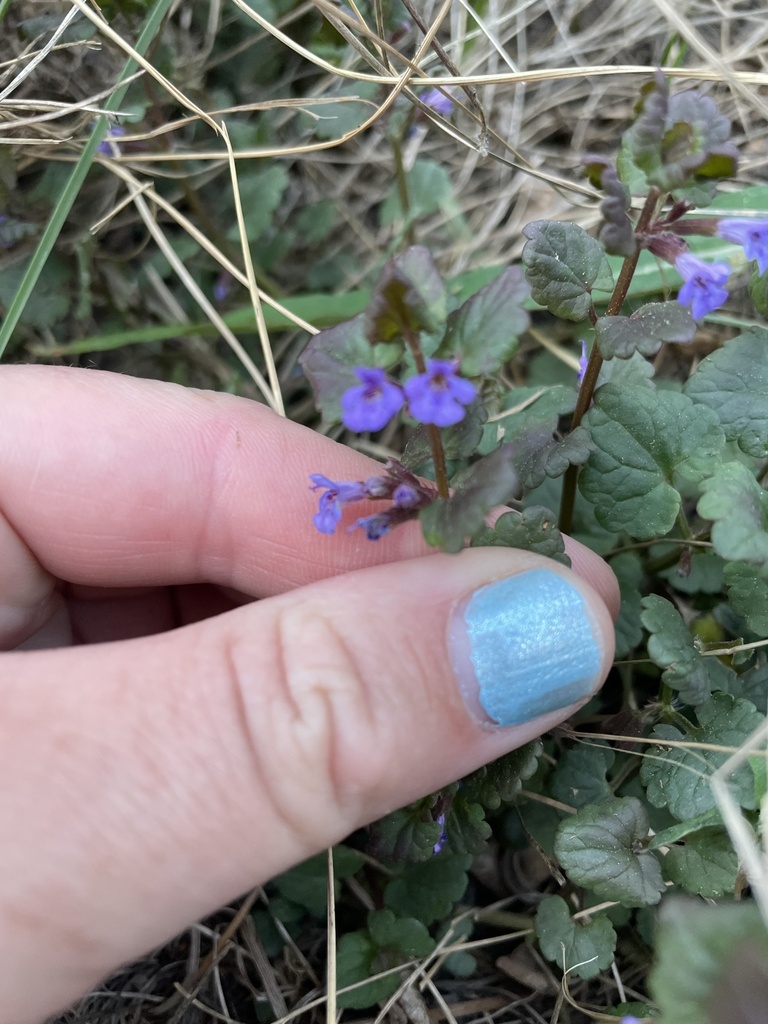
no rights reserved · CC0
Family: Lamiaceae · Type: Herb · Not Native
Glechoma hederacea (Ground ivy) is a non-native California herb in the Lamiaceae family, recognized by European genus naturalized in North America, representing Old World mint flora adapted to shade.
Ground ivy is a naturalized perennial found in northwestern California, Sierra Nevada foothills, central western California, and southern coastal California in disturbed, generally moist and shaded places at elevations below 800 meters. Flowering from March to June, this plant produces violet flowers with purple spots, typically 15 to 25 millimeters long in bisexual flowers. Growing with spreading to reflexed hairy stems 10 to 50 centimeters tall, it spreads along the ground with a trailing habit. Its leaves are round to kidney-shaped, approximately 1 to 2 centimeters wide, with petioles generally 1 to 2 centimeters long. The flower calyxes are fine and bristly, measuring 3 to 7 millimeters in length.
Identification and appearance
Key characters: European genus naturalized in North America, representing Old World mint flora adapted to shade
Habitat and range
Habitat: Disturbed, generally moist, shaded places
Elevation: < 800 m
California counties: Los Angeles, San Bernardino, Mendocino, Ventura, Tulare, Madera, Fresno, Shasta, Humboldt, Lake, Santa Clara, Butte, Sonoma, San Diego, Yolo, San Luis Obispo, Santa Cruz, Monterey, Mariposa
Outside California: widespread North America, native to Europe
Bloom period
Glechoma hederacea blooms Mar-Jun.
How to tell it apart
vs Lamium: Glechoma has completely round leaves; Lamium leaves are heart-shaped with a pointed tip.; vs Hydrocotyle: Glechoma flowers emerge from square mint stems at leaf joints; Hydrocotyle flowers are on separate stalks.; vs Modiola: Glechoma has tubular two-lipped mint flowers; Modiola has flat open flowers with five petals.; vs Veronica: Glechoma flowers are large tubular mints from leaf joints; Veronica has tiny four-petaled flowers in spikes.; vs Boykinia: Glechoma stems are square and leaves opposite; Boykinia has round stems and alternate leaves.
Frequently asked questions
Is Glechoma hederacea native to California?
No. Glechoma hederacea is not native to California (recorded as not native).
When does Glechoma hederacea bloom?
Glechoma hederacea blooms Mar-Jun.
Where in California does Glechoma hederacea grow?
Glechoma hederacea occurs in Los Angeles, San Bernardino, Mendocino, Ventura, Tulare, Madera, Fresno, Shasta and other counties, at elevations of < 800 m.
What plant family does Glechoma hederacea belong to?
Glechoma hederacea is in the Lamiaceae family, genus Glechoma.
What habitat does Glechoma hederacea grow in?
Glechoma hederacea grows in Disturbed, generally moist, shaded places.
Related species
Other California species in the same genus, family, or bioregion.
Sources: Jepson eFlora · Index of California Plant Names · CalPhotos
Last updated 2026-10-07
Data from The California Species Project — 14,000+ California species with verified data from CNPS, CDFW, USFWS, Cal-IPC, and more.