Gleditsia triacanthos
Honey locust
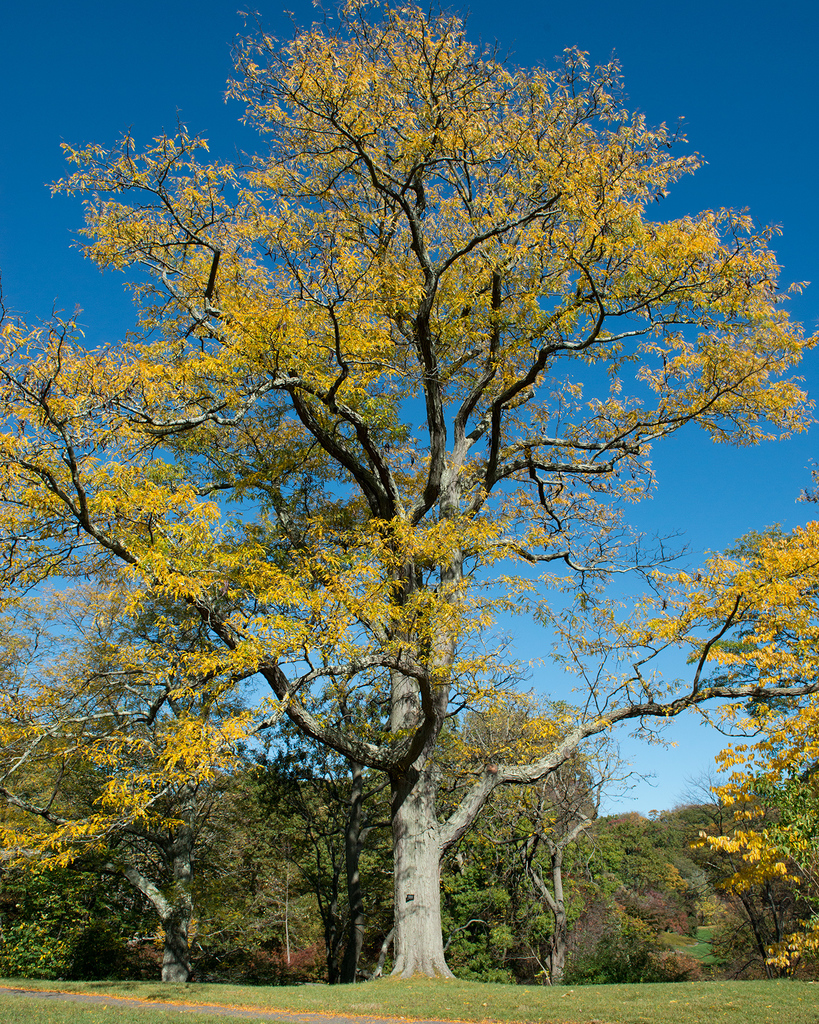
(c) Plant Image Library, some rights reserved (CC BY-SA) · licence
Family: Fabaceae · Type: Shrub / Tree · Not Native
Gleditsia triacanthos (Honey locust) is a non-native California shrub / tree in the Fabaceae family, recognized by Only Gleditsia species in California, naturalized from eastern North America.
Honey locust is a naturalized tree found in the Sacramento Valley and Peninsular Ranges at elevations below 800 meters, typically growing in moist riparian to dry upland woodland habitats. Flowering from May to June, this tree produces yellow-green flowers in small clusters on branch spurs. Growing with a broad, spreading form and reaching substantial heights, it develops complex 2-pinnate leaves with multiple leaflets arranged in intricate patterns. Its leaves are deciduous, featuring 7 to 17 primary leaflets and 4 to 20 secondary leaflets, each elliptic to oblong and measuring 1.3 to 2.5 centimeters long. The fruit is a distinctive long, curved pod 20 to 40 centimeters in length, brown and shiny, which persists on the tree and often becomes twisted with age.
Identification and appearance
Key characters: Only Gleditsia species in California, naturalized from eastern North America
Habitat and range
Habitat: Uncommon. Moist riparian to dry upland woodland
Elevation: < 800 m
Outside California: central and eastern United States, widely cultivated
Bloom period
Gleditsia triacanthos blooms May-Jun.
How to tell it apart
vs Robinia: Gleditsia has branched thorns and twice-compound leaves; Robinia has paired spines and once-compound leaves.; vs Tipuana: Gleditsia has fierce branched thorns on trunk; Tipuana is thornless with showy yellow flowers.; vs Jacaranda: Gleditsia has branched thorns and greenish flowers; Jacaranda is thornless with showy blue-purple flowers.; vs Grevillea: Gleditsia has compound leaves and legume pods; Grevillea has simple or divided leaves and follicle fruits.; vs Neltuma: Gleditsia has massive branched thorns; Neltuma has straight paired spines at nodes.
Frequently asked questions
Is Gleditsia triacanthos native to California?
No. Gleditsia triacanthos is not native to California (recorded as not native).
When does Gleditsia triacanthos bloom?
Gleditsia triacanthos blooms May-Jun.
What plant family does Gleditsia triacanthos belong to?
Gleditsia triacanthos is in the Fabaceae family, genus Gleditsia.
What habitat does Gleditsia triacanthos grow in?
Gleditsia triacanthos grows in Uncommon. Moist riparian to dry upland woodland.
Related species
Other California species in the same genus, family, or bioregion.
Sources: Jepson eFlora · CalPhotos
Last updated 2026-10-07
Data from The California Species Project — 14,000+ California species with verified data from CNPS, CDFW, USFWS, Cal-IPC, and more.