Glossopetalon spinescens var. aridum
Nevada greasewood, Nevada Greasewood
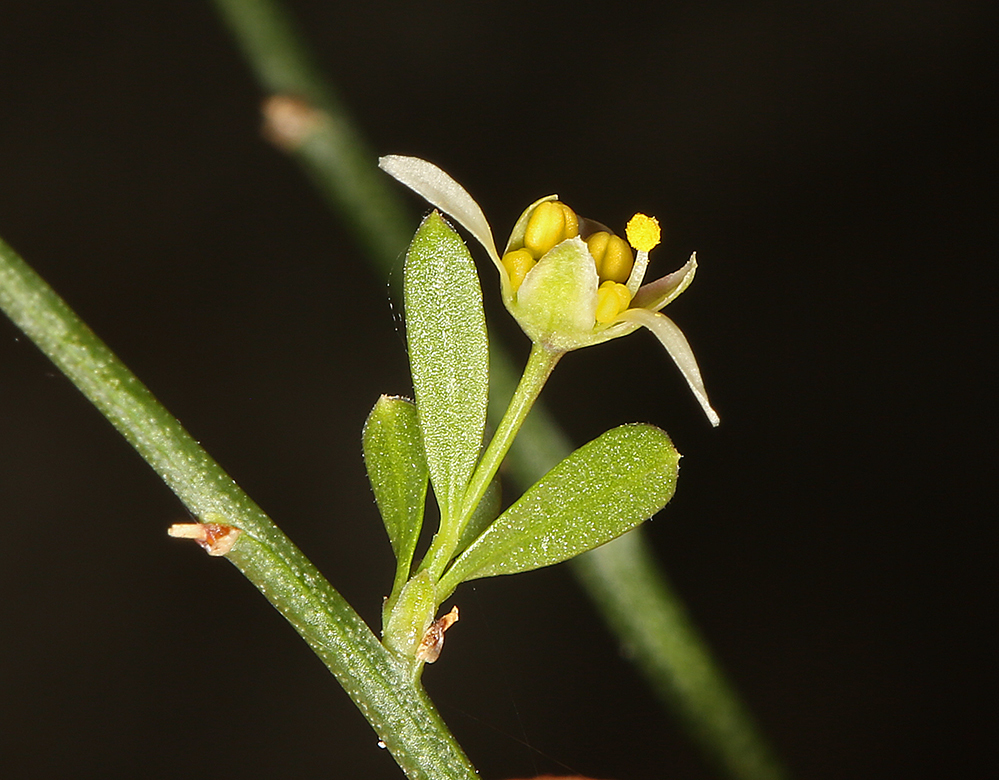
(c) Steve Matson, some rights reserved (CC BY), uploaded by Steve Matson · licence
Family: Crossosomataceae · Type: Shrub · Native
Glossopetalon spinescens var. aridum (Nevada greasewood) is a native California shrub in the Crossosomataceae family, recognized by key differences are growth form and stem thorniness.
Nevada greasewood is a native shrub found in southern Klamath Ranges, southern Sierra Nevada Mountains (Piute Mountains, Kern County), southern Border Mountains (northern base), White and Inyo Mountains, and Desert Mountains in limestone habitats at elevations of 850 to 2,720 meters. Flowering from April to May, this plant produces small white to cream-colored flowers 3 to 7 millimeters long with delicate petals. Growing to less than 2 meters tall with an upright form, it develops distinctively thorny branch tips and a compact, somewhat rigid structure. Its leaves are 5 to 17 millimeters long, oblong to obovate with barely visible veins on the underside, creating a subtle, muted green appearance. The plant produces one to two shiny brown seeds 2 to 3 millimeters long, adding to its distinctive desert adaptation.
Identification and appearance
Key characters: 1 sympatric species; key differences are growth form and stem thorniness
Habitat and range
Habitat: Limestone
Elevation: 850-2720 m
California counties: Inyo, San Bernardino, Mono, Trinity, Siskiyou, Kern
Outside California: to Washington, Wyoming, Texas, northern Mexico
Bloom period
Glossopetalon spinescens var. aridum blooms Apr-May.
How to tell it apart
vs Crossosoma: Glossopetalon flowers are in leaf axils with 4-10 stamens; Crossosoma flowers are at branch tips with 15-50 stamens.; vs Thamnosma: Glossopetalon is unscented and has opposite leaves; Thamnosma is strongly aromatic with alternate leaves.; vs Castela: Glossopetalon has bisexual flowers; Castela has separate male and female flowers.; vs Tamarix: Glossopetalon has large petals and 4-10 stamens; Tamarix has tiny petals in dense pink spikes.; vs Maytenus: Glossopetalon has separate petals; Maytenus has tiny flowers with petals joined at base.
Frequently asked questions
Is Glossopetalon spinescens var. aridum native to California?
Yes. Glossopetalon spinescens var. aridum is native to California (recorded as native).
When does Glossopetalon spinescens var. aridum bloom?
Glossopetalon spinescens var. aridum blooms Apr-May.
Where in California does Glossopetalon spinescens var. aridum grow?
Glossopetalon spinescens var. aridum occurs in Inyo, San Bernardino, Mono, Trinity, Siskiyou, Kern, at elevations of 850-2720 m.
What plant family does Glossopetalon spinescens var. aridum belong to?
Glossopetalon spinescens var. aridum is in the Crossosomataceae family, genus Glossopetalon.
What habitat does Glossopetalon spinescens var. aridum grow in?
Glossopetalon spinescens var. aridum grows in Limestone.
Related species
Other California species in the same genus, family, or bioregion.
Sources: Jepson eFlora · Index of California Plant Names · CalPhotos
Last updated 2026-10-07
Data from The California Species Project — 14,000+ California species with verified data from CNPS, CDFW, USFWS, Cal-IPC, and more.