Glyceria fluitans
Water manna grass
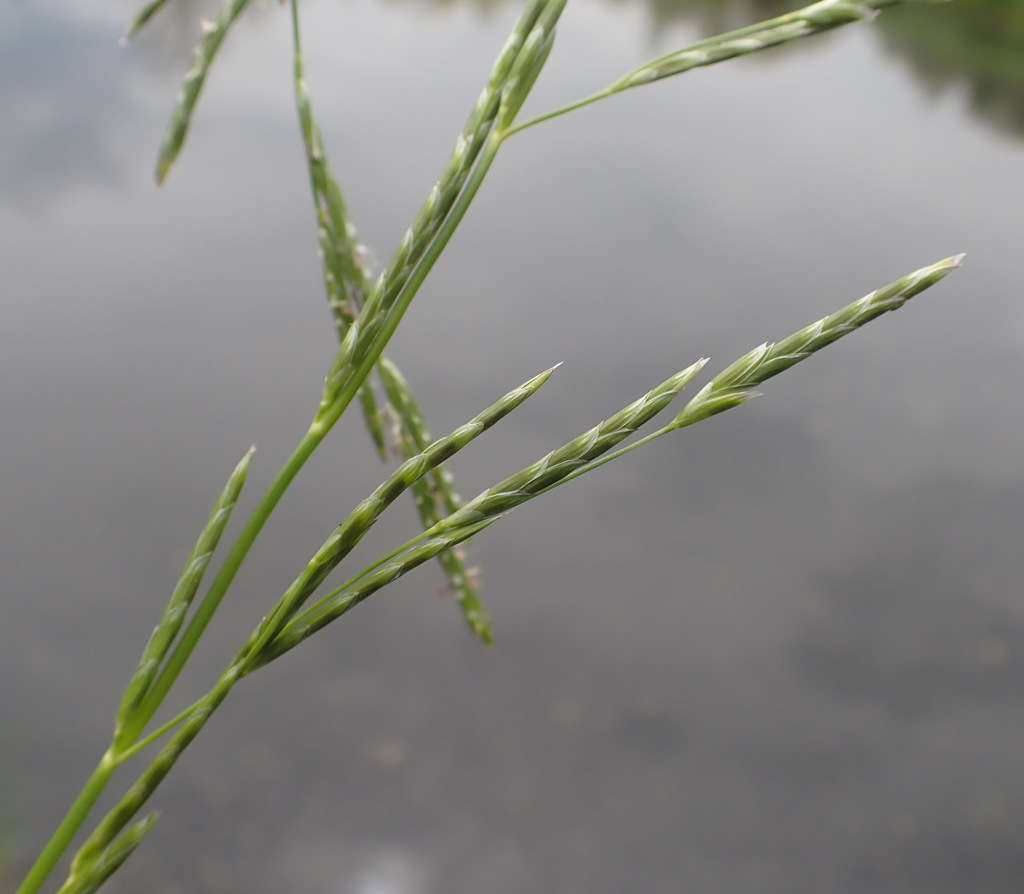
(c) Thomas Gyselinck, some rights reserved (CC BY), uploaded by Thomas Gyselinck · licence
Family: Poaceae · Type: Grass · Not Native
Glyceria fluitans (Water manna grass) is a non-native California grass in the Poaceae family, recognized by very long spikelets and low elevation diagnostic.
Water manna grass is a naturalized perennial found in northern coastal California, northern coastal and interior California, and the California Ranges in wet places at elevations below 500 meters. Flowering from June to July, this plant produces pale green to green spikelets in narrow inflorescences 15 to 50 centimeters long. Growing with stems 20 to 150 centimeters tall that occasionally form floating mats, it has a robust, spreading habit. Its leaves have blades 10 to 25 centimeters long and 3 to 10 millimeters wide, with ligules 5 to 15 millimeters long. The narrow, cylindrical spikelets contain 6 to 16 florets, with lemmas 6 to 8 millimeters long and acute to acuminate tips.
Identification and appearance
Key characters: 7 sympatric species; very long spikelets and low elevation diagnostic
Habitat and range
Habitat: Uncommon. Wet places
Elevation: < 500 m
Outside California: British Columbia, eastern United States, native to Eurasia
Bloom period
Glyceria fluitans blooms Jun-Jul.
How to tell it apart
vs Pleuropogon: Glyceria has closed leaf sheaths and 1-veined upper glumes; Pleuropogon has open sheaths and distinctive bumpy, jointed spikelet axes.; vs Oloptum: Glyceria has closed sheaths in wetlands; Oloptum has open sheaths in dry sites with needle-like rolled leaves.; vs Torreyochloa: Glyceria has 1-veined upper glumes; Torreyochloa has 3-veined upper glumes and more prominent lemma veining.; vs Puccinellia: Glyceria has closed leaf sheaths in freshwater; Puccinellia has open sheaths in saline/alkaline sites.; vs Desmazeria: Glyceria is perennial in wetlands with closed sheaths; Desmazeria is annual of dry sites with open sheaths.
Frequently asked questions
Is Glyceria fluitans native to California?
No. Glyceria fluitans is not native to California (recorded as not native).
When does Glyceria fluitans bloom?
Glyceria fluitans blooms Jun-Jul.
What plant family does Glyceria fluitans belong to?
Glyceria fluitans is in the Poaceae family, genus Glyceria.
What habitat does Glyceria fluitans grow in?
Glyceria fluitans grows in Uncommon. Wet places.
Related species
Other California species in the same genus, family, or bioregion.
Sources: Jepson eFlora · CalPhotos
Last updated 2026-10-07
Data from The California Species Project — 14,000+ California species with verified data from CNPS, CDFW, USFWS, Cal-IPC, and more.