Glyceria grandis
American manna grass
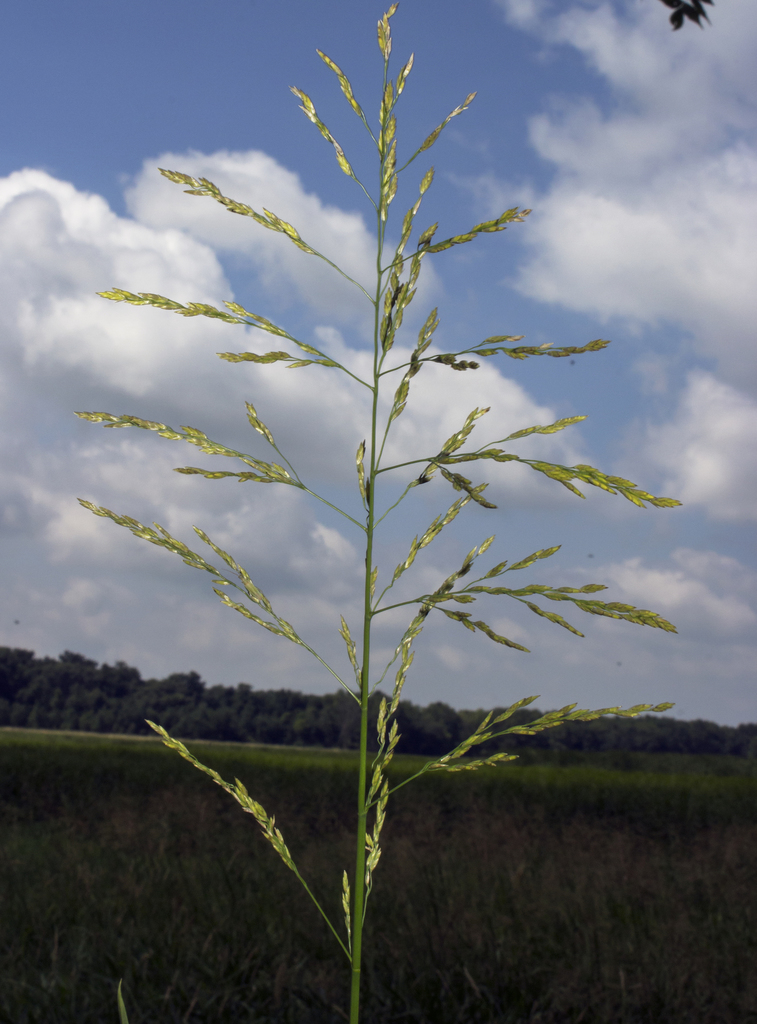
(c) aarongunnar, some rights reserved (CC BY), uploaded by aarongunnar · licence
Family: Poaceae · Type: Grass · Native
Conservation status: CNPS 2B.3
Glyceria grandis (American manna grass) is a native California grass in the Poaceae family, recognized by large size, thick stems, 3 anthers, and flat lemma tips diagnostic.
American manna grass is a California native perennial found in northern coastal, northern coastal ridges, Sierra Nevada, and Sierra Nevada eastern regions in wet meadows, lake and stream margins at elevations below 2,100 meters. Flowering from June to August, this grass produces delicate green-tinged spikelets with pale green flowers in loose, spreading branches 16 to 40 centimeters long. Growing with robust stems 90 to 200 centimeters tall and 3 to 6 millimeters in diameter, it forms dense, upright clumps in moist environments. Its leaves have thick, wide blades 4 to 15 millimeters across and ligules 2 to 7 millimeters long, creating a lush, verdant appearance. The grass produces small ovoid spikelets 4 to 6.5 millimeters long, each containing 4 to 7 florets with slightly flat tips.
Identification and appearance
Key characters: 7 sympatric species; large size, thick stems, 3 anthers, and flat lemma tips diagnostic
Habitat and range
Habitat: Wet places, meadows, lake and stream margins
Elevation: < 2100 m
California counties: Mendocino, El Dorado, San Bernardino, Madera, Placer, Humboldt, Fresno, Mono, Tulare, Sierra
Outside California: Alaska, eastern United States
Bloom period
Glyceria grandis blooms Jun-Aug.
Conservation status
CNPS 2B.3
How to tell it apart
vs Pleuropogon: Glyceria has closed leaf sheaths and 1-veined upper glumes; Pleuropogon has open sheaths and distinctive bumpy, jointed spikelet axes.; vs Oloptum: Glyceria has closed sheaths in wetlands; Oloptum has open sheaths in dry sites with needle-like rolled leaves.; vs Torreyochloa: Glyceria has 1-veined upper glumes; Torreyochloa has 3-veined upper glumes and more prominent lemma veining.; vs Puccinellia: Glyceria has closed leaf sheaths in freshwater; Puccinellia has open sheaths in saline/alkaline sites.; vs Desmazeria: Glyceria is perennial in wetlands with closed sheaths; Desmazeria is annual of dry sites with open sheaths.
Frequently asked questions
Is Glyceria grandis native to California?
Yes. Glyceria grandis is native to California (recorded as native).
When does Glyceria grandis bloom?
Glyceria grandis blooms Jun-Aug.
Where in California does Glyceria grandis grow?
Glyceria grandis occurs in Mendocino, El Dorado, San Bernardino, Madera, Placer, Humboldt, Fresno, Mono and other counties, at elevations of < 2100 m.
What plant family does Glyceria grandis belong to?
Glyceria grandis is in the Poaceae family, genus Glyceria.
Is Glyceria grandis rare or endangered?
Glyceria grandis carries California Rare Plant Rank 2B.3, state rank S3.
Related species
Other California species in the same genus, family, or bioregion.
Sources: Jepson eFlora · CNPS Rare Plant Inventory · Index of California Plant Names · CalPhotos · CDFW CNDDB
Last updated 2026-10-07
Data from The California Species Project — 14,000+ California species with verified data from CNPS, CDFW, USFWS, Cal-IPC, and more.