Goodmania luteola
Golden goodmania, Golden Goodmania
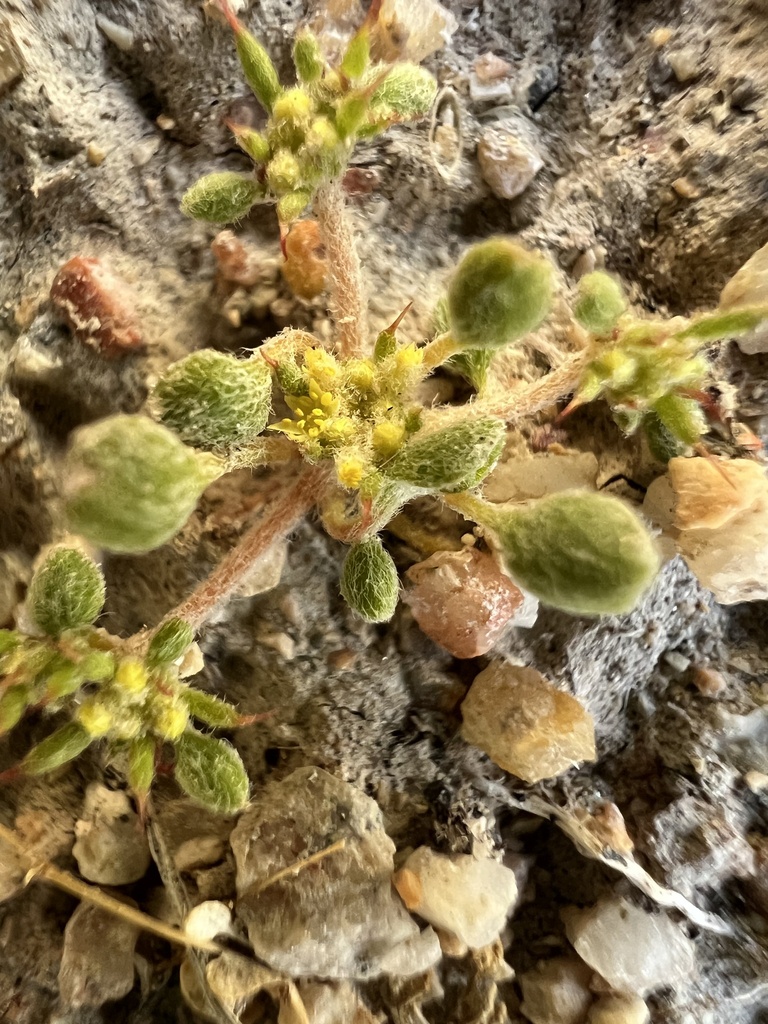
(c) Steve Matson, some rights reserved (CC BY) · licence
Family: Polygonaceae · Type: Herb · Native
Conservation status: CNPS 4.2
Goodmania luteola (Golden goodmania) is a native California herb in the Polygonaceae family, recognized by Monotypic genus, rare California endemic with small range extension into Nevada.
Golden goodmania is a California native annual found in southern San Joaquin Valley (extirpated), southern and eastern Sierra Nevada in Mono and Inyo counties, and western Mojave Desert in Kern and Los Angeles counties, growing in clay habitats at elevations of 70 to 2,200 meters. Flowering from April to August, this plant produces small yellow flowers in clusters with 6 to 15 blooms per cluster, each flower approximately 1 millimeter long. Growing with spreading stems 5 to 15 centimeters tall and up to 15 centimeters wide, the plant can be hairy or smooth with an open, branching growth habit. Its leaves are small and distinctive, with basal leaves roughly round and measuring 2 to 5 millimeters across, while stem leaves are narrow and linear with pointed tips. The fruit is light brown, obconical, and approximately 1 to 1.2 millimeters long with a curved embryo.
Identification and appearance
Key characters: Monotypic genus, rare California endemic with small range extension into Nevada
Habitat and range
Habitat: Clay
Elevation: 70-2200 m
California counties: Los Angeles, Kern, Mono, Inyo, Fresno, Madera, Tulare, San Bernardino
Outside California: west-central Nevada
Bloom period
Goodmania luteola blooms Apr-Aug.
Conservation status
CNPS 4.2
How to tell it apart
vs Gilmania: Goodmania flowers are subtended by a whorl of 5 narrow, awned involucral bracts and its leaves are opposite; Gilmania has no involucre at all and leaves whorled in 3s.; vs Eriogonum: Goodmania has flat, awn-tipped involucral bracts spread in an open whorl; Eriogonum encloses flowers in a lobed or toothed cup-shaped involucre.; vs Oxytheca: Goodmania involucres form a flat 5-parted whorl of stiff-awned bracts; Oxytheca has funnel- or tube-shaped involucres with fewer spreading awns.; vs Chorizanthe: Goodmania has yellow flowers and a low spreading habit with awned whorled bracts; Chorizanthe has 3-toothed cylindric involucres, often massed in dense heads.; vs Mucronea: Goodmania involucral bracts spread openly in a whorl of 5; Mucronea has spine-tipped involucres clustered in a stiff, forking inflorescence.
Frequently asked questions
Is Goodmania luteola native to California?
Yes. Goodmania luteola is native to California (recorded as native).
When does Goodmania luteola bloom?
Goodmania luteola blooms Apr-Aug.
Where in California does Goodmania luteola grow?
Goodmania luteola occurs in Los Angeles, Kern, Mono, Inyo, Fresno, Madera, Tulare, San Bernardino, at elevations of 70-2200 m.
What plant family does Goodmania luteola belong to?
Goodmania luteola is in the Polygonaceae family, genus Goodmania.
Is Goodmania luteola rare or endangered?
Goodmania luteola carries California Rare Plant Rank 4.2, state rank S3.
Related species
Other California species in the same genus, family, or bioregion.
Sources: Jepson eFlora · CNPS Rare Plant Inventory · Index of California Plant Names · CalPhotos · CDFW CNDDB
Last updated 2026-10-07
Data from The California Species Project — 14,000+ California species with verified data from CNPS, CDFW, USFWS, Cal-IPC, and more.