Gossypium hirsutum
Cotton, Cotton
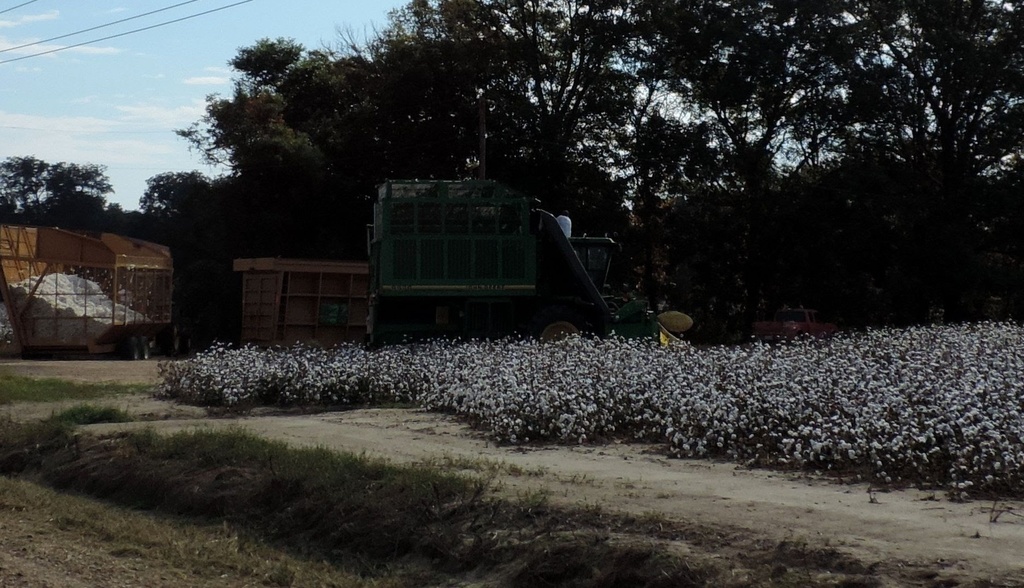
(c) Lauren McLaurin, some rights reserved (CC BY) · licence
Family: Malvaceae · Type: Shrub / Tree · Not Native
Gossypium hirsutum (Cotton) is a non-native California shrub / tree in the Malvaceae family, recognized by Only Gossypium species in California, agricultural escape from tropical America.
Cotton is a naturalized perennial found in the Sacramento Valley and southern deserts in disturbed places and agricultural lands at elevations below 100 meters. Flowering from April to October, this plant produces cream or pale yellow flowers with a dark basal spot, typically 2 to 5 centimeters wide. Growing with widely branching stems 50 to 200 centimeters tall and covered in star-shaped hairs, it develops an erect habit. Its large leaves are heart-shaped with 3 to 5 shallow, widely ovate lobes measuring 4 to 10 centimeters across, featuring distinctive curved stipules. The fruit is a widely ovoid capsule 2 to 4 centimeters long, containing several seeds hidden by long hairs.
Identification and appearance
Key characters: Only Gossypium species in California, agricultural escape from tropical America
Habitat and range
Habitat: Uncommon. Disturbed places, roadsides, agricultural land
Elevation: < 100 m
California counties: Imperial, Riverside, Tulare, San Diego, Fresno, Sacramento
Outside California: southern United States, originally tropical America, especially Mexico
Bloom period
Gossypium hirsutum blooms Apr-Oct.
How to tell it apart
vs Hibiscus: Gossypium has 3 large, entire-to-toothed leafy epicalyx bractlets and a capsule (boll) that splits to expose cotton-lint-covered seeds; Hibiscus has many narrow epicalyx bractlets and lintless seeds.; vs Abutilon: Gossypium fruit is a loculicidal capsule with fuzzy seeds; Abutilon fruit is a ring of many separate beaked mericarps.; vs Malva: Gossypium has large cream-to-yellow flowers with a conspicuous 3-parted epicalyx; Malva has small pink-lilac flowers and a wheel of dry mericarps (cheeses).; vs Alcea: Gossypium has cordate, shallowly 3-5-lobed leaves and a capsular boll; Alcea (hollyhock) is a tall wand with rounded lobed leaves and a flat disk of mericarps.; vs Sidalcea: Gossypium has broad cordate lobed leaves and cottony-seeded capsules; Sidalcea has palmately dissected leaves and pink flowers in slender spikes with dry mericarps.
Frequently asked questions
Is Gossypium hirsutum native to California?
No. Gossypium hirsutum is not native to California (recorded as not native).
When does Gossypium hirsutum bloom?
Gossypium hirsutum blooms Apr-Oct.
Where in California does Gossypium hirsutum grow?
Gossypium hirsutum occurs in Imperial, Riverside, Tulare, San Diego, Fresno, Sacramento, at elevations of < 100 m.
What plant family does Gossypium hirsutum belong to?
Gossypium hirsutum is in the Malvaceae family, genus Gossypium.
What habitat does Gossypium hirsutum grow in?
Gossypium hirsutum grows in Uncommon. Disturbed places, roadsides, agricultural land.
Related species
Other California species in the same genus, family, or bioregion.
Sources: Jepson eFlora · Index of California Plant Names · CalPhotos
Last updated 2026-10-07
Data from The California Species Project — 14,000+ California species with verified data from CNPS, CDFW, USFWS, Cal-IPC, and more.