Gratiola ebracteata
Bractless hedge-hyssop
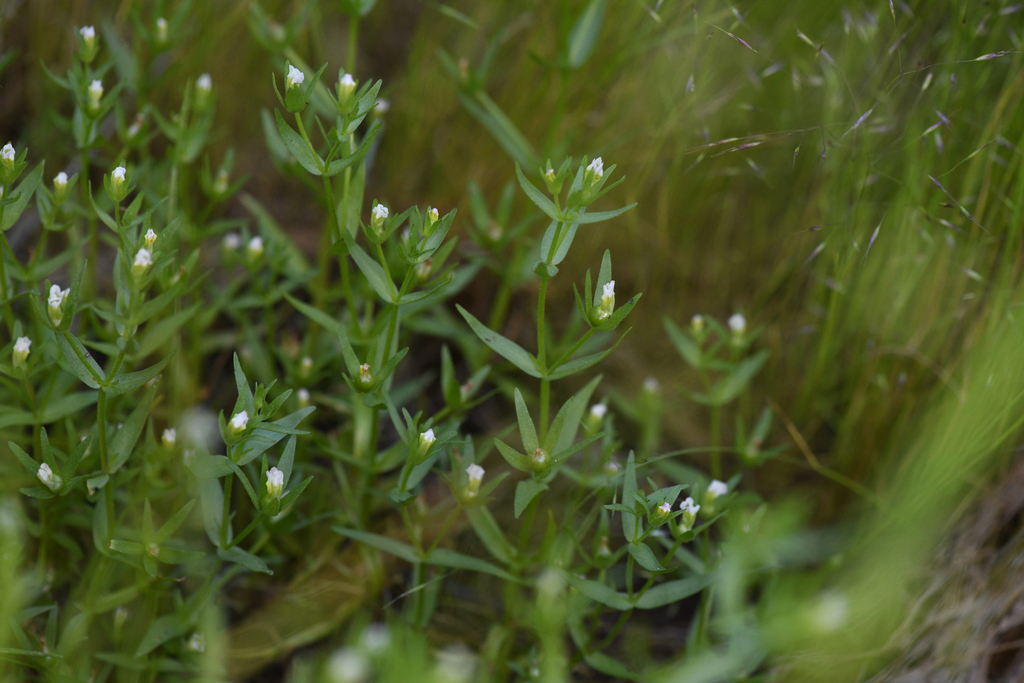
(c) Trevor Van Loon, some rights reserved (CC BY) · licence
Family: Plantaginaceae · Type: Herb · Native
Gratiola ebracteata (Bractless hedge-hyssop) is a native California herb in the Plantaginaceae family, recognized by lack of bractlets and abruptly pointed fruit valve tips.
Bractless hedge-hyssop is a California native annual found in northern and central California Floristic Province, excluding the North Coast Ranges, and in the Modoc Plateau in wet, muddy places at elevations below 2,400 meters. Flowering from April to June, this plant produces white flowers with a yellowish throat, sometimes pink-tinged, on stout erect pedicels. Growing 5 to 20 centimeters tall with simple to branched stems containing 6 to 12 leafy nodes, it forms delicate upright clusters. Its lance-ovate to lance-linear leaves measure 7 to 25 millimeters long, tapering to a point and nearly entire. The spherical fruit is 4-angled with abruptly pointed valve tips, measuring 3.5 to 6 millimeters across.
Identification and appearance
Key characters: 2 sympatric species; distinguished by lack of bractlets and abruptly pointed fruit valve tips
Habitat and range
Habitat: Wet, muddy places
Elevation: < 2400 m
California counties: Calaveras, Butte, Shasta, San Joaquin, Mendocino, Humboldt, Tuolumne, Sonoma, Tehama, Modoc, Siskiyou, Lake, Napa, Stanislaus, Placer, Amador, Sacramento, Marin, Lassen, Plumas, Sierra, Yuba, Merced, Contra Costa, Del Norte, Mariposa, El Dorado, San Mateo, Madera, Solano, Nevada, Sutter
Outside California: to British Columbia, Montana
Bloom period
Gratiola ebracteata blooms Apr-Jun.
How to tell it apart
vs Antirrhinum: Antirrhinum has rounded flower tubes; Gratiola's tube has four distinct angles you can feel.; vs Synthyris: Synthyris has basal leaves only; Gratiola has leaves arranged along the stem.; vs Lindernia: Lindernia has a cylindrical flower tube; Gratiola's tube is distinctly four-angled.; vs Dopatrium: Dopatrium has scale-like upper leaves; Gratiola has normal leaves and four-angled flower tubes.; vs Veronica: Veronica has flat, four-petaled wheel-like flowers; Gratiola has tubular flowers with angled tubes.
Frequently asked questions
Is Gratiola ebracteata native to California?
Yes. Gratiola ebracteata is native to California (recorded as native).
When does Gratiola ebracteata bloom?
Gratiola ebracteata blooms Apr-Jun.
Where in California does Gratiola ebracteata grow?
Gratiola ebracteata occurs in Calaveras, Butte, Shasta, San Joaquin, Mendocino, Humboldt, Tuolumne, Sonoma and other counties, at elevations of < 2400 m.
What plant family does Gratiola ebracteata belong to?
Gratiola ebracteata is in the Plantaginaceae family, genus Gratiola.
What habitat does Gratiola ebracteata grow in?
Gratiola ebracteata grows in Wet, muddy places.
Related species
Other California species in the same genus, family, or bioregion.
Sources: Jepson eFlora · Index of California Plant Names · CalPhotos
Last updated 2026-10-07
Data from The California Species Project — 14,000+ California species with verified data from CNPS, CDFW, USFWS, Cal-IPC, and more.