Gratiola heterosepala
Boggs lake hedge-hyssop
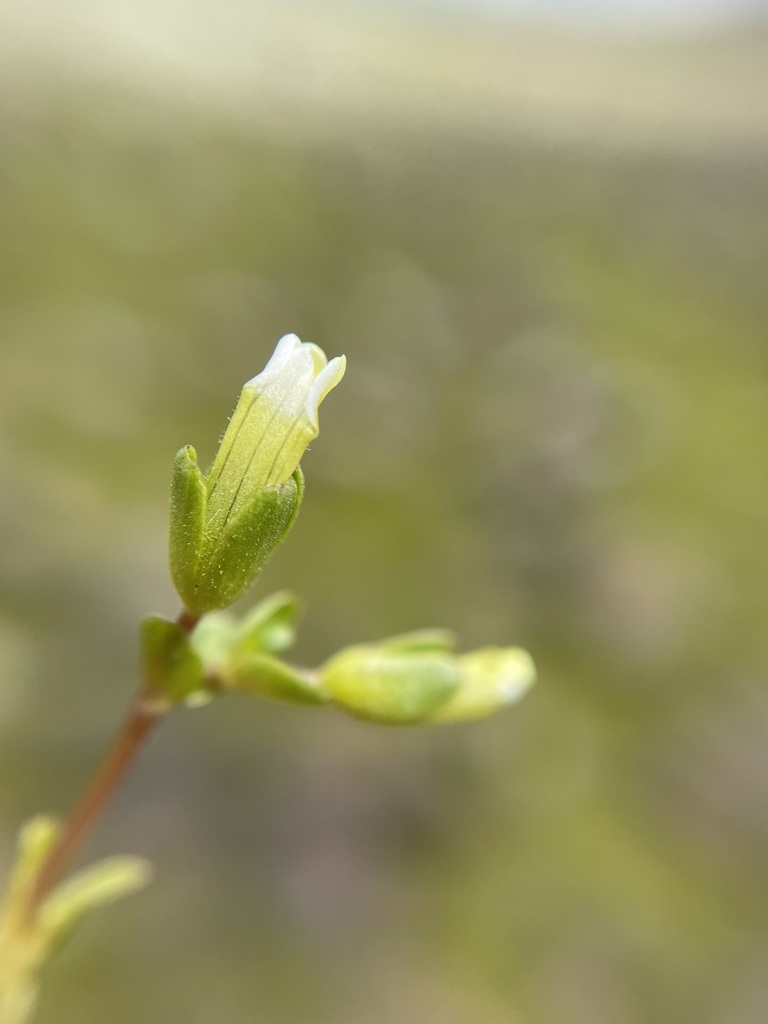
(c) Matt Berger, some rights reserved (CC BY) · licence
Family: Plantaginaceae · Type: Herb · Native
Conservation status: CNPS 1B.2
Gratiola heterosepala (Boggs lake hedge-hyssop) is a native California herb in the Plantaginaceae family, recognized by unequal, unequally fused sepals and yellow corolla with white lower lobes.
Boggs lake hedge-hyssop is a rare (CNPS 1B.2) California native annual found in the northern Coast Ranges, Cascade Range, northern and central Sierra Nevada Foothill, Central Valley, and Modoc Plateau in shallow water and vernal pool margins at elevations up to 1,600 meters. Flowering from April to September, this delicate plant produces yellow flowers with white lower lobes, blooming in small, slender clusters. Growing with erect stems 2 to 10 centimeters tall and 4 to 7 leafy nodes, it forms compact, low-growing clusters. Its leaves vary from lance-linear proximally to oblong or obovate distally, with rounded to notched tips and clasping upper stems. The small ovoid fruits measure 3.5 to 5 millimeters long with blunt valve tips, containing tiny seeds less than one millimeter in size.
Identification and appearance
Key characters: 2 sympatric species; distinguished by unequal, unequally fused sepals and yellow corolla with white lower lobes
Habitat and range
Habitat: Shallow water, margins of vernal pools
Elevation: < 1600 m (2400 m in Wrn)
California counties: Lassen, Lake, Madera, Sacramento, Tehama, Fresno, Modoc, Placer, Shasta, Sonoma, Solano, Merced
Outside California: to south-central Oregon (Lake Co.)
Bloom period
Gratiola heterosepala blooms Apr-Sep.
Conservation status
CNPS 1B.2
How to tell it apart
vs Antirrhinum: Antirrhinum has rounded flower tubes; Gratiola's tube has four distinct angles you can feel.; vs Synthyris: Synthyris has basal leaves only; Gratiola has leaves arranged along the stem.; vs Lindernia: Lindernia has a cylindrical flower tube; Gratiola's tube is distinctly four-angled.; vs Dopatrium: Dopatrium has scale-like upper leaves; Gratiola has normal leaves and four-angled flower tubes.; vs Veronica: Veronica has flat, four-petaled wheel-like flowers; Gratiola has tubular flowers with angled tubes.
Frequently asked questions
Is Gratiola heterosepala native to California?
Yes. Gratiola heterosepala is native to California (recorded as native).
When does Gratiola heterosepala bloom?
Gratiola heterosepala blooms Apr-Sep.
Where in California does Gratiola heterosepala grow?
Gratiola heterosepala occurs in Lassen, Lake, Madera, Sacramento, Tehama, Fresno, Modoc, Placer and other counties, at elevations of < 1600 m (2400 m in Wrn).
What plant family does Gratiola heterosepala belong to?
Gratiola heterosepala is in the Plantaginaceae family, genus Gratiola.
Is Gratiola heterosepala rare or endangered?
Gratiola heterosepala carries California Rare Plant Rank 1B.2, state rank S2.
Related species
Other California species in the same genus, family, or bioregion.
Sources: Jepson eFlora · CNPS Rare Plant Inventory · Index of California Plant Names · CalPhotos · CDFW CNDDB
Last updated 2026-10-07
Data from The California Species Project — 14,000+ California species with verified data from CNPS, CDFW, USFWS, Cal-IPC, and more.