Grayia spinosa
Hop sage
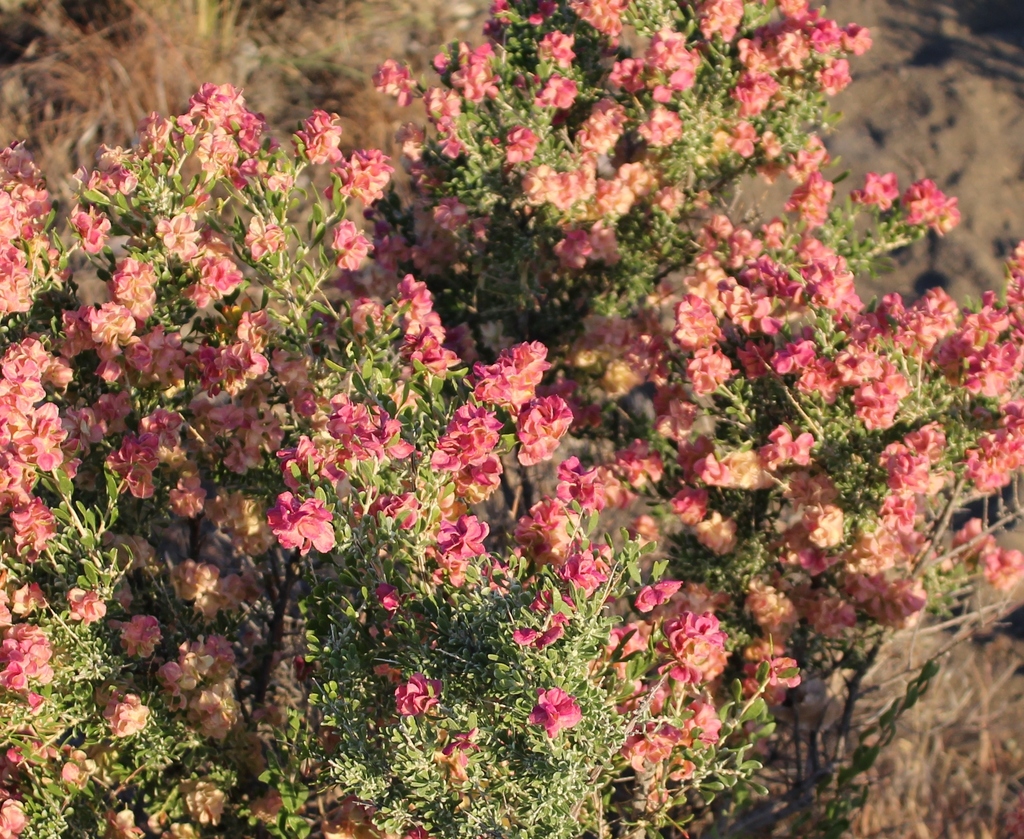
(c) 66dodge, some rights reserved (CC BY), uploaded by 66dodge · licence
Family: Chenopodiaceae · Type: Shrub · Native
Grayia spinosa (Hop sage) is a native California shrub in the Chenopodiaceae family, recognized by Only Grayia species in California, Great Basin shrub at edge of range.
Hop sage is a California native shrub found in the eastern Sierra Nevada, Tehachapi, southeastern San Joaquin Valley, northern western Transverse Ranges, Great Basin, eastern Mojave Desert, and northwestern Sonoran Desert in sandy to gravelly soils of scrub and pinyon/juniper woodland at elevations of 300 to 2,900 meters. Flowering from March to June, this plant produces white to red-tinged flowers in spike-like clusters with distinctive white-tipped leaves. Growing 1 to 3 meters tall with many stiff, spine-like branches that have red-brown bark peeling in strips, it develops a rounded shape with age. Its alternate leaves are spoon-shaped to oblanceolate, 5 to 25 millimeters long, flat and entire with green blades and white-tipped ends. The fruit bracts are fused into a sac-like, round, white to red-tinged structure with flat, winged margins.
Identification and appearance
Key characters: Only Grayia species in California, Great Basin shrub at edge of range
Habitat and range
Habitat: Sandy to gravelly soils in scrub, pinyon/juniper woodland
Elevation: 300-2900 m
California counties: San Bernardino, Inyo, San Luis Obispo, San Diego, Mono, Modoc, Los Angeles, Siskiyou, Kern, Riverside, Tulare, Placer, Lassen, Alpine, Sierra, Ventura
Outside California: to Washington, Montana, New Mexico
Bloom period
Grayia spinosa blooms Mar-Jun.
How to tell it apart
vs Atriplex: Grayia fruits have completely fused, round flat wings; Atriplex fruit bracts are triangular with free tips.; vs Sarcobatus: Grayia has smooth round-winged fruits; Sarcobatus has spiny branches and cone-like spiral fruits.; vs Lycium: Grayia has flat winged fruits; Lycium has fleshy red berries and spiny branches.; vs Eriogonum: Grayia has large flat circular fruit wings; Eriogonum has tiny 3-winged achenes in flower clusters.; vs Bougainvillea: Grayia has circular fruit wings; Bougainvillea has colorful papery bracts beneath tubular flowers.
Frequently asked questions
Is Grayia spinosa native to California?
Yes. Grayia spinosa is native to California (recorded as native).
When does Grayia spinosa bloom?
Grayia spinosa blooms Mar-Jun.
Where in California does Grayia spinosa grow?
Grayia spinosa occurs in San Bernardino, Inyo, San Luis Obispo, San Diego, Mono, Modoc, Los Angeles, Siskiyou and other counties, at elevations of 300-2900 m.
What plant family does Grayia spinosa belong to?
Grayia spinosa is in the Chenopodiaceae family, genus Grayia.
What habitat does Grayia spinosa grow in?
Grayia spinosa grows in Sandy to gravelly soils in scrub, pinyon/juniper woodland.
Related species
Other California species in the same genus, family, or bioregion.
Sources: Jepson eFlora · Index of California Plant Names · CalPhotos
Last updated 2026-10-07
Data from The California Species Project — 14,000+ California species with verified data from CNPS, CDFW, USFWS, Cal-IPC, and more.