Greeneocharis circumscissa var. circumscissa
Cushion greeneocharis
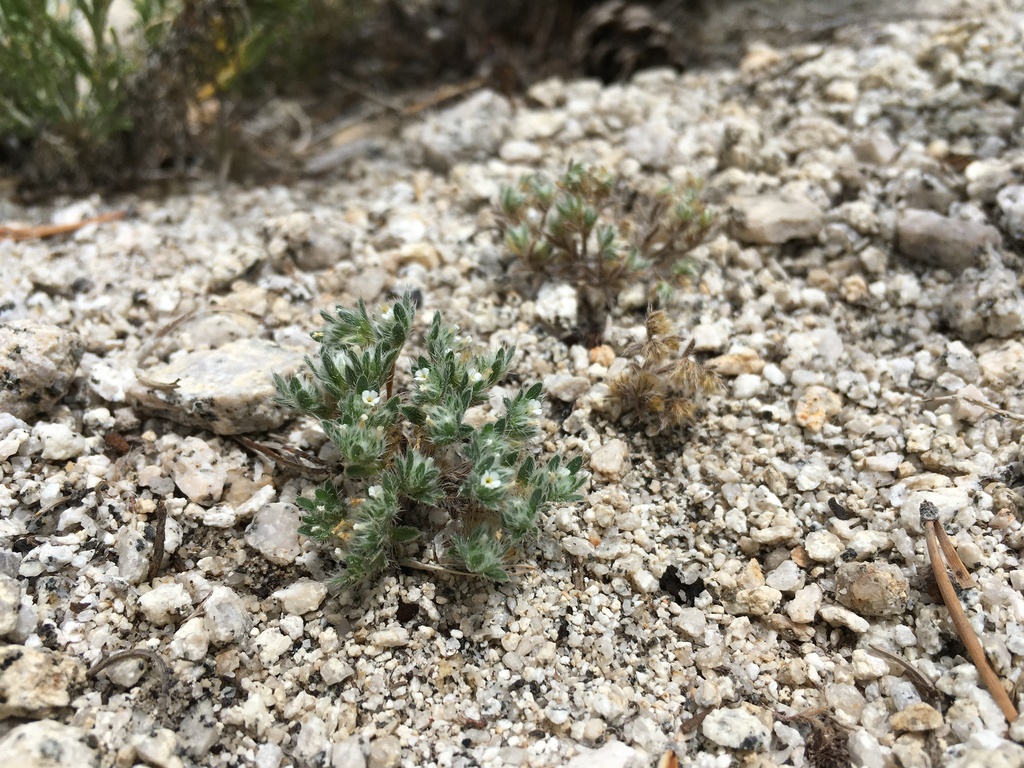
Photo: parent species Greeneocharis circumscissa · (c) Martin Purdy, some rights reserved (CC BY) · licence
Family: Boraginaceae · Type: Annual · Native
Greeneocharis circumscissa var. circumscissa (Cushion greeneocharis) is a native California annual in the Boraginaceae family, recognized by size, branching pattern, and red-purple coloration.
Cushion greeneocharis is a California native annual found in the Sierra Nevada, southern San Joaquin Valley, southern Coast Ranges, eastern Southern California, Transverse Ranges, eastern Peninsular Ranges, Great Basin, and Deserts in sandy or silty flats and slopes at elevations of 150 to 3,650 meters. Flowering from March to August, this plant produces small white to pale lavender flowers with a distinctive red-purple plant base that becomes especially prominent when dry. Growing with multiple branching stems 4 to 10 centimeters tall, it spreads in an open, delicate pattern across sandy terrain. Its narrow linear leaves have margins rolled underneath, creating a compact cushion-like appearance. The fruits consist of 3 or 4 small triangular-ovate nutlets, which are brown or mottled brown with sharp-angled margins.
Identification and appearance
Key characters: 2 sympatric species; key features are size, branching pattern, and red-purple coloration
Habitat and range
Habitat: Sandy or silty flats, slopes, washes
Elevation: 150-3650 m
California counties: San Bernardino, Inyo, Mono, Los Angeles, Kern, Riverside, El Dorado, Fresno, Lassen, Monterey, San Benito, Plumas, Tulare, Ventura, Santa Barbara, San Luis Obispo, San Diego
Bloom period
Greeneocharis circumscissa var. circumscissa blooms Mar-Aug.
How to tell it apart
vs Cryptantha: Greeneocharis is a tiny cushion-like annual whose fruiting calyx breaks off cleanly around the middle like a lid (circumscissile); Cryptantha calyces persist and fall whole or split lengthwise, and plants are taller and more openly branched.; vs Eremocarya: Greeneocharis forms a low cushion broader than tall with a reddish base and a lid-splitting calyx; Eremocarya is usually taller than wide with a persistent, non-lidded calyx.; vs Johnstonella: Greeneocharis has the circumscissile calyx and crowded linear leaves; Johnstonella has ordinary persistent calyces and differently margined, sculptured nutlets.; vs Plagiobothrys: Greeneocharis is a dwarf cushion with a calyx that sheds like a lid; Plagiobothrys (popcornflower) is leafier, often stains purple, and has coiled flower spikes with a persistent calyx.; vs Pectocarya: Greeneocharis nutlets stay enclosed in the shed calyx; Pectocarya has distinctive paired nutlets spreading in a cross with toothed or hooked margins.
Frequently asked questions
Is Greeneocharis circumscissa var. circumscissa native to California?
Yes. Greeneocharis circumscissa var. circumscissa is native to California (recorded as native).
When does Greeneocharis circumscissa var. circumscissa bloom?
Greeneocharis circumscissa var. circumscissa blooms Mar-Aug.
Where in California does Greeneocharis circumscissa var. circumscissa grow?
Greeneocharis circumscissa var. circumscissa occurs in San Bernardino, Inyo, Mono, Los Angeles, Kern, Riverside, El Dorado, Fresno and other counties, at elevations of 150-3650 m.
What plant family does Greeneocharis circumscissa var. circumscissa belong to?
Greeneocharis circumscissa var. circumscissa is in the Boraginaceae family, genus Greeneocharis.
What habitat does Greeneocharis circumscissa var. circumscissa grow in?
Greeneocharis circumscissa var. circumscissa grows in Sandy or silty flats, slopes, washes.
Related species
Other California species in the same genus, family, or bioregion.
Sources: Jepson eFlora · Index of California Plant Names · CalPhotos
Last updated 2026-09-30
Data from The California Species Project — 14,000+ California species with verified data from CNPS, CDFW, USFWS, Cal-IPC, and more.