Greeneocharis circumscissa var. rosulata
Rosette cushion greeneocharis
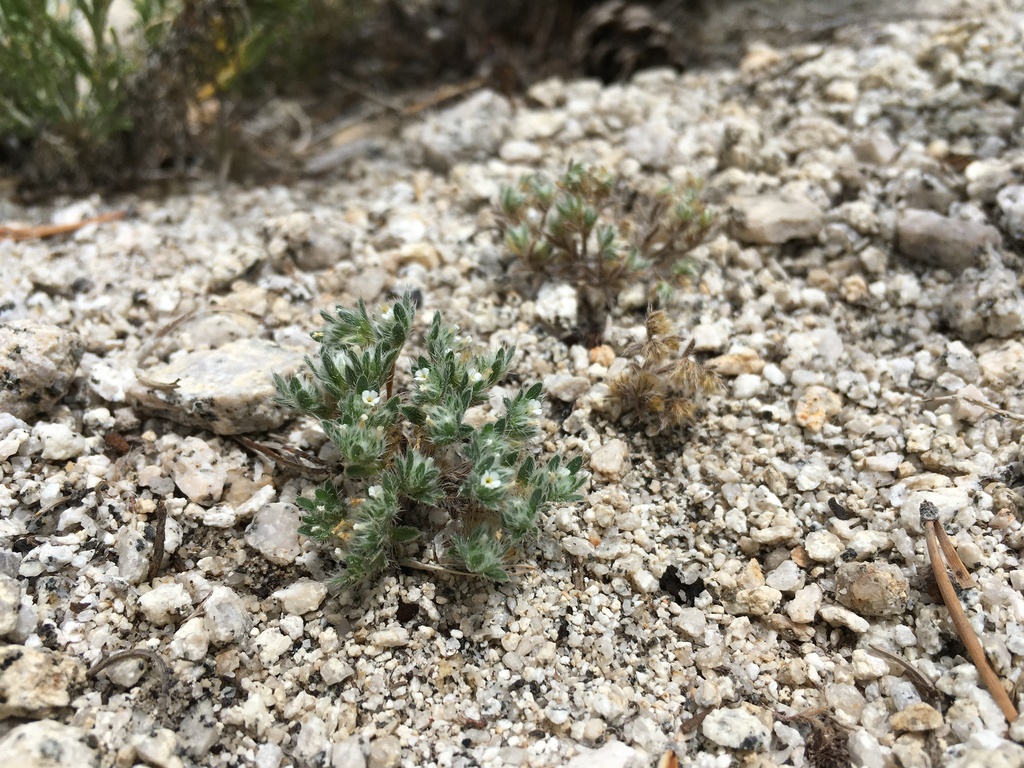
Photo: parent species Greeneocharis circumscissa · (c) Martin Purdy, some rights reserved (CC BY) · licence
Family: Boraginaceae · Type: Herb · Native
Conservation status: CNPS 1B.2
Greeneocharis circumscissa var. rosulata (Rosette cushion greeneocharis) is a native California herb in the Boraginaceae family, recognized by size, elevation, and lack of red-purple base coloration.
Rosette cushion greeneocharis is a rare (CNPS 1B.2) California native annual found in the Sierra Nevada Mountains of Inyo and Tulare counties on barren granitic gravels at elevations of 2,950 to 3,650 meters. Flowering from July to August, this tiny plant produces delicate white flowers with minute corolla appendages. Growing as a prostrate plant just 0.5 to 3.5 centimeters tall, it forms compact, strigose stems with few branches. Its leaves are oblanceolate to narrow-oblong with nearly flat margins, arranged close to the ground in a distinctive rosette pattern. The plant produces 3 or 4 smooth, shiny gray nutlets, each lance-triangular and approximately 1.5 to 1.8 millimeters long.
Identification and appearance
Key characters: 2 sympatric species; distinguished by size, elevation, and lack of red-purple base coloration
Habitat and range
Habitat: Barren granitic gravels
Elevation: 2950-3650 m
California counties: Inyo, Tulare
Bloom period
Greeneocharis circumscissa var. rosulata blooms Jul-Aug.
Conservation status
CNPS 1B.2
How to tell it apart
vs Cryptantha: Greeneocharis is a tiny cushion-like annual whose fruiting calyx breaks off cleanly around the middle like a lid (circumscissile); Cryptantha calyces persist and fall whole or split lengthwise, and plants are taller and more openly branched.; vs Eremocarya: Greeneocharis forms a low cushion broader than tall with a reddish base and a lid-splitting calyx; Eremocarya is usually taller than wide with a persistent, non-lidded calyx.; vs Johnstonella: Greeneocharis has the circumscissile calyx and crowded linear leaves; Johnstonella has ordinary persistent calyces and differently margined, sculptured nutlets.; vs Plagiobothrys: Greeneocharis is a dwarf cushion with a calyx that sheds like a lid; Plagiobothrys (popcornflower) is leafier, often stains purple, and has coiled flower spikes with a persistent calyx.; vs Pectocarya: Greeneocharis nutlets stay enclosed in the shed calyx; Pectocarya has distinctive paired nutlets spreading in a cross with toothed or hooked margins.
Frequently asked questions
Is Greeneocharis circumscissa var. rosulata native to California?
Yes. Greeneocharis circumscissa var. rosulata is native to California (recorded as native).
When does Greeneocharis circumscissa var. rosulata bloom?
Greeneocharis circumscissa var. rosulata blooms Jul-Aug.
Where in California does Greeneocharis circumscissa var. rosulata grow?
Greeneocharis circumscissa var. rosulata occurs in Inyo, Tulare, at elevations of 2950-3650 m.
What plant family does Greeneocharis circumscissa var. rosulata belong to?
Greeneocharis circumscissa var. rosulata is in the Boraginaceae family, genus Greeneocharis.
Is Greeneocharis circumscissa var. rosulata rare or endangered?
Greeneocharis circumscissa var. rosulata carries California Rare Plant Rank 1B.2, state rank S2.
Related species
Other California species in the same genus, family, or bioregion.
Sources: Jepson eFlora · CNPS Rare Plant Inventory · Index of California Plant Names · CalPhotos · CDFW CNDDB
Last updated 2026-10-07
Data from The California Species Project — 14,000+ California species with verified data from CNPS, CDFW, USFWS, Cal-IPC, and more.