Grindelia camporum
Common gumplant
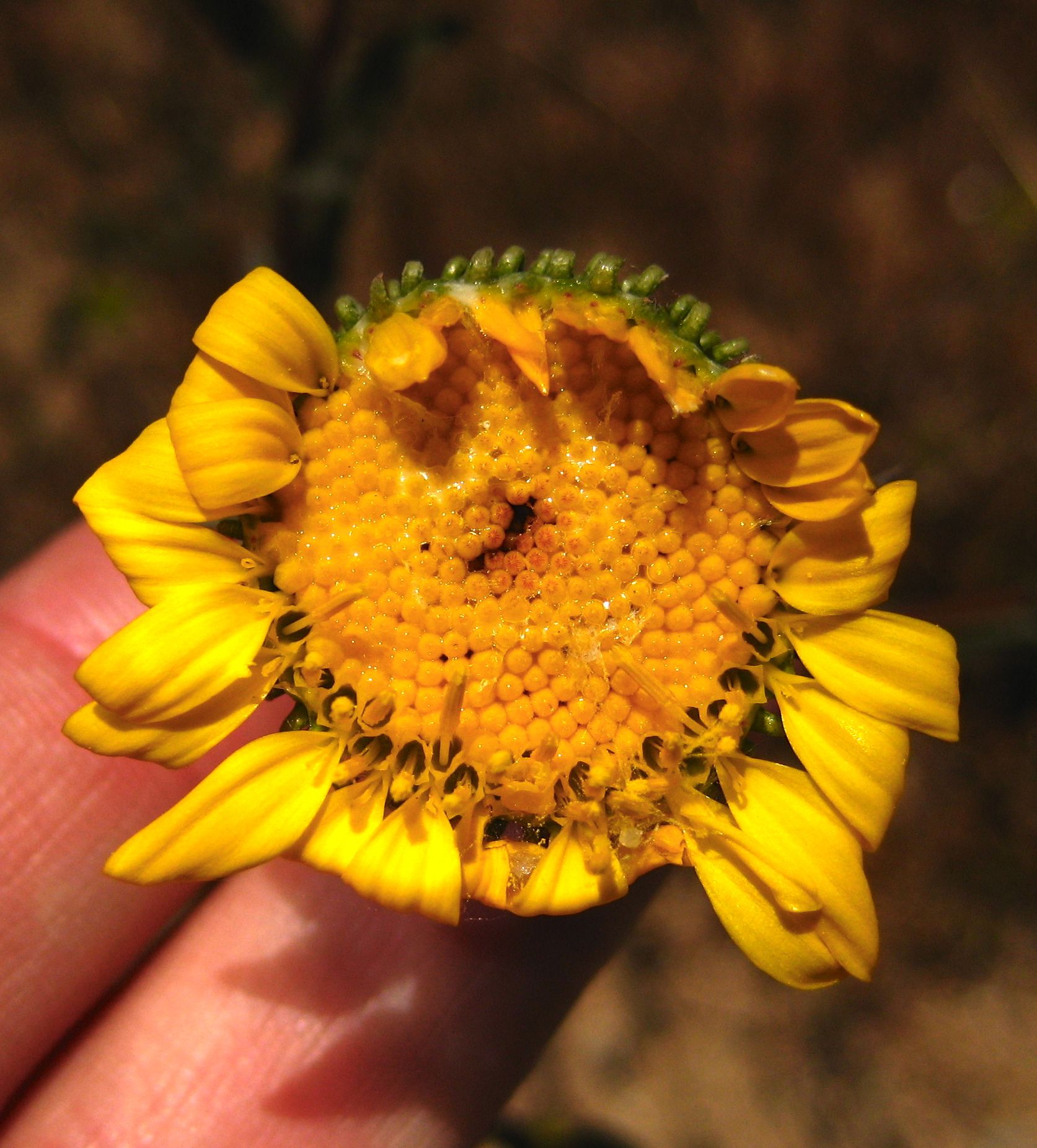
Photo by Chez Brungraber
Family: Asteraceae · Type: Subshrub · Native
Grindelia camporum (Common gumplant) is a native California subshrub in the Asteraceae family, recognized by widespread range, branching pattern, and involucre characteristics.
Common gumplant is a California native perennial found in the Klamath Ranges, northern Coast Ranges, Sierra Nevada foothills, Central Valley, San Francisco Bay Area, southern Coast Ranges, southwestern California, Sierra Nevada eastern slopes, and Mojave Desert in sandy or saline bottomlands and roadsides at elevations below 1,400 meters. Flowering from May to November, this plant produces yellow flower heads with bright yellow ray flowers 5 to 11 millimeters long in clusters 10 to 22 millimeters wide. Growing with erect, much-branched stems 60 to 250 centimeters tall, it forms a robust and spreading habit. Its leaves are lanceolate to ovate, sessile and clasping, ranging 2 to 15 centimeters long, often resinous and yellow- to gray-green with entire or slightly serrate edges. The fruit is 2 to 5 millimeters long, white to golden-brown with ridged tops and paired pappus awns.
Identification and appearance
Key characters: 8 sympatric species; distinguished by widespread range, branching pattern, and involucre characteristics
Habitat and range
Habitat: Sandy or saline bottomland, roadsides
Elevation: < 1400 m
Outside California: Baja California
Bloom period
Grindelia camporum blooms May-Nov.
How to tell it apart
vs Heterotheca: Grindelia has sticky gummy bracts; Heterotheca has dry, non-sticky bracts and spreading hairs on stems.; vs Agoseris: Grindelia has ray and disc flowers; Agoseris has only strap-shaped ligulate flowers (dandelion-like).; vs Erigeron: Grindelia has gummy sticky bracts; Erigeron has dry bracts and typically 50+ very narrow rays.; vs Solidago: Grindelia has large sticky-bracted heads; Solidago has tiny non-sticky heads in dense branched clusters.; vs Deinandra: Grindelia bracts curl backward and are gummy; Deinandra has spine-tipped bracts and is a tarweed.
Frequently asked questions
Is Grindelia camporum native to California?
Yes. Grindelia camporum is native to California (recorded as native).
When does Grindelia camporum bloom?
Grindelia camporum blooms May-Nov.
What plant family does Grindelia camporum belong to?
Grindelia camporum is in the Asteraceae family, genus Grindelia.
What habitat does Grindelia camporum grow in?
Grindelia camporum grows in Sandy or saline bottomland, roadsides.
Related species
Other California species in the same genus, family, or bioregion.
Sources: Jepson eFlora · Index of California Plant Names · CalPhotos
Last updated 2026-10-07
Data from The California Species Project — 14,000+ California species with verified data from CNPS, CDFW, USFWS, Cal-IPC, and more.