Gunnera tinctoria
Chilean-rhubarb, Chilean-Rhubarb
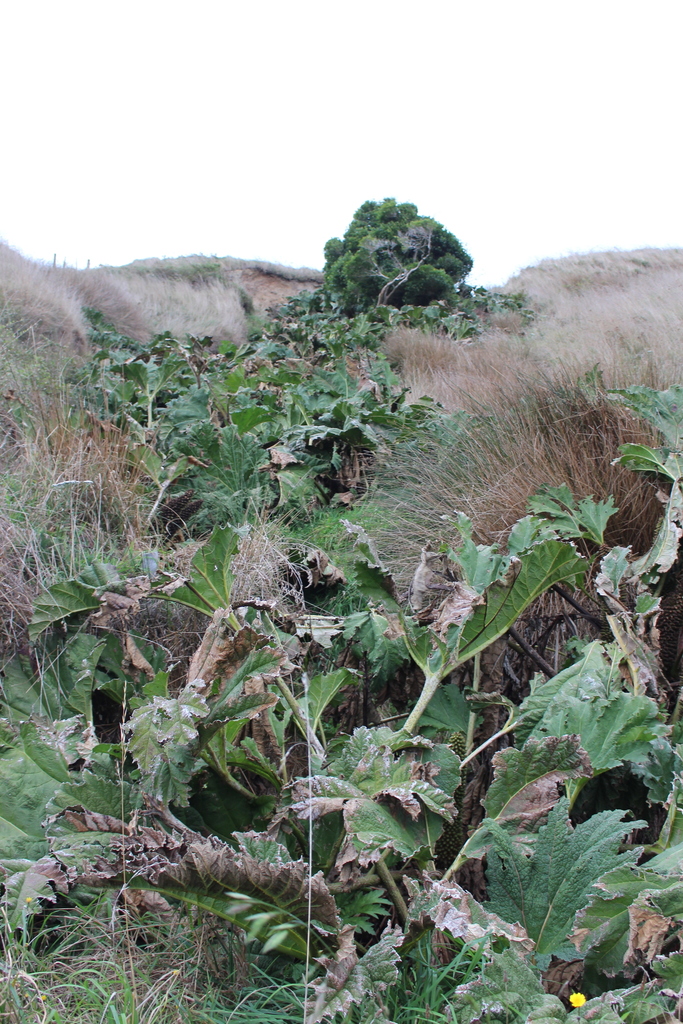
(c) Joe Potter Butler, some rights reserved (CC BY) · licence
Family: Gunneraceae · Type: Herb · Not Native
Conservation status: Cal-IPC Yes
Gunnera tinctoria (Chilean-rhubarb) is a non-native California herb in the Gunneraceae family, recognized by Only Gunnera species in California, Chilean introduction to limited coastal areas.
Chilean-rhubarb is a naturalized perennial found in the coastal counties of Marin and San Francisco in disturbed, shaded, damp areas at elevations below 100 meters. Flowering from July to October, this plant produces small red fruits in dense, stout spikes emerging nearly from ground level. Growing with massive rhizomes and extraordinary leaf structures, it develops enormous leaves up to 2 meters wide with palmate lobes and prominent veins, covered in stiff, hard prickles. Its petioles can reach 1 to 1.5 meters long, supporting round, slightly concave leaf blades that are thick and rough with irregular toothed edges. The plant's inflorescences are conical, rising 50 to 75 centimeters tall with multiple compact spikes.
Identification and appearance
Key characters: Only Gunnera species in California, Chilean introduction to limited coastal areas
Habitat and range
Habitat: Uncommon. Disturbed, shaded, damp areas
Elevation: < 100 m
Outside California: native to Chile
Bloom period
Gunnera tinctoria blooms Jul-Oct.
Conservation status
Cal-IPC Yes
How to tell it apart
vs Rheum: Gunnera leaves are palmately lobed, rough, and set with hard prickles on petiole and blade; garden rhubarb (Rheum) has smooth, unlobed heart-shaped leaves on smooth reddish stalks.; vs Darmera: Gunnera has prickly petioles and a tall conic spike-panicle arising beside the leaves; Darmera (Indian rhubarb) has smooth peltate leaves and a flat-topped pink cluster on a separate leafless stalk.; vs Petasites: Gunnera has huge rough prickly palmate leaves and a stout conic flower panicle; Petasites has smaller soft-woolly leaves and daisy-family flower heads.; vs Rumex: Gunnera is gigantic (leaves to 2 m) with prickly petioles and a massive conic inflorescence; Rumex (dock) is a much smaller herb with smooth lance leaves and papery-winged fruits.; vs Colocasia: Gunnera leaves are palmately lobed and prickly with a branched conic inflorescence; Colocasia (elephant ear) has smooth peltate arrow-heart leaves and an arum-type spadix and spathe.
Frequently asked questions
Is Gunnera tinctoria native to California?
No. Gunnera tinctoria is not native to California (recorded as not native).
When does Gunnera tinctoria bloom?
Gunnera tinctoria blooms Jul-Oct.
What plant family does Gunnera tinctoria belong to?
Gunnera tinctoria is in the Gunneraceae family, genus Gunnera.
Is Gunnera tinctoria invasive in California?
Gunnera tinctoria is listed by Cal-IPC with an invasiveness rating of Yes.
What habitat does Gunnera tinctoria grow in?
Gunnera tinctoria grows in Uncommon. Disturbed, shaded, damp areas.
Related species
Other California species in the same genus, family, or bioregion.
Sources: Jepson eFlora · CalPhotos
Last updated 2026-10-07
Data from The California Species Project — 14,000+ California species with verified data from CNPS, CDFW, USFWS, Cal-IPC, and more.