Gypsophila paniculata
Baby's-breath
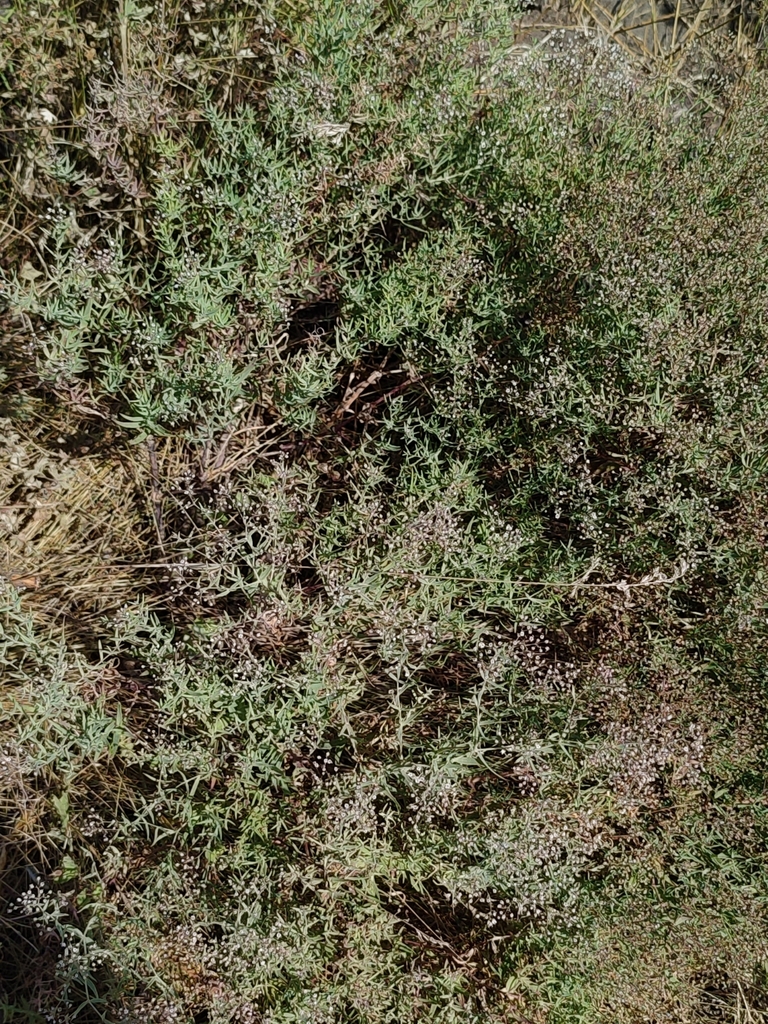
(c) Igor Balashov, some rights reserved (CC BY) · licence
Family: Caryophyllaceae · Type: Herb · Not Native
Conservation status: Cal-IPC Yes
Gypsophila paniculata (Baby's-breath) is a non-native California herb in the Caryophyllaceae family, recognized by tiny flowers and perennial habit.
Baby's-breath is a naturalized perennial herb found in disturbed areas across northern California, the Sierra Nevada, San Joaquin Valley, central and southern coastal regions, Great Basin, and Mojave Desert at elevations of 1,200 to 2,100 meters. Flowering from summer to fall, this plant produces delicate white flowers in openly branched clusters with many small blooms. Growing with sturdy stems 50 to 90 centimeters tall and a stout rhizome, it forms an airy, widespread growth habit. Its leaves are narrow and lance-shaped, measuring 2 to 9 millimeters wide, creating a light, feathery appearance. The small white flowers, each just 1 to 4 millimeters long, are held on glabrous pedicels with cup-shaped calyxes.
Identification and appearance
Key characters: 3 sympatric species; distinguished by tiny flowers and perennial habit
Habitat and range
Habitat: Disturbed areas
Elevation: 1200-2100 m
California counties: San Diego, Lassen, Siskiyou, Mono, Tulare, Stanislaus, San Luis Obispo, Santa Barbara
Outside California: to British Columbia, northeastern North America, native to central and eastern Europe, adjacent Asia
Bloom period
Gypsophila paniculata blooms Summer-fall.
Conservation status
Cal-IPC Yes
How to tell it apart
vs Torilis: Gypsophila has cloud-like flower masses with 5-petaled flowers; Torilis has umbrella-shaped clusters with tiny white umbels.; vs Lobularia: Gypsophila has tubular flowers with visible sepals; Lobularia has 4-petaled cross-shaped flowers with no visible tube.; vs Eriogonum: Gypsophila has opposite leaves and tubular flowers; Eriogonum has basal leaf rosettes and papery flower bracts.; vs Saponaria: Gypsophila has tiny flowers (tube under 5mm) with white-striped tubes; Saponaria has large flowers (tube 9-25mm) with solid green tubes.; vs Vaccaria: Gypsophila has cup-shaped tubes under 5mm with white stripes; Vaccaria has angled tubes 9-25mm that are solid green.
Frequently asked questions
Is Gypsophila paniculata native to California?
No. Gypsophila paniculata is not native to California (recorded as not native).
When does Gypsophila paniculata bloom?
Gypsophila paniculata blooms Summer-fall.
Where in California does Gypsophila paniculata grow?
Gypsophila paniculata occurs in San Diego, Lassen, Siskiyou, Mono, Tulare, Stanislaus, San Luis Obispo, Santa Barbara, at elevations of 1200-2100 m.
What plant family does Gypsophila paniculata belong to?
Gypsophila paniculata is in the Caryophyllaceae family, genus Gypsophila.
Is Gypsophila paniculata invasive in California?
Gypsophila paniculata is listed by Cal-IPC with an invasiveness rating of Yes.
Related species
Other California species in the same genus, family, or bioregion.
Sources: Jepson eFlora · Index of California Plant Names · CalPhotos
Last updated 2026-10-07
Data from The California Species Project — 14,000+ California species with verified data from CNPS, CDFW, USFWS, Cal-IPC, and more.