Halogeton glomeratus
Saltlover, Saltlover
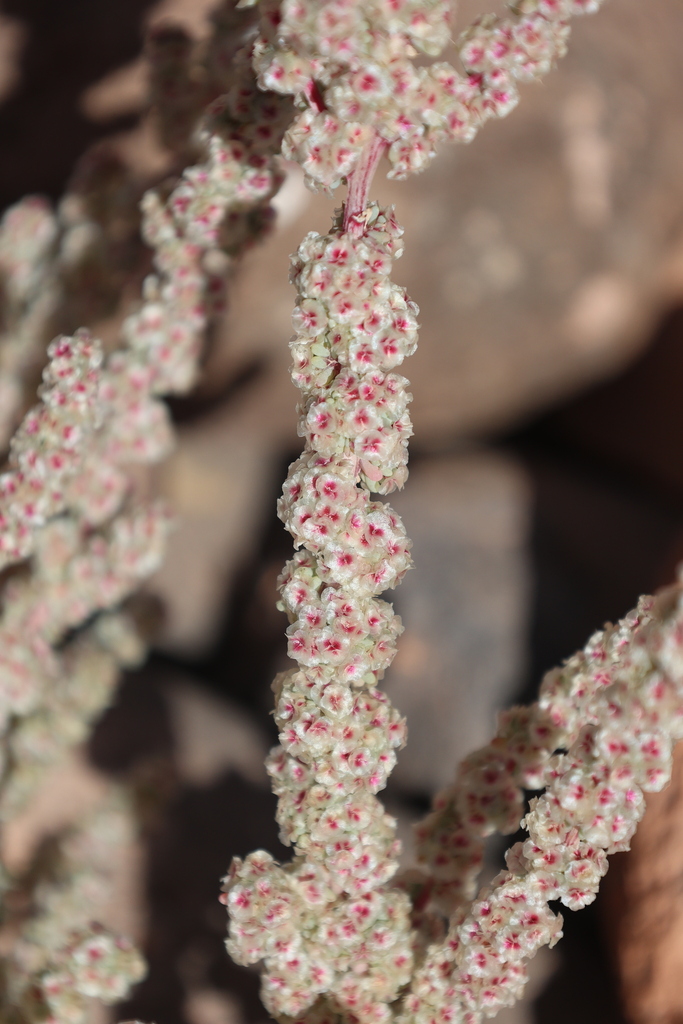
no rights reserved · CC0
Family: Chenopodiaceae · Type: Herb · Not Native
Conservation status: Cal-IPC Yes
Halogeton glomeratus (Saltlover) is a non-native California herb in the Chenopodiaceae family, recognized by Only Halogeton species in California, toxic Eurasian introduction to alkaline desert soils.
Saltlover is a naturalized annual found in the California Ranges, Great Basin, and Mojave Desert regions on alkaline soils, open flats, and scrub areas at elevations of 600 to 1,800 meters. Flowering from July to August, this plant produces small, fan-like white to cream-colored flowers with delicate membranous petals. Growing with erect stems 6 to 40 centimeters tall and spreading lateral branches from the base, it forms dense, leafy clusters. Its narrow leaves are small, measuring 4 to 17 millimeters long and 1 to 1.5 millimeters wide, with stiff bristles at the tips. The plant's tiny fruits are less than 2 millimeters long, allowing it to spread quickly across disturbed alkaline landscapes.
Identification and appearance
Key characters: Only Halogeton species in California, toxic Eurasian introduction to alkaline desert soils
Habitat and range
Habitat: Alkaline soils, open flats, scrub
Elevation: 600-1800 m
California counties: Lassen, San Bernardino, Inyo, Mono, Los Angeles, Riverside
Outside California: to Montana, New Mexico, Washington, native to Eurasia
Bloom period
Halogeton glomeratus blooms Jul-Aug.
Conservation status
Cal-IPC Yes
How to tell it apart
vs Salsola: Halogeton has club-shaped leaves with abrupt bristle tips; Salsola has thread-like leaves tapering gradually to spines.; vs Suaeda: Halogeton leaves end in sharp bristle tips; Suaeda leaves have soft rounded tips.; vs Kochia: Halogeton has club-shaped succulent leaves with bristle tips; Kochia has soft flat or cylindric leaves without bristles.
Frequently asked questions
Is Halogeton glomeratus native to California?
No. Halogeton glomeratus is not native to California (recorded as not native).
When does Halogeton glomeratus bloom?
Halogeton glomeratus blooms Jul-Aug.
Where in California does Halogeton glomeratus grow?
Halogeton glomeratus occurs in Lassen, San Bernardino, Inyo, Mono, Los Angeles, Riverside, at elevations of 600-1800 m.
What plant family does Halogeton glomeratus belong to?
Halogeton glomeratus is in the Chenopodiaceae family, genus Halogeton.
Is Halogeton glomeratus invasive in California?
Halogeton glomeratus is listed by Cal-IPC with an invasiveness rating of Yes.
Related species
Other California species in the same genus, family, or bioregion.
Sources: Jepson eFlora · Index of California Plant Names · CalPhotos
Last updated 2026-10-07
Data from The California Species Project — 14,000+ California species with verified data from CNPS, CDFW, USFWS, Cal-IPC, and more.