Hazardia cana
San clemente island hazardia, San Clemente Island Hazardia
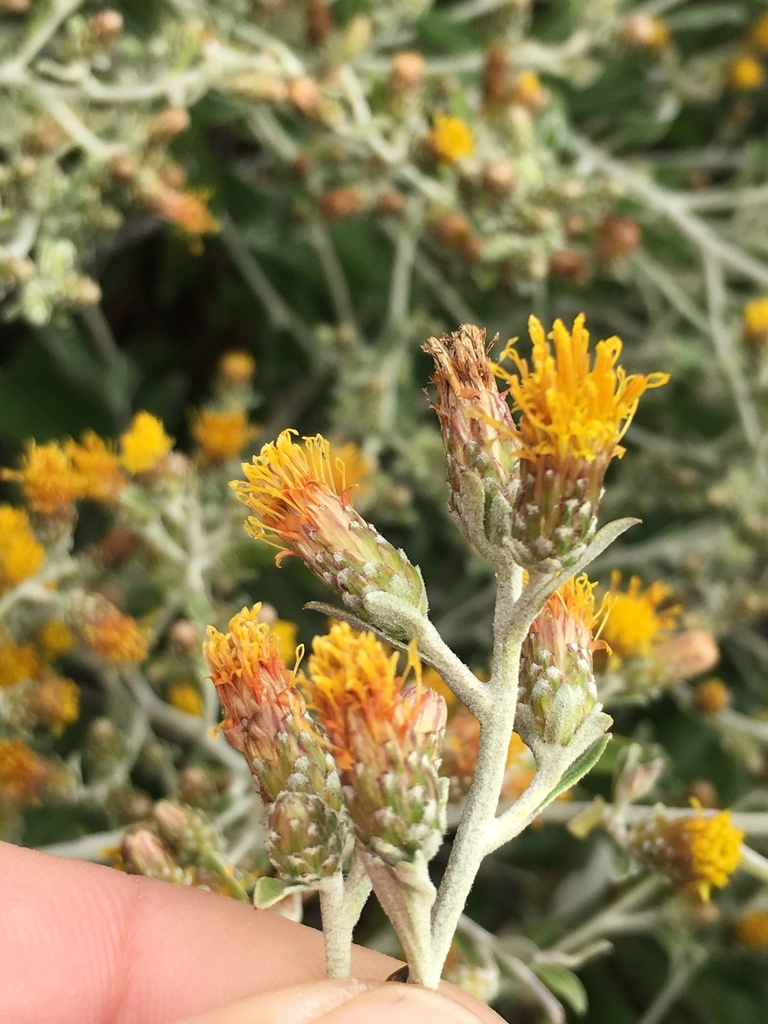
(c) Adam J. Searcy, some rights reserved (CC BY), uploaded by Adam J. Searcy · licence
Family: Asteraceae · Type: Shrub · Native
Conservation status: CNPS 1B.2
Hazardia cana (San clemente island hazardia) is a native California shrub in the Asteraceae family, recognized by size, leaf shape, and flower count.
San clemente island hazardia is a rare (CNPS 1B.2) California native shrub found in southern Channel Islands in coastal bluffs, canyon walls, and scrub at elevations of 200 to 500 meters. Flowering from June to September, this plant produces white flowers with yellow centers and occasional red-purple tones in heads 5 to 8 millimeters wide. Growing with woolly-tomentose stems 60 to 200 centimeters tall, it forms a distinctive shrubby structure with variable branching. Its leaves are oblanceolate, 4 to 12 centimeters long, thin, and ranging from nearly entire to finely serrate with surfaces becoming increasingly glabrous. The fruit is 3 to 4 millimeters long with 4 distinct ribs and a brown to red-brown pappus.
Identification and appearance
Key characters: 3 sympatric species; distinguished by size, leaf shape, and flower count
Habitat and range
Habitat: Coastal bluffs, canyon walls, scrub
Elevation: 200-500 m
Outside California: Baja California (Guadalupe Island)
Bloom period
Hazardia cana blooms Jun-Sep.
Conservation status
CNPS 1B.2
How to tell it apart
vs Isocoma: Hazardia has toothed leaf margins; Isocoma has entirely smooth-edged leaves.; vs Baccharis: Hazardia has yellow to purple disk flowers; Baccharis has separate male/female plants with whitish flowers.; vs Eriogonum: Hazardia is an Asteraceae shrub with daisy flowers; Eriogonum (Polygonaceae) has ball-like flower clusters.; vs Quercus: Hazardia has daisy flowers and herbaceous leaves; Quercus has acorns and woody oak leaves.; vs Ericameria: Hazardia has toothed leaves and 5-18 female flowers; Ericameria has entire leaves and 0-7 female flowers.
Frequently asked questions
Is Hazardia cana native to California?
Yes. Hazardia cana is native to California (recorded as native).
When does Hazardia cana bloom?
Hazardia cana blooms Jun-Sep.
What plant family does Hazardia cana belong to?
Hazardia cana is in the Asteraceae family, genus Hazardia.
Is Hazardia cana rare or endangered?
Hazardia cana carries California Rare Plant Rank 1B.2, state rank S3.
What habitat does Hazardia cana grow in?
Hazardia cana grows in Coastal bluffs, canyon walls, scrub.
Related species
Other California species in the same genus, family, or bioregion.
Sources: Jepson eFlora · CNPS Rare Plant Inventory · Index of California Plant Names · CalPhotos · CDFW CNDDB
Last updated 2026-10-07
Data from The California Species Project — 14,000+ California species with verified data from CNPS, CDFW, USFWS, Cal-IPC, and more.