Hazardia whitneyi var. discoidea
Rayless whitney's goldenbush
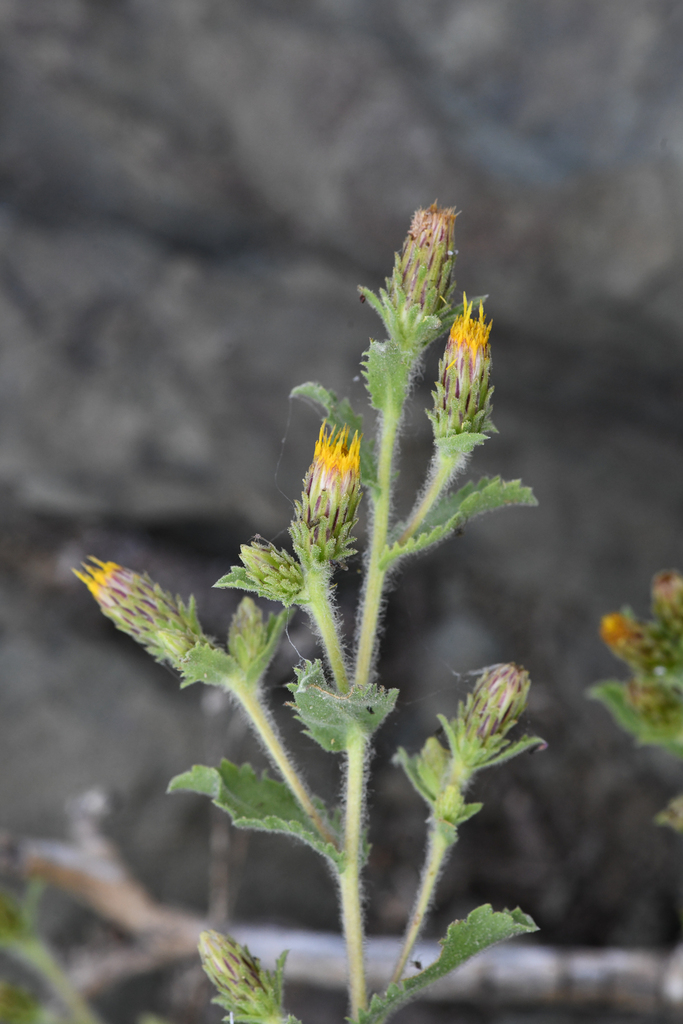
Photo: parent species Hazardia whitneyi · (c) Trevor Van Loon, some rights reserved (CC BY) · licence
Family: Asteraceae · Type: Subshrub · Native
Hazardia whitneyi var. discoidea (Rayless whitney's goldenbush) is a native California subshrub in the Asteraceae family, recognized by 1 sympatric variety; distinguished by lack of ray flowers.
Rayless whitney's goldenbush is a California native perennial found in northwestern California in open montane conifer forest at elevations of 1,000 to 2,500 meters. Flowering from July to September, this plant produces distinctive rayless flower heads without traditional ray flowers. Growing with erect stems reaching 30 to 50 centimeters tall, it forms a compact herbaceous cluster in forest clearings. Its leaves are small and densely clustered, with narrow, lance-shaped blades contributing to its compact appearance. The fruit is less than 10 millimeters long, supporting the plant's delicate and understated botanical structure.
Identification and appearance
Key characters: 1 sympatric variety; distinguished by lack of ray flowers
Habitat and range
Habitat: Open montane conifer forest
Elevation: 1000-2500 m
Outside California: Oregon
Bloom period
Hazardia whitneyi var. discoidea blooms Jul-Sep.
How to tell it apart
vs Isocoma: Hazardia has toothed leaf margins; Isocoma has entirely smooth-edged leaves.; vs Baccharis: Hazardia has yellow to purple disk flowers; Baccharis has separate male/female plants with whitish flowers.; vs Eriogonum: Hazardia is an Asteraceae shrub with daisy flowers; Eriogonum (Polygonaceae) has ball-like flower clusters.; vs Quercus: Hazardia has daisy flowers and herbaceous leaves; Quercus has acorns and woody oak leaves.; vs Ericameria: Hazardia has toothed leaves and 5-18 female flowers; Ericameria has entire leaves and 0-7 female flowers.
Frequently asked questions
Is Hazardia whitneyi var. discoidea native to California?
Yes. Hazardia whitneyi var. discoidea is native to California (recorded as native).
When does Hazardia whitneyi var. discoidea bloom?
Hazardia whitneyi var. discoidea blooms Jul-Sep.
What plant family does Hazardia whitneyi var. discoidea belong to?
Hazardia whitneyi var. discoidea is in the Asteraceae family, genus Hazardia.
What habitat does Hazardia whitneyi var. discoidea grow in?
Hazardia whitneyi var. discoidea grows in Open montane conifer forest.
Related species
Other California species in the same genus, family, or bioregion.
- Hazardia whitneyi var. whitneyi — Whitney's bristleweed
- Hazardia brickellioides — Brickell goldenbush
- Hazardia cana — San clemente island hazardia
- Hazardia detonsa — Island hazardia
- Hazardia orcuttii — Orcutt's hazardia
- Hazardia sp. — Goldenbush
- Hecastocleis shockleyi — Shockley's prickleleaf
- Hecastocleis sp.
- Hedypnois rhagadioloides — Crete weed
Sources: Jepson eFlora · Index of California Plant Names · CalPhotos
Last updated 2026-10-07
Data from The California Species Project — 14,000+ California species with verified data from CNPS, CDFW, USFWS, Cal-IPC, and more.