Hecastocleis shockleyi
Shockley's prickleleaf
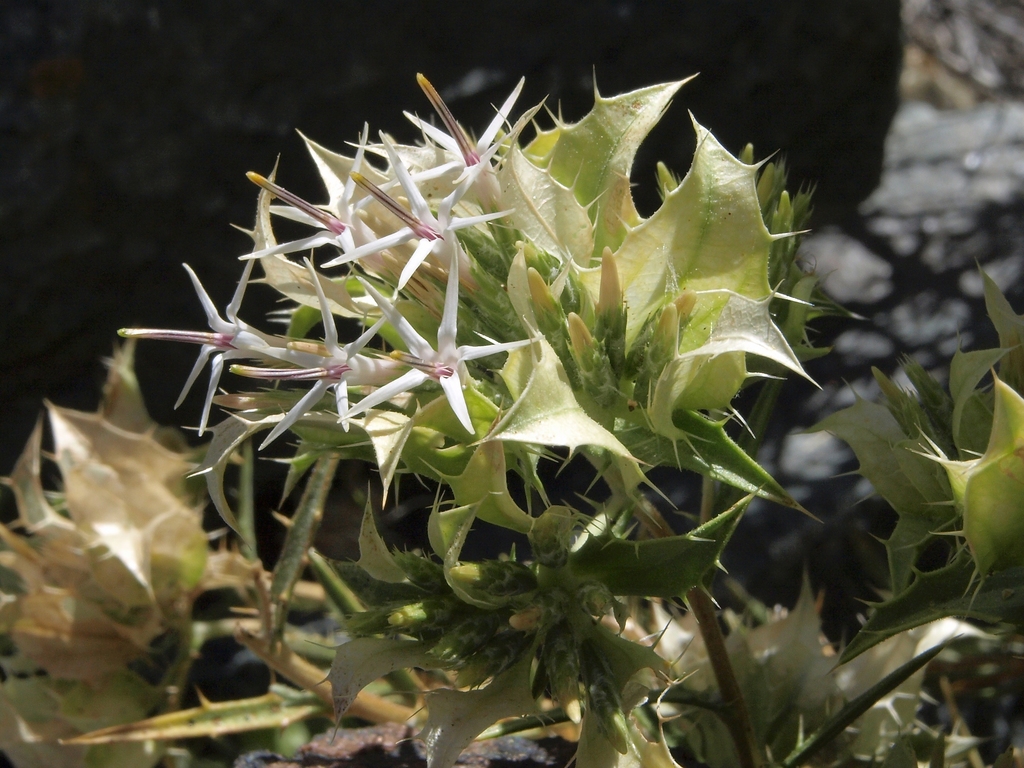
(c) Jim Morefield, some rights reserved (CC BY) · licence
Family: Asteraceae · Type: Shrub · Native
Conservation status: CNPS 3
Hecastocleis shockleyi (Shockley's prickleleaf) is a native California shrub in the Asteraceae family, recognized by Monotypic genus, Great Basin endemic with very limited California range.
Shockley's prickleleaf is a California native shrub found in the eastern Sierra Nevada and desert mountains on dry, rocky slopes at elevations of 1,000 to 2,200 meters. Flowering from May to July, this plant produces flowers that emerge pink to red-purple in bud, opening to green-white with delicate linear lobes. Growing 4 to 7 decimeters tall with stiff, much-branched stems that are glandular-puberulent, it develops distinctive spine-tipped linear leaves that persist as sharp spines when dry. Its leaves are simple and alternate, with primary leaves 1 to 3 centimeters long, sparsely spiny-dentate, and clustered axillary leaves that are narrower and often obtuse. The plant forms dense, head-like clusters of small flowers surrounded by spiny-toothed, net-veined bracts, creating a unique and sculptural appearance in its arid mountain habitats.
Identification and appearance
Key characters: Monotypic genus, Great Basin endemic with very limited California range
Habitat and range
Habitat: Dry, rocky slopes
Elevation: 1000-2200 m
Outside California: western Nevada
Bloom period
Hecastocleis shockleyi blooms May-Jul.
Conservation status
CNPS 3
How to tell it apart
vs Flaveria: Hecastocleis is a spiny desert shrub; Flaveria is a smooth herbaceous plant with no spines.; vs Artemisia: Hecastocleis has sharp persistent leaf spines; Artemisia has soft aromatic foliage without spines.; vs Echinops: Hecastocleis has flattened clusters hidden by bracts; Echinops has spherical blue flower heads on tall stems.; vs Eriophyllum: Hecastocleis has spine-tipped leaves and veiny bracts concealing flowers; Eriophyllum has woolly soft leaves and open daisy flowers.; vs Orochaenactis: Hecastocleis is a woody shrub with persistent spines; Orochaenactis is herbaceous without spines.
Frequently asked questions
Is Hecastocleis shockleyi native to California?
Yes. Hecastocleis shockleyi is native to California (recorded as native).
When does Hecastocleis shockleyi bloom?
Hecastocleis shockleyi blooms May-Jul.
What plant family does Hecastocleis shockleyi belong to?
Hecastocleis shockleyi is in the Asteraceae family, genus Hecastocleis.
Is Hecastocleis shockleyi rare or endangered?
Hecastocleis shockleyi carries California Rare Plant Rank 3, state rank S4.
What habitat does Hecastocleis shockleyi grow in?
Hecastocleis shockleyi grows in Dry, rocky slopes.
Related species
Other California species in the same genus, family, or bioregion.
Sources: Jepson eFlora · CNPS Rare Plant Inventory · Index of California Plant Names · CalPhotos · CDFW CNDDB
Last updated 2026-10-07
Data from The California Species Project — 14,000+ California species with verified data from CNPS, CDFW, USFWS, Cal-IPC, and more.