Hedera helix
English ivy
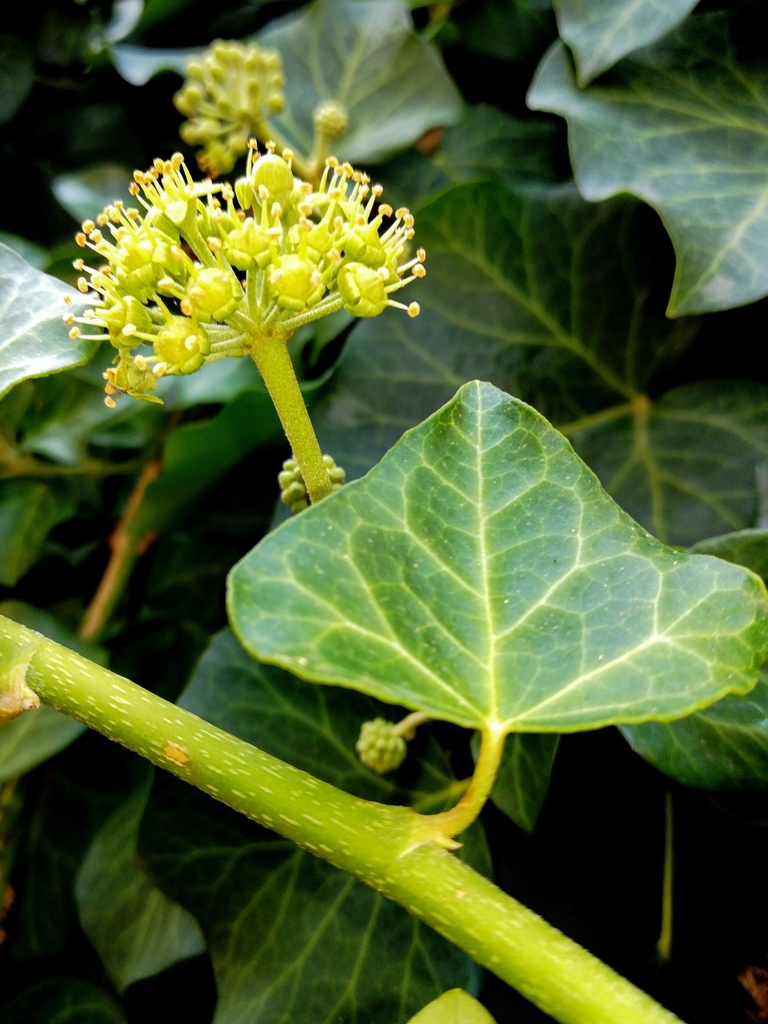
(c) Gianni Del Bufalo bygdb, some rights reserved (CC BY), uploaded by Gianni Del Bufalo bygdb · licence
Family: Araliaceae · Type: Vine · Not Native
Conservation status: Cal-IPC Yes
Hedera helix (English ivy) is a non-native California vine in the Araliaceae family, recognized by (H. canariensis). Key difference is leaf shape on flowering stems and broader elevational/geographic range.
English ivy is a naturalized perennial found in northern California coastal regions, northern Coast Ranges, northern Sierra Nevada foothills, Central Valley, central Coast, San Francisco Bay Area, and southwestern California in woodland and open disturbed areas at elevations below 1,280 meters. Flowering from August to November, this plant produces small greenish flowers in clusters. Growing as a climbing vine with flexible stems that can reach several meters in length, it spreads extensively through both horizontal and vertical growth. Its distinctive leaves are ovate to diamond-shaped, typically 5 to 15 centimeters long, with a slightly hairy undersurface. The plant produces small dark fruits approximately 5 millimeters in diameter that aid in its widespread distribution.
Identification and appearance
Key characters: 1 sympatric species (H. canariensis). Key difference is leaf shape on flowering stems and broader elevational/geographic range.
Habitat and range
Habitat: Woodland, open, disturbed areas
Elevation: < 1280 m
California counties: Santa Cruz, Orange, Santa Barbara, San Diego, Contra Costa, Los Angeles, San Bernardino, San Francisco, Ventura, Stanislaus, San Luis Obispo, San Mateo, Mendocino, Humboldt, Sonoma, Butte, Alameda, Del Norte, Placer, Kern, Monterey
Outside California: native to Europe
Bloom period
Hedera helix blooms Aug-Nov.
Conservation status
Cal-IPC Yes
How to tell it apart
vs Delairea: Hedera has thick, leathery leaves and woody stems; Delairea has soft, succulent leaves on herbaceous stems.; vs Parthenocissus: Hedera clings with aerial rootlets and has simple lobed leaves; Parthenocissus uses tendrils with adhesive pads and has compound leaves.; vs Marah: Hedera is evergreen and woody with lobed leaves; Marah is deciduous with tendrils and deeply palmately divided leaves.; vs Vitis: Hedera clings with aerial rootlets; Vitis climbs with coiling tendrils and has bark that peels in strips.; vs Asarum: Hedera is a climbing woody vine; Asarum is a low ground-hugging herb with kidney-shaped leaves.
Frequently asked questions
Is Hedera helix native to California?
No. Hedera helix is not native to California (recorded as not native).
When does Hedera helix bloom?
Hedera helix blooms Aug-Nov.
Where in California does Hedera helix grow?
Hedera helix occurs in Santa Cruz, Orange, Santa Barbara, San Diego, Contra Costa, Los Angeles, San Bernardino, San Francisco and other counties, at elevations of < 1280 m.
What plant family does Hedera helix belong to?
Hedera helix is in the Araliaceae family, genus Hedera.
Is Hedera helix invasive in California?
Hedera helix is listed by Cal-IPC with an invasiveness rating of Yes.
Related species
Other California species in the same genus, family, or bioregion.
Sources: Jepson eFlora · Index of California Plant Names · CalPhotos
Last updated 2026-10-07
Data from The California Species Project — 14,000+ California species with verified data from CNPS, CDFW, USFWS, Cal-IPC, and more.