Hedypnois rhagadioloides
Crete weed, Crete Weed
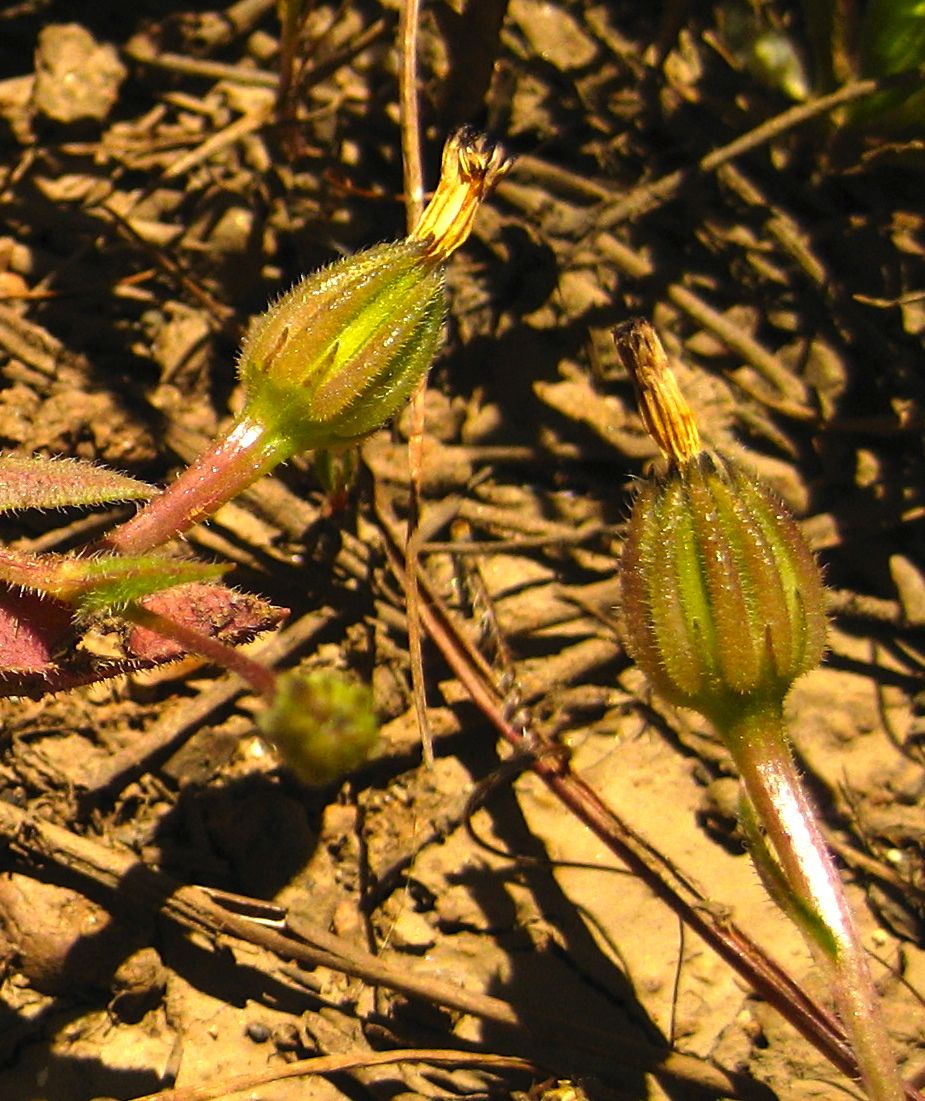
Photo by Chez Brungraber
Family: Asteraceae · Type: Herb · Not Native
Hedypnois rhagadioloides (Crete weed) is a non-native California herb in the Asteraceae family, recognized by Only Hedypnois species in California, Mediterranean introduction now widespread.
Crete weed is a naturalized annual herb found in coastal, central, and southern California regions, including grasslands, pastures, and roadsides at elevations below 1,150 meters. Flowering from February to June, this plant produces yellow flowers in heads 8 to 10 millimeters long arranged in open, loose clusters. Growing with slender stems 5 to 40 centimeters tall that are finely bristly with forked hairs, it develops a delicate, spreading form. Its leaves are oblong to oblanceolate, measuring 5 to 18 centimeters long, with lower leaves tapering to the base and covered in soft, minute bristles. The fruit is 5 to 7 millimeters long with a distinctive pappus of fused scale-like structures.
Identification and appearance
Key characters: Only Hedypnois species in California, Mediterranean introduction now widespread
Habitat and range
Habitat: Weed of pastures, grassy slopes, roadsides
Elevation: < 1150 m
California counties: Ventura, San Diego, San Luis Obispo, Santa Cruz, Butte, Nevada, Riverside, Los Angeles, Merced, Mariposa, Tuolumne, Mendocino, Napa, Contra Costa, Sonoma, Yuba, San Francisco, Tehama, Marin, Calaveras, Orange, Santa Barbara, Monterey
Outside California: to Texas, native to Mediterranean
Bloom period
Hedypnois rhagadioloides blooms Feb-Jun.
How to tell it apart
vs Hypochaeris: Hypochaeris stems don't swell below heads and has feathery pappus, Hedypnois has swollen stems and barbed bristles.; vs Helminthotheca: Helminthotheca has distinctive spiny-bristly phyllaries, Hedypnois has smooth phyllaries but swollen stems.; vs Taraxacum: Taraxacum has all basal leaves on hollow unbranched stalks, Hedypnois has stem leaves.; vs Calendula: Calendula has curved spine-like seeds without pappus, Hedypnois has bristly pappus.; vs Krigia: Krigia has scales and bristles mixed in pappus, Hedypnois has only minutely barbed bristles.
Frequently asked questions
Is Hedypnois rhagadioloides native to California?
No. Hedypnois rhagadioloides is not native to California (recorded as not native).
When does Hedypnois rhagadioloides bloom?
Hedypnois rhagadioloides blooms Feb-Jun.
Where in California does Hedypnois rhagadioloides grow?
Hedypnois rhagadioloides occurs in Ventura, San Diego, San Luis Obispo, Santa Cruz, Butte, Nevada, Riverside, Los Angeles and other counties, at elevations of < 1150 m.
What plant family does Hedypnois rhagadioloides belong to?
Hedypnois rhagadioloides is in the Asteraceae family, genus Hedypnois.
What habitat does Hedypnois rhagadioloides grow in?
Hedypnois rhagadioloides grows in Weed of pastures, grassy slopes, roadsides.
Related species
Other California species in the same genus, family, or bioregion.
Sources: Jepson eFlora · Index of California Plant Names · CalPhotos
Last updated 2026-10-07
Data from The California Species Project — 14,000+ California species with verified data from CNPS, CDFW, USFWS, Cal-IPC, and more.