Heliotropium curassavicum var. oculatum
Seaside heliotrope, alkali heliotrope, Alkali Heliotrope
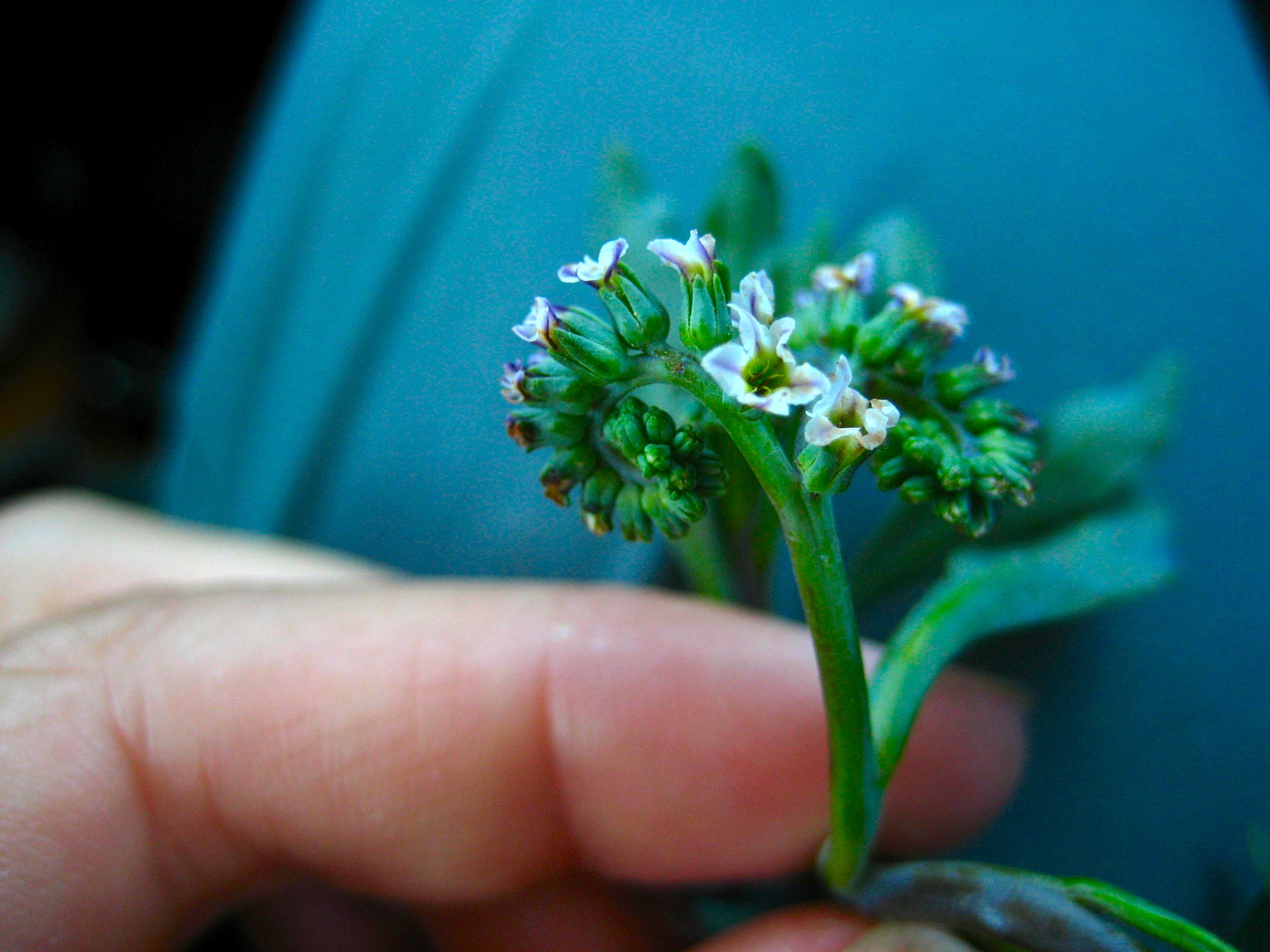
Photo by Chez Brungraber
Family: Heliotropiaceae · Type: Subshrub · Native
Heliotropium curassavicum var. oculatum (Seaside heliotrope) is a native California subshrub in the Heliotropiaceae family, recognized by distinctive glabrous, fleshy habit and saline habitat preference.
Seaside heliotrope is a California native perennial found in coastal and southern California regions in moist to dry, saline to alkaline soils near water at elevations below 2,250 meters. Flowering from February to October, this plant produces white flowers with a distinctive blue-purple throat, arranged in small spike-like clusters typically 3 to 5 millimeters in diameter. Growing with prostrate to ascending fleshy stems 10 to 60 centimeters long, the plant spreads with a occasionally rhizome-like root system. Its leaves are glabrous, oblanceolate, 1 to 6 centimeters long, and arranged with short petioles or nearly sessile along the stem. The plant produces smooth nutlets in clusters of four, creating distinctive seed formations in its habitat.
Identification and appearance
Key characters: 2 sympatric species; distinctive glabrous, fleshy habit and saline habitat preference
Habitat and range
Habitat: Moist to dry, saline to alkaline soils, generally near water
Elevation: < 2250 m
California counties: San Diego, Los Angeles, San Bernardino, Ventura, Riverside, Orange, Kern, Imperial, Yolo, Inyo, Santa Barbara, San Luis Obispo, Lake, Mono, Monterey, Fresno, San Joaquin, Modoc, Santa Clara, San Benito, Alameda, Humboldt, San Mateo, Tulare, Solano, Tehama, Sonoma, Merced, Colusa, Marin, Santa Cruz, Mendocino, Siskiyou, Glenn, Lassen, Plumas, Kings, Contra Costa, Napa, Sutter, Stanislaus, Sacramento
Outside California: southern Nevada, southwestern Utah, to western Texas, northern Mexico
Bloom period
Heliotropium curassavicum var. oculatum blooms Feb-Oct.
How to tell it apart
vs Lobularia: Heliotropium has tubular 5-petaled flowers; Lobularia has 4-petaled flowers with separate petals spreading flat.; vs Lantana: Heliotropium has flowers in one-sided coils; Lantana has flowers in flat-topped, dense rounded clusters.; vs Cryptantha: Heliotropium has flowers in continuous coiled spikes; Cryptantha has flowers spaced along straight stems.; vs Myoporum: Heliotropium has tiny flowers in coiled clusters; Myoporum has larger axillary flowers with spotted throats.; vs Phacelia: Heliotropium has an undivided style; Phacelia has a style split partway into 2 branches.
Frequently asked questions
Is Heliotropium curassavicum var. oculatum native to California?
Yes. Heliotropium curassavicum var. oculatum is native to California (recorded as native).
When does Heliotropium curassavicum var. oculatum bloom?
Heliotropium curassavicum var. oculatum blooms Feb-Oct.
Where in California does Heliotropium curassavicum var. oculatum grow?
Heliotropium curassavicum var. oculatum occurs in San Diego, Los Angeles, San Bernardino, Ventura, Riverside, Orange, Kern, Imperial and other counties, at elevations of < 2250 m.
What plant family does Heliotropium curassavicum var. oculatum belong to?
Heliotropium curassavicum var. oculatum is in the Heliotropiaceae family, genus Heliotropium.
What habitat does Heliotropium curassavicum var. oculatum grow in?
Heliotropium curassavicum var. oculatum grows in Moist to dry, saline to alkaline soils, generally near water.
Related species
Other California species in the same genus, family, or bioregion.
Sources: Jepson eFlora · Index of California Plant Names · CalPhotos
Last updated 2026-10-07
Data from The California Species Project — 14,000+ California species with verified data from CNPS, CDFW, USFWS, Cal-IPC, and more.