Helminthotheca echioides
Bristly ox-tongue
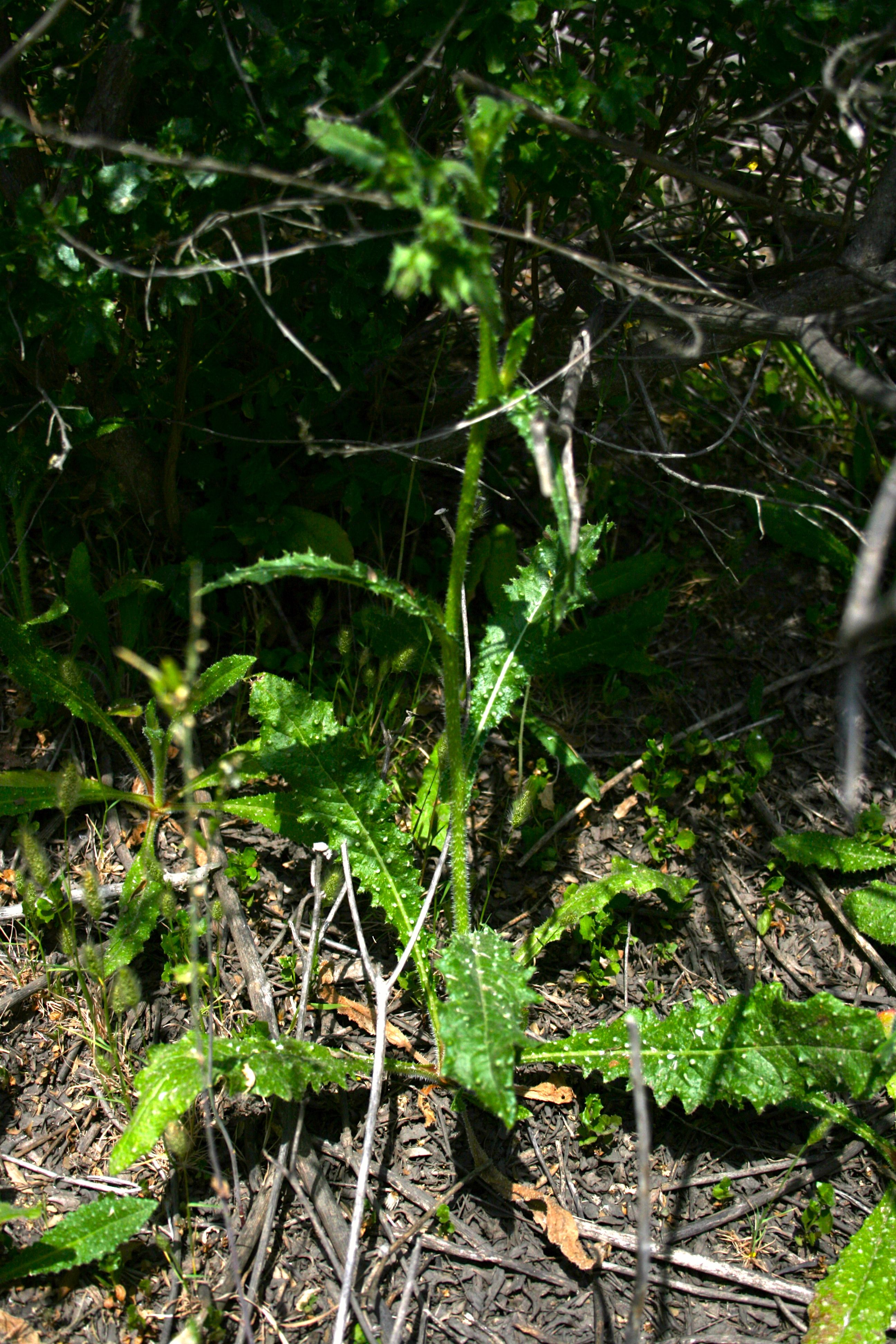
Photo by Chez Brungraber
Family: Asteraceae · Type: Herb · Not Native
Conservation status: Cal-IPC Yes
Helminthotheca echioides (Bristly ox-tongue) is a non-native California herb in the Asteraceae family, recognized by European introduction that has become naturalized across much of California's lower elevation disturbed habitats.
Bristly ox-tongue is a naturalized annual found in northwestern California, northern Sierra Nevada foothills, the Great Valley, central western, and southwestern California in disturbed areas at elevations below 1,050 meters. Flowering throughout the year, this plant produces yellow flowers in heads 2 to 4 centimeters wide, with distinctive leaf-like outer phyllaries that often conceal the inner phyllaries. Growing with coarse, stout stems 30 to 200 centimeters tall, it spreads readily in open areas. Its leaves range from 5 to 20 centimeters long, oblong in shape, with variable margins that can be entire, coarsely toothed, or shallowly lobed, with lower leaves tapering to winged leaf stalks and upper leaves sometimes clasping the stem. The fruit is 5 to 7.5 millimeters long, with outer surfaces ranging from white to straw-colored or tan, and inner surfaces brown and transversely roughened.
Identification and appearance
Key characters: European introduction that has become naturalized across much of California's lower elevation disturbed habitats
Habitat and range
Habitat: Common. Disturbed areas
Elevation: < 1050 m
California counties: Humboldt, Ventura, Los Angeles, Glenn, San Diego, Alameda, Butte, Napa, San Bernardino, San Joaquin, Yolo, Contra Costa, Marin, Monterey, Orange, San Francisco, San Luis Obispo, San Mateo, Santa Barbara, Santa Clara, Santa Cruz, Solano, Sonoma, Colusa, Mendocino, Sacramento, Tuolumne, Riverside
Outside California: North America, native to Europe
Bloom period
Helminthotheca echioides blooms All year.
Conservation status
Cal-IPC Yes
How to tell it apart
vs Sonchus: Helminthotheca is densely bristly overall; Sonchus may have spines but isn't uniformly bristly; vs Taraxacum: Helminthotheca has bristly leaves along stems; dandelion has smooth basal leaves only; vs Hypochaeris: Helminthotheca is bristly with two bract series; Hypochaeris is less bristly with overlapping bracts; vs Lactuca: Helminthotheca is densely bristly-hairy; Lactuca may be spiny but not covered in stiff bristles; vs Picris: Helminthotheca has distinctly wide outer bracts; Picris has more uniform narrow bracts
Frequently asked questions
Is Helminthotheca echioides native to California?
No. Helminthotheca echioides is not native to California (recorded as not native).
When does Helminthotheca echioides bloom?
Helminthotheca echioides blooms All year.
Where in California does Helminthotheca echioides grow?
Helminthotheca echioides occurs in Humboldt, Ventura, Los Angeles, Glenn, San Diego, Alameda, Butte, Napa and other counties, at elevations of < 1050 m.
What plant family does Helminthotheca echioides belong to?
Helminthotheca echioides is in the Asteraceae family, genus Helminthotheca.
Is Helminthotheca echioides invasive in California?
Helminthotheca echioides is listed by Cal-IPC with an invasiveness rating of Yes.
Related species
Other California species in the same genus, family, or bioregion.
Sources: Jepson eFlora · Index of California Plant Names · CalPhotos
Last updated 2026-10-07
Data from The California Species Project — 14,000+ California species with verified data from CNPS, CDFW, USFWS, Cal-IPC, and more.