Hemizonella minima
Opposite leaved tarweed
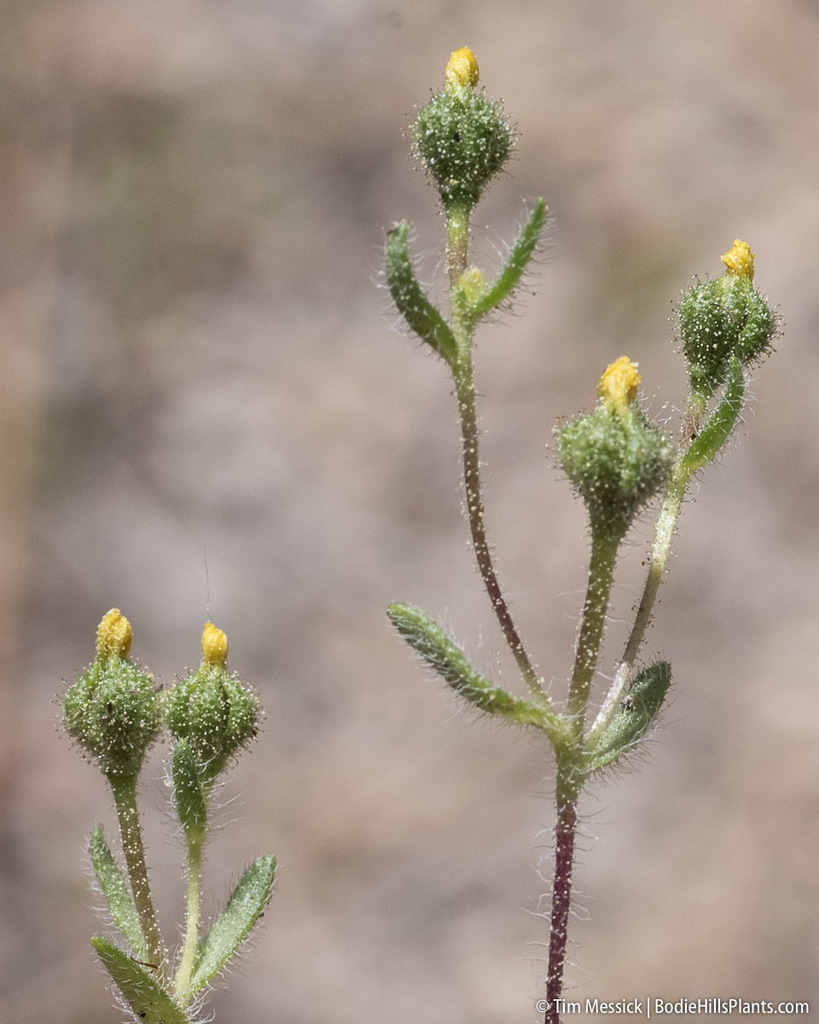
(c) Tim Messick, some rights reserved (CC BY), uploaded by Tim Messick · licence
Family: Asteraceae · Type: Herb · Native
Hemizonella minima (Opposite leaved tarweed) is a native California herb in the Asteraceae family, recognized by Monotypic genus representing a distinct evolutionary lineage within the tarweed complex, distributed across western North America with….
Opposite leaved tarweed is a California native annual found in the Klamath Ranges, northern Coast Ranges, Cascade Range, Sierra Nevada, southeastern San Francisco Bay Area, southern Coast Ranges, Transverse Ranges, Peninsular Ranges, and Modoc Plateau in gravelly or rocky open sites in scrub, meadows, and forest at elevations of 300 to 2,900 meters. Flowering from April to August, this plant produces pale yellow flowers in small heads 1 to 4 millimeters in diameter, with delicate ray flowers barely extending beyond the involucre. Growing with decumbent to erect stems 1 to 20 centimeters tall, the plant has widely divergent branches covered in minute coarse hairs with glandular stalks. Its leaves are distinctive, with lower leaves opposite and upper leaves alternate, linear and sessile, 5 to 25 millimeters long and less than 2.5 millimeters wide, covered in coarse hairs and glandular on the upper surfaces. The small black fruits are compressed, slightly arched, and tipped with a minute straight beak.
Identification and appearance
Key characters: Monotypic genus representing a distinct evolutionary lineage within the tarweed complex, distributed across western North America with California as the center of abundance
Habitat and range
Habitat: Gravelly or rocky, generally open sites in scrub, meadows, forest
Elevation: 300-2900 m
California counties: Fresno, Kern, El Dorado, Los Angeles, Riverside, Tulare, Modoc, Siskiyou, Nevada, Tuolumne, Alpine, Mendocino, Amador, Calaveras, Lassen, Madera, Monterey, Placer, San Bernardino, San Diego, Santa Clara, Sierra, Ventura, Butte, Plumas, Glenn, Humboldt, Shasta, Lake, Mariposa, Tehama, Trinity, Mono, Colusa, Del Norte, Napa, Sonoma, Inyo, Santa Barbara
Outside California: to Washington, Montana, Nevada
Bloom period
Hemizonella minima blooms Apr-Aug.
How to tell it apart
vs Madia: Hemizonella has fruits compressed front-to-back and is tiny (1-8 inches); Madia has fruits compressed side-to-side and is more robust.; vs Adenocaulon: Hemizonella is a tiny tarweed under 8 inches in open sites; Adenocaulon has large triangular leaves white below in shaded forests.; vs Artemisia: Hemizonella is a tiny annual with one disk flower per head; Artemisia is a woody aromatic shrub with many flowers in branching clusters.; vs Iva: Hemizonella is a miniature annual 1-8 inches tall; Iva is a perennial herb or subshrub in wetlands.; vs Amblyopappus: Hemizonella has 1-2 disk flowers per head and fruits compressed front-to-back; Amblyopappus has 3-4 disk flowers and different fruit shape.
Frequently asked questions
Is Hemizonella minima native to California?
Yes. Hemizonella minima is native to California (recorded as native).
When does Hemizonella minima bloom?
Hemizonella minima blooms Apr-Aug.
Where in California does Hemizonella minima grow?
Hemizonella minima occurs in Fresno, Kern, El Dorado, Los Angeles, Riverside, Tulare, Modoc, Siskiyou and other counties, at elevations of 300-2900 m.
What plant family does Hemizonella minima belong to?
Hemizonella minima is in the Asteraceae family, genus Hemizonella.
What habitat does Hemizonella minima grow in?
Hemizonella minima grows in Gravelly or rocky, generally open sites in scrub, meadows, forest.
Related species
Other California species in the same genus, family, or bioregion.
Sources: Jepson eFlora · Index of California Plant Names · CalPhotos
Last updated 2026-10-07
Data from The California Species Project — 14,000+ California species with verified data from CNPS, CDFW, USFWS, Cal-IPC, and more.