Hemizonia congesta subsp. clevelandii
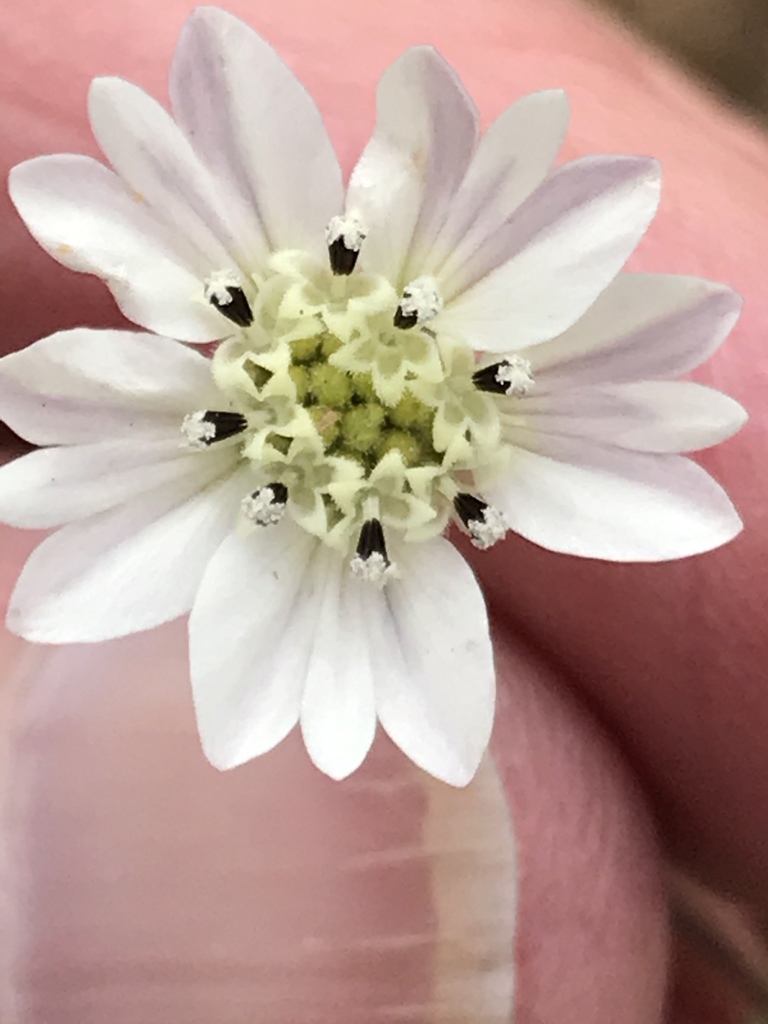
Photo: parent species Hemizonia congesta · (c) Bruce Homer-Smith, some rights reserved (CC BY) · licence
Family: Asteraceae · Type: Herb · Native
Hemizonia congesta subsp. clevelandii is a native California herb in the Asteraceae family, recognized by 5 sympatric subspecies. Key diagnostic: no calyx-like bracts, phyllary tips < bodies.
Cleveland's hayfield tarweed is a California native annual found in southern Klamath Ranges, northern Coast Ranges, western edge of northern Sierra Nevada Foothills, and Sacramento Valley in dry grasslands, chaparral openings, and woodland sites at elevations of 40 to 1,600 meters. Flowering from June to November, this plant produces white ray flowers with distinctive purple veining on heads arranged in spike- or raceme-like clusters. Growing with multiple branches and coarse-hairy stems up to several tens of centimeters tall, it forms open, well-developed side branches. Its leaves are notably coarse-hairy to shaggy, with distal leaves often bearing stalked glands and minutely bristly surfaces. The small fruits are compact, with a width approximately two-thirds of their length.
Identification and appearance
Key characters: 5 sympatric subspecies. Key diagnostic: no calyx-like bracts, phyllary tips < bodies
Habitat and range
Habitat: dry sites, grassland, opening in chaparral and woodland
Elevation: 40-1600 m
California counties: Lake, Sonoma, Colusa, Glenn, Plumas, Santa Cruz, Humboldt, Mendocino, Napa, Trinity, Tehama, Butte, El Dorado, Siskiyou
Outside California: southwestern Oregon
Bloom period
Hemizonia congesta subsp. clevelandii blooms Jun-Nov.
How to tell it apart
vs Deinandra: Hemizonia rays often purple-veined beneath; Deinandra rays pure yellow without veining.; vs Madia: Hemizonia has paleae throughout disk; Madia has ray fruits enclosed by phyllaries.; vs Calycadenia: Hemizonia rays shallowly lobed; Calycadenia rays deeply split into spreading lobes.; vs Holocarpha: Hemizonia lacks pit glands on stalks; Holocarpha has distinctive pit-gland-tipped stalk bracts.; vs Anisocarpus: Hemizonia has chaff throughout flower disk; Anisocarpus typically lacks chaff scales.
Frequently asked questions
Is Hemizonia congesta subsp. clevelandii native to California?
Yes. Hemizonia congesta subsp. clevelandii is native to California (recorded as native).
When does Hemizonia congesta subsp. clevelandii bloom?
Hemizonia congesta subsp. clevelandii blooms Jun-Nov.
Where in California does Hemizonia congesta subsp. clevelandii grow?
Hemizonia congesta subsp. clevelandii occurs in Lake, Sonoma, Colusa, Glenn, Plumas, Santa Cruz, Humboldt, Mendocino and other counties, at elevations of 40-1600 m.
What plant family does Hemizonia congesta subsp. clevelandii belong to?
Hemizonia congesta subsp. clevelandii is in the Asteraceae family, genus Hemizonia.
What habitat does Hemizonia congesta subsp. clevelandii grow in?
Hemizonia congesta subsp. clevelandii grows in dry sites, grassland, opening in chaparral and woodland.
Related species
Other California species in the same genus, family, or bioregion.
Sources: Jepson eFlora · Index of California Plant Names · CalPhotos
Last updated 2026-10-07
Data from The California Species Project — 14,000+ California species with verified data from CNPS, CDFW, USFWS, Cal-IPC, and more.