Hemizonia congesta subsp. tracyi
Tracy's tarplant, Tracy's Tarplant
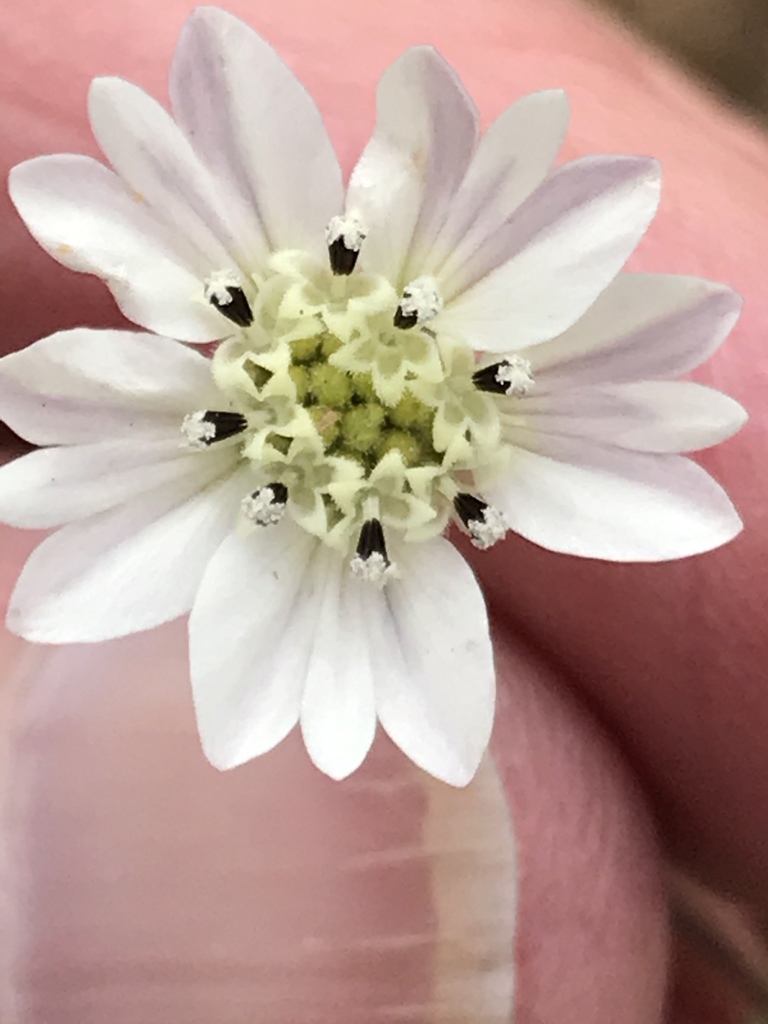
Photo: parent species Hemizonia congesta · (c) Bruce Homer-Smith, some rights reserved (CC BY) · licence
Family: Asteraceae · Type: Herb · Native
Conservation status: CNPS 4.3
Hemizonia congesta subsp. tracyi (Tracy's tarplant) is a native California herb in the Asteraceae family, recognized by 2 sympatric subspecies. Main distinction from lutescens is white vs yellow rays.
Tracy's tarplant is a native annual herb found in northern coastal California, including Cape Mendocino and Humboldt County, in grassy sites, riverbanks, and openings in scrub and woodland habitats at elevations below 1,200 meters. Flowering from May to November, this plant produces white ray flowers with delicate clusters arranged in panicle-like formations. Growing with slender stems 10 to 50 centimeters tall, it has leaves that are generally puberulent or minutely bristly, with soft hairy and glandular upper leaves. Its leaves are distinctively textured, being minutely bristly or strigose throughout, with distal leaves becoming long-soft-hairy and glandular. The fruit is small, with a width about half its length, developing after its white flowers bloom in open, sunny habitats.
Identification and appearance
Key characters: 2 sympatric subspecies. Main distinction from lutescens is white vs yellow rays
Habitat and range
Habitat: Grassy sites, riverbanks, openings in scrub, woodland, forest
Elevation: < 1200 m
California counties: Humboldt, Colusa, Mendocino, Trinity, Alameda
Bloom period
Hemizonia congesta subsp. tracyi blooms May-Nov.
Conservation status
CNPS 4.3
How to tell it apart
vs Deinandra: Hemizonia rays often purple-veined beneath; Deinandra rays pure yellow without veining.; vs Madia: Hemizonia has paleae throughout disk; Madia has ray fruits enclosed by phyllaries.; vs Calycadenia: Hemizonia rays shallowly lobed; Calycadenia rays deeply split into spreading lobes.; vs Holocarpha: Hemizonia lacks pit glands on stalks; Holocarpha has distinctive pit-gland-tipped stalk bracts.; vs Anisocarpus: Hemizonia has chaff throughout flower disk; Anisocarpus typically lacks chaff scales.
Frequently asked questions
Is Hemizonia congesta subsp. tracyi native to California?
Yes. Hemizonia congesta subsp. tracyi is native to California (recorded as native).
When does Hemizonia congesta subsp. tracyi bloom?
Hemizonia congesta subsp. tracyi blooms May-Nov.
Where in California does Hemizonia congesta subsp. tracyi grow?
Hemizonia congesta subsp. tracyi occurs in Humboldt, Colusa, Mendocino, Trinity, Alameda, at elevations of < 1200 m.
What plant family does Hemizonia congesta subsp. tracyi belong to?
Hemizonia congesta subsp. tracyi is in the Asteraceae family, genus Hemizonia.
Is Hemizonia congesta subsp. tracyi rare or endangered?
Hemizonia congesta subsp. tracyi carries California Rare Plant Rank 4.3, state rank S4.
Related species
Other California species in the same genus, family, or bioregion.
- Hemizonia sp. — Hayfield tarweed
- Hemizonia congesta — Hayfield tarweed
- Hemizonia congesta subsp. calyculata — Mendocino tarplant
- Hemizonia congesta subsp. clevelandii
- Hemizonia congesta subsp. congesta — Congested-headed hayfield tarplant
- Hemizonia congesta subsp. lutescens
- Hesperevax acaulis — Dwarf evax
- Hesperevax acaulis var. acaulis — Stemless evax
- Hesperevax acaulis var. ambusticola — Fire evax
Sources: Jepson eFlora · CNPS Rare Plant Inventory · Index of California Plant Names · CalPhotos · CDFW CNDDB
Last updated 2026-10-07
Data from The California Species Project — 14,000+ California species with verified data from CNPS, CDFW, USFWS, Cal-IPC, and more.