Herniaria hirsuta var. cinerea
Herniaria
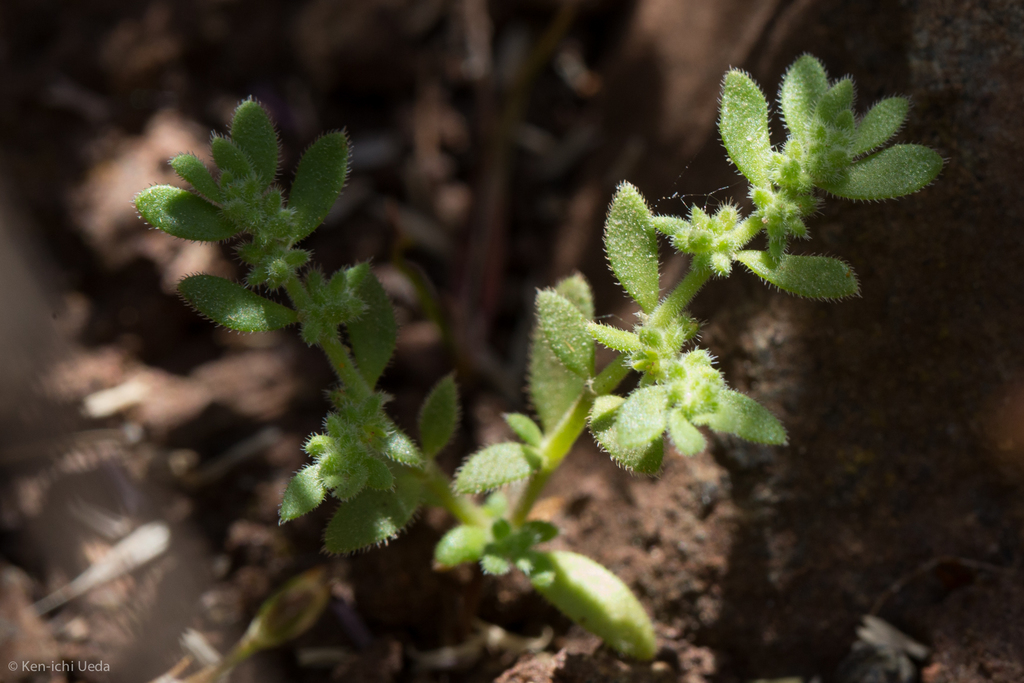
Photo: parent species Herniaria hirsuta · (c) Ken-ichi Ueda, some rights reserved (CC BY) · licence
Family: Caryophyllaceae · Type: Herb · Not Native
Herniaria hirsuta var. cinerea (Herniaria) is a non-native California herb in the Caryophyllaceae family, recognized by flower size and style length.
Herniaria is a naturalized annual found in southern Sierra Nevada foothills, Tehachapi, San Joaquin Valley, San Francisco Bay Area, and southern California coastal regions in disturbed areas, alkaline hills, and clay flats at elevations below 800 meters. Flowering from spring to fall, this plant produces tiny green-white flowers less than 2 millimeters long arranged in small clusters of 3 to 8 blooms. Growing with spreading or prostrate stems 5 to 20 centimeters long, it forms low-growing mats across the landscape. Its small leaves are densely hairy, creating a soft, grayish-green ground cover that spreads across disturbed terrain. The tiny seeds measure just 0.5 to 0.6 millimeters, contributing to its ability to quickly colonize open ground.
Identification and appearance
Key characters: 1 sympatric species - distinguished by flower size and style length
Habitat and range
Habitat: Disturbed areas, alkaline hills, clay flats
Elevation: < 800 m
California counties: Los Angeles, Colusa, Fresno, Ventura, San Benito, San Bernardino, Alameda, Madera, Butte, Calaveras, Humboldt, Marin, Merced, Monterey, Kern, Napa, San Joaquin, Santa Cruz, Stanislaus, Tehama, Tulare, Yolo, Mariposa, San Luis Obispo, Tuolumne, Siskiyou, Santa Barbara, Riverside, San Diego
Outside California: Oregon, Arizona, Maryland, native to southern Europe, northern Africa, southwestern Asia
Bloom period
Herniaria hirsuta var. cinerea blooms Spring-fall.
How to tell it apart
vs Polycarpon: Herniaria has long hooked hairs and blunt sepals; Polycarpon has small white petals.; vs Paronychia: Herniaria sepals are blunt and green-edged; Paronychia has bristle-tipped white-edged sepals.; vs Cardionema: Herniaria lacks woolly coating; Cardionema is densely fuzzy-woolly.; vs Achyronychia: Herniaria has narrow blunt sepals; Achyronychia has broad rounded sepals.; vs Scopulophila: Herniaria is annual mat; Scopulophila is perennial with woolly base cushion.
Frequently asked questions
Is Herniaria hirsuta var. cinerea native to California?
No. Herniaria hirsuta var. cinerea is not native to California (recorded as not native).
When does Herniaria hirsuta var. cinerea bloom?
Herniaria hirsuta var. cinerea blooms Spring-fall.
Where in California does Herniaria hirsuta var. cinerea grow?
Herniaria hirsuta var. cinerea occurs in Los Angeles, Colusa, Fresno, Ventura, San Benito, San Bernardino, Alameda, Madera and other counties, at elevations of < 800 m.
What plant family does Herniaria hirsuta var. cinerea belong to?
Herniaria hirsuta var. cinerea is in the Caryophyllaceae family, genus Herniaria.
What habitat does Herniaria hirsuta var. cinerea grow in?
Herniaria hirsuta var. cinerea grows in Disturbed areas, alkaline hills, clay flats.
Related species
Other California species in the same genus, family, or bioregion.
Sources: Jepson eFlora · Index of California Plant Names · CalPhotos
Last updated 2026-10-07
Data from The California Species Project — 14,000+ California species with verified data from CNPS, CDFW, USFWS, Cal-IPC, and more.