Hesperevax acaulis var. acaulis
Stemless evax, Stemless Evax
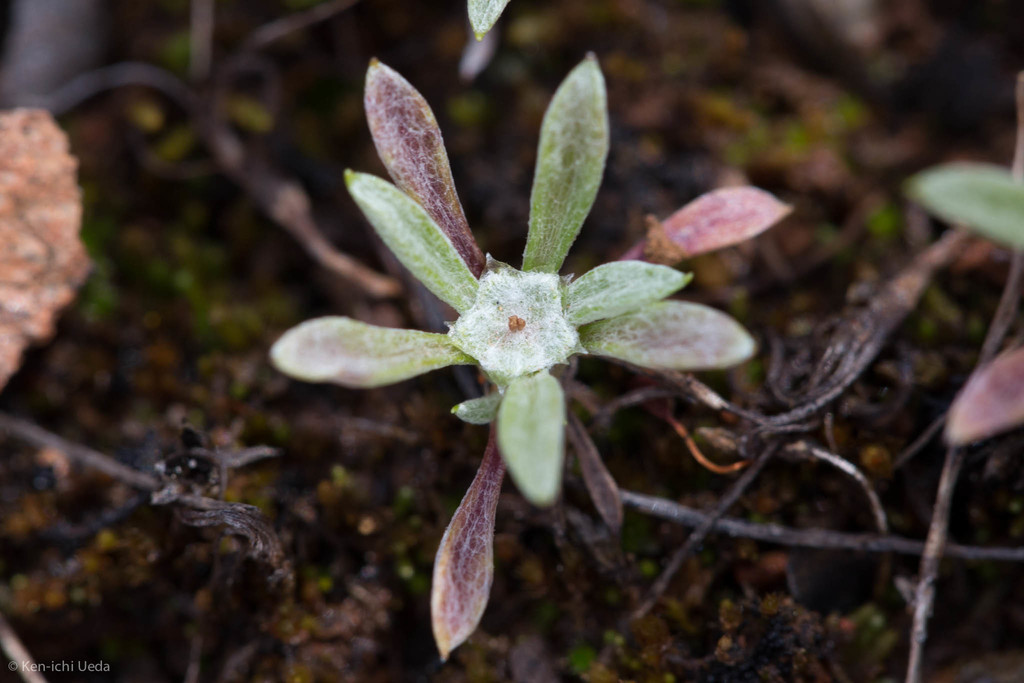
(c) Ken-ichi Ueda, some rights reserved (CC BY), uploaded by Ken-ichi Ueda · licence
Family: Asteraceae · Type: Herb · Native
Hesperevax acaulis var. acaulis (Stemless evax) is a native California herb in the Asteraceae family, recognized by head size and clustering pattern.
Stemless evax is a California native annual found in the Sierra Nevada Foothills, northern and eastern Great Valley, eastern San Francisco Bay Area, and southern Coast Ranges in grasslands, swales, moss turf, and chaparral at elevations of 30 to 900 meters. Flowering from March to May, this plant produces tiny white flowers in compact heads 2.5 to 3 millimeters wide. Growing extremely small, typically 1 to 2 centimeters tall with virtually no stem or occasionally a short prostrate branch, it forms a delicate ground-hugging structure. Its leaves are oblanceolate, relatively narrow at 0.5 to 2 millimeters wide, with the largest leaves reaching 7 to 12 millimeters long and positioned somewhat erect toward the plant's tip. The plant's diminutive size and compact form allow it to thrive in tight, low-growing habitats like moss turf and grassland margins.
Identification and appearance
Key characters: 4 sympatric species; distinguished by head size and clustering pattern
Habitat and range
Habitat: Grassland, swales, moss turf, chaparral
Elevation: 30-900 m
California counties: Tulare, Butte, Calaveras, Tehama, Colusa, Shasta, Amador, Tuolumne, Mariposa, Fresno, Madera, Santa Clara, San Luis Obispo, Monterey, El Dorado, Stanislaus, Lake
Outside California: southwestern Oregon
Bloom period
Hesperevax acaulis var. acaulis blooms Mar-May.
How to tell it apart
vs Ancistrocarphus: Hesperevax has erect, flat, blunt-tipped bracts; Ancistrocarphus has inward-hooked spine-like tips.; vs Filago: Hesperevax has heads nestled in leaf clusters; Filago has cone-shaped heads on visible stems.; vs Logfia: Hesperevax has flat-tipped erect bracts; Logfia has mushroom-shaped heads with spreading outer bracts.; vs Stylocline: Hesperevax has enlarged flat-tipped bracts; Stylocline has tiny heads hidden in dense woolly mats.; vs Micropus: Hesperevax lacks prominent petal-like bracts; Micropus has 4-6 conspicuous spoon-shaped outer bracts.
Frequently asked questions
Is Hesperevax acaulis var. acaulis native to California?
Yes. Hesperevax acaulis var. acaulis is native to California (recorded as native).
When does Hesperevax acaulis var. acaulis bloom?
Hesperevax acaulis var. acaulis blooms Mar-May.
Where in California does Hesperevax acaulis var. acaulis grow?
Hesperevax acaulis var. acaulis occurs in Tulare, Butte, Calaveras, Tehama, Colusa, Shasta, Amador, Tuolumne and other counties, at elevations of 30-900 m.
What plant family does Hesperevax acaulis var. acaulis belong to?
Hesperevax acaulis var. acaulis is in the Asteraceae family, genus Hesperevax.
What habitat does Hesperevax acaulis var. acaulis grow in?
Hesperevax acaulis var. acaulis grows in Grassland, swales, moss turf, chaparral.
Related species
Other California species in the same genus, family, or bioregion.
Sources: Jepson eFlora · Index of California Plant Names · CalPhotos
Last updated 2026-10-07
Data from The California Species Project — 14,000+ California species with verified data from CNPS, CDFW, USFWS, Cal-IPC, and more.