Hesperevax sparsiflora var. brevifolia
Shortleaved evax
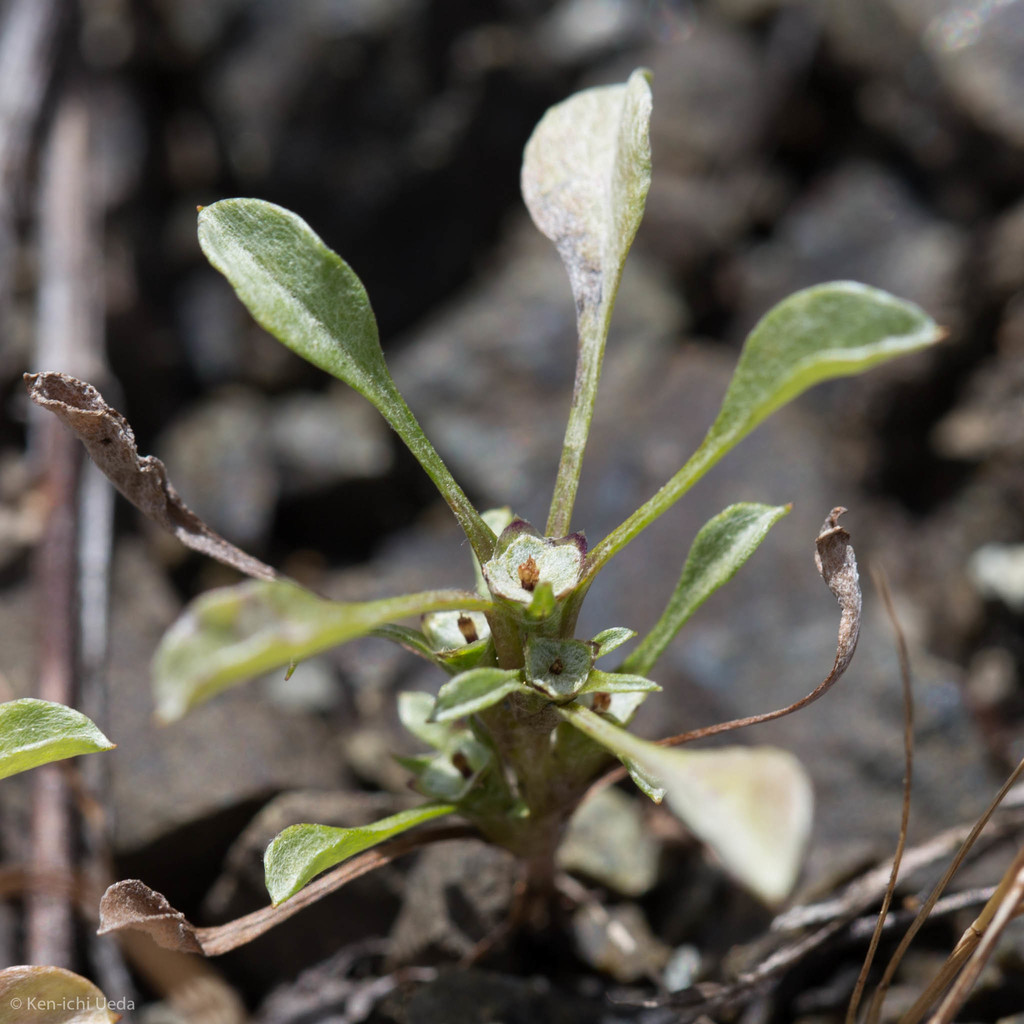
(c) Ken-ichi Ueda, some rights reserved (CC BY), uploaded by Ken-ichi Ueda · licence
Family: Asteraceae · Type: Herb · Native
Conservation status: CNPS 1B.2
Hesperevax sparsiflora var. brevifolia (Shortleaved evax) is a native California herb in the Asteraceae family, recognized by size and coastal habitat.
Shortleaved evax is a rare (CNPS 1B.2) California native annual found in northern Coast Ranges and northern Central Coast bioregions in sandy, grassy coastal bluffs, terraces, and dunes at elevations below 100 meters. Flowering from March to July, this plant produces small white flowers in compact heads less than 4 millimeters long. Growing to 3 to 9 centimeters tall with a delicate, spreading form, it has a soft, greenish appearance. Its leaves are distinctively woolly and rounded, measuring 6 to 12 millimeters long and 3 to 5 millimeters wide, creating a dense, compact botanical profile. The plant's diminutive size and woolly texture make it a subtle but distinctive component of coastal grassland ecosystems.
Identification and appearance
Key characters: 1 sympatric species; distinguished by size and coastal habitat
Habitat and range
Habitat: Sandy, grassy or wooded coastal bluffs, terraces, dunes
Elevation: < 100(300) m
Outside California: to southwestern Oregon
Bloom period
Hesperevax sparsiflora var. brevifolia blooms Mar-Jul.
Conservation status
CNPS 1B.2
How to tell it apart
vs Ancistrocarphus: Hesperevax has erect, flat, blunt-tipped bracts; Ancistrocarphus has inward-hooked spine-like tips.; vs Filago: Hesperevax has heads nestled in leaf clusters; Filago has cone-shaped heads on visible stems.; vs Logfia: Hesperevax has flat-tipped erect bracts; Logfia has mushroom-shaped heads with spreading outer bracts.; vs Stylocline: Hesperevax has enlarged flat-tipped bracts; Stylocline has tiny heads hidden in dense woolly mats.; vs Micropus: Hesperevax lacks prominent petal-like bracts; Micropus has 4-6 conspicuous spoon-shaped outer bracts.
Frequently asked questions
Is Hesperevax sparsiflora var. brevifolia native to California?
Yes. Hesperevax sparsiflora var. brevifolia is native to California (recorded as native).
When does Hesperevax sparsiflora var. brevifolia bloom?
Hesperevax sparsiflora var. brevifolia blooms Mar-Jul.
What plant family does Hesperevax sparsiflora var. brevifolia belong to?
Hesperevax sparsiflora var. brevifolia is in the Asteraceae family, genus Hesperevax.
Is Hesperevax sparsiflora var. brevifolia rare or endangered?
Hesperevax sparsiflora var. brevifolia carries California Rare Plant Rank 1B.2, state rank S3.
What habitat does Hesperevax sparsiflora var. brevifolia grow in?
Hesperevax sparsiflora var. brevifolia grows in Sandy, grassy or wooded coastal bluffs, terraces, dunes.
Related species
Other California species in the same genus, family, or bioregion.
- Hesperevax sparsiflora var. sparsiflora — Erect dwarf cudweed
- Hesperevax acaulis — Dwarf evax
- Hesperevax acaulis var. acaulis — Stemless evax
- Hesperevax acaulis var. ambusticola — Fire evax
- Hesperevax acaulis var. robustior — Big evax
- Hesperevax caulescens — Hogwallow starfish
- Heteranthemis sp.
- Heteranthemis viscidihirta — Sand chrysanthemum
- Heterotheca grandiflora — Telegraph weed
Sources: Jepson eFlora · CalPhotos · CDFW CNDDB
Last updated 2026-10-07
Data from The California Species Project — 14,000+ California species with verified data from CNPS, CDFW, USFWS, Cal-IPC, and more.