Hesperidanthus jaegeri
Jaeger's hesperidanthus
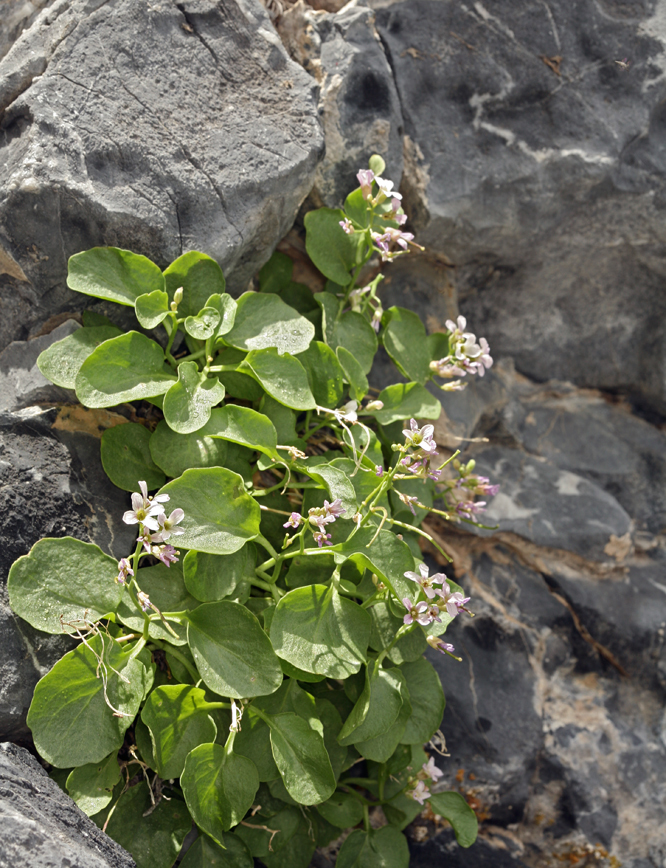
(c) Steve Matson, some rights reserved (CC BY), uploaded by Steve Matson · licence
Family: Brassicaceae · Type: Subshrub · Native
Conservation status: CNPS 1B.2
Hesperidanthus jaegeri (Jaeger's hesperidanthus) is a native California subshrub in the Brassicaceae family, recognized by Endemic genus with this species restricted to limestone habitats in the Inyo Mountains, representing a relict lineage in the mustard family.
Jaeger's hesperidanthus is a rare (CNPS 1B.2) California native perennial found in the southern Inyo Mountains in rocky crevices and limestone clefts at elevations of 1,500 to 2,800 meters. Flowering from April to June, this plant produces white to purple flowers with delicate purple veins, spoon-shaped and 9 to 14 millimeters long. Growing with woody, branched stems 10 to 30 centimeters tall and featuring characteristically wavy stem architecture, it forms a deep-rooted compact plant. Its leaves are ovate, 3 to 6 centimeters long with coarse teeth, typically 3 to 7 leaves per stem, and positioned on short 1 to 2 centimeter petioles. The fruit develops 3 to 5 centimeters long with 26 to 42 small oblong seeds nestled within.
Identification and appearance
Key characters: Endemic genus with this species restricted to limestone habitats in the Inyo Mountains, representing a relict lineage in the mustard family
Habitat and range
Habitat: Rocky crevices, cliffs, limestone clefts
Elevation: 1500-2800 m
California counties: Inyo
Bloom period
Hesperidanthus jaegeri blooms Apr-Jun.
Conservation status
CNPS 1B.2
How to tell it apart
vs Raphanus: Hesperidanthus has woody perennial base; radish is annual with soft stems.; vs Coincya: Hesperidanthus is woody perennial on cliffs; Coincya is annual in sandy coastal areas.; vs Eruca: Hesperidanthus has entire or toothed leaves; arugula has deeply divided leaves.; vs Barbarea: Hesperidanthus grows in desert limestone; winter cress grows in wet lowland areas.; vs Caulanthus: Hesperidanthus has smooth-edged waxy leaves; jewelflower has clasping or divided leaves.
Frequently asked questions
Is Hesperidanthus jaegeri native to California?
Yes. Hesperidanthus jaegeri is native to California (recorded as native).
When does Hesperidanthus jaegeri bloom?
Hesperidanthus jaegeri blooms Apr-Jun.
Where in California does Hesperidanthus jaegeri grow?
Hesperidanthus jaegeri occurs in Inyo, at elevations of 1500-2800 m.
What plant family does Hesperidanthus jaegeri belong to?
Hesperidanthus jaegeri is in the Brassicaceae family, genus Hesperidanthus.
Is Hesperidanthus jaegeri rare or endangered?
Hesperidanthus jaegeri carries California Rare Plant Rank 1B.2, state rank S2.
Related species
Other California species in the same genus, family, or bioregion.
Sources: Jepson eFlora · CNPS Rare Plant Inventory · Index of California Plant Names · CalPhotos · CDFW CNDDB
Last updated 2026-10-07
Data from The California Species Project — 14,000+ California species with verified data from CNPS, CDFW, USFWS, Cal-IPC, and more.