Hesperochiron pumilus
Dwarf hesperochiron
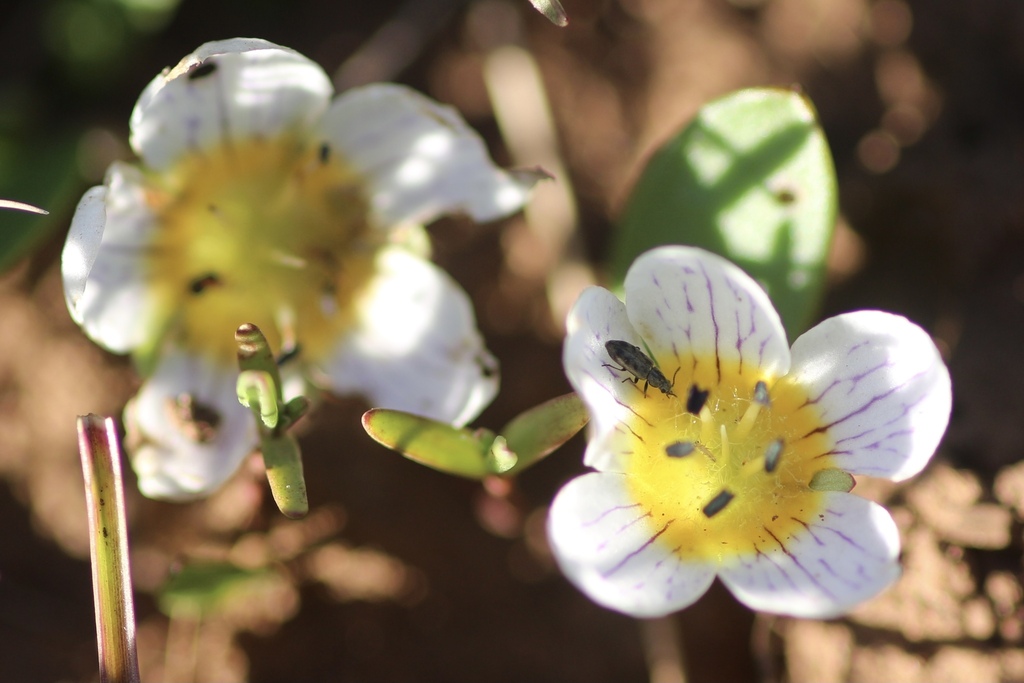
no rights reserved · CC0
Family: Hydrophyllaceae · Type: Herb · Native
Hesperochiron pumilus (Dwarf hesperochiron) is a native California herb in the Hydrophyllaceae family, recognized by key differences in flower shape (rotate vs bell), petal shape, flower number, and glandular leaf pubescence.
Dwarf hesperochiron is a California native perennial found in the Klamath Ranges, northern Coast Ranges, Cascade Range, Sierra Nevada, Tehachapi Mountains, western Transverse Ranges, Great Basin, and northern Death Valley regions in wet meadows and slopes at elevations of 400 to 3,000 meters. Flowering from April to July, this plant produces white to bluish-purple, pinkish-white, or lavender flowers with yellow throats, broadly bell-shaped and 5 to 15 millimeters long. Growing as a small, compact plant 2 to 10 centimeters tall with a diameter of 10 or more centimeters, it has a simple or branched caudex sometimes forming rhizomes. Its leaves are generally 2 to 10 in number, short-glandular hairy, with blades 1 to 8 centimeters long and 0.5 to 3 centimeters wide, ranging from linear-oblong to oblanceolate in shape. The fruit is 5 to 9 millimeters long, with individual seeds measuring 1 to 1.5 millimeters.
Identification and appearance
Key characters: 1 sympatric species; key differences in flower shape (rotate vs bell), petal shape, flower number, and glandular leaf pubescence
Habitat and range
Habitat: Wet meadows, slopes, flats
Elevation: 400-3000 m
California counties: Modoc, Plumas, Tehama, Trinity, Lassen, Fresno, Siskiyou, Madera, Mariposa, Inyo, Tulare, Calaveras, Lake, Nevada, El Dorado, Placer, Tuolumne, Shasta, Alpine, Mono
Outside California: to British Columbia, Montana, Utah, Arizona
Bloom period
Hesperochiron pumilus blooms Apr-Jul.
How to tell it apart
vs Phacelia: Hesperochiron has one flower per stalk from a basal rosette; Phacelia has many flowers in coiled clusters.; vs Montia: Hesperochiron has 5-petaled tubular flowers; Montia has tiny 2-5 petaled flowers with notched petals.; vs Eucrypta: Hesperochiron has single large flowers on individual stalks; Eucrypta has small flowers in branched clusters.; vs Emmenanthe: Hesperochiron has flowers on individual stalks from base; Emmenanthe has hanging bells on branched stems.; vs Nama: Hesperochiron has large solitary flowers on leafless stalks; Nama has small flowers along leafy stems.
Frequently asked questions
Is Hesperochiron pumilus native to California?
Yes. Hesperochiron pumilus is native to California (recorded as native).
When does Hesperochiron pumilus bloom?
Hesperochiron pumilus blooms Apr-Jul.
Where in California does Hesperochiron pumilus grow?
Hesperochiron pumilus occurs in Modoc, Plumas, Tehama, Trinity, Lassen, Fresno, Siskiyou, Madera and other counties, at elevations of 400-3000 m.
What plant family does Hesperochiron pumilus belong to?
Hesperochiron pumilus is in the Hydrophyllaceae family, genus Hesperochiron.
What habitat does Hesperochiron pumilus grow in?
Hesperochiron pumilus grows in Wet meadows, slopes, flats.
Related species
Other California species in the same genus, family, or bioregion.
Sources: Jepson eFlora · Index of California Plant Names · CalPhotos
Last updated 2026-10-07
Data from The California Species Project — 14,000+ California species with verified data from CNPS, CDFW, USFWS, Cal-IPC, and more.