Hesperocnide tenella
Western nettle
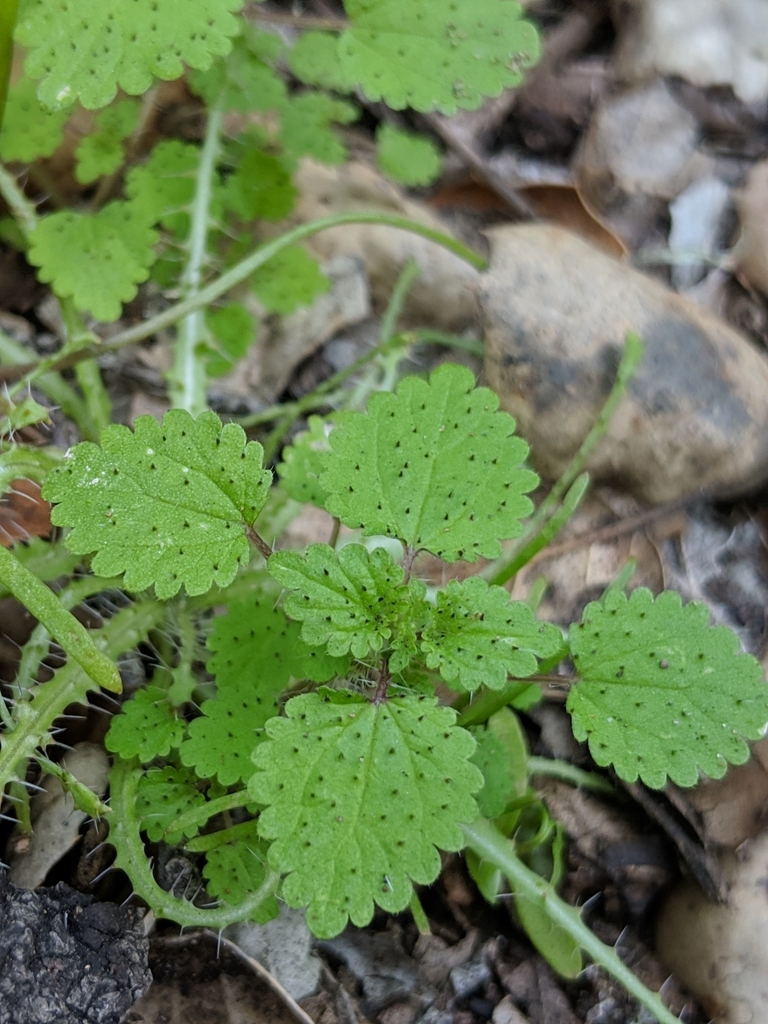
no rights reserved, uploaded by Alex Heyman · CC0
Family: Urticaceae · Type: Herb · Native
Hesperocnide tenella (Western nettle) is a native California herb in the Urticaceae family, recognized by Monotypic genus representing a non-stinging lineage in the nettle family, endemic to southern California and Baja California.
Western nettle is a California native annual found in coastal and southwestern bioregions including northern coastal and Sierra Nevada foothills, inhabiting moist, shaded areas in chaparral, coastal scrub, and riparian woodlands at elevations below 1,200 meters. Flowering from February to June, this delicate plant produces small, inconspicuous flowers in spheric clusters. Growing with slender stems up to 50 centimeters tall, it forms a delicate, wispy habit in sheltered woodland environments. Its thin, ovate leaves measure 4 to 40 millimeters long with blunt serrated edges, often positioned at the base of rocks or shrubs. The small stipules and slender leaf stalks contribute to its subtle, understated botanical character.
Identification and appearance
Key characters: Monotypic genus representing a non-stinging lineage in the nettle family, endemic to southern California and Baja California
Habitat and range
Habitat: Moist, shaded areas, often at base of rocks or shrubs, in chaparral, coastal scrub, riparian woodland, mesic oak woodland
Elevation: < 1200 m
California counties: San Diego, Los Angeles, San Bernardino, Madera, Santa Barbara, Fresno, San Francisco, Riverside, Orange, Monterey, Ventura, San Mateo, Alameda, San Benito, Santa Cruz, Santa Clara, San Luis Obispo, Contra Costa, Kern, Marin, Amador, Calaveras, Mariposa, Nevada, Placer, Sonoma, Stanislaus, Tehama, Tulare, Tuolumne, Butte, Sutter, Colusa, Lake
Outside California: northern Baja California
Bloom period
Hesperocnide tenella blooms Feb-Jun.
How to tell it apart
vs Urtica: Hesperocnide is a small annual with fused sepals; Urtica is typically perennial with separate sepals.; vs Stachys: Hesperocnide stings; Stachys is safe to touch and has square stems.; vs Scrophularia: Hesperocnide has stinging hairs; Scrophularia is completely safe to handle.; vs Rubus: Hesperocnide is a delicate annual herb; Rubus has woody stems with thorns.; vs Marrubium: Hesperocnide stings and has nettle flowers; Marrubium is fuzzy-safe with whorled mint flowers.
Frequently asked questions
Is Hesperocnide tenella native to California?
Yes. Hesperocnide tenella is native to California (recorded as native).
When does Hesperocnide tenella bloom?
Hesperocnide tenella blooms Feb-Jun.
Where in California does Hesperocnide tenella grow?
Hesperocnide tenella occurs in San Diego, Los Angeles, San Bernardino, Madera, Santa Barbara, Fresno, San Francisco, Riverside and other counties, at elevations of < 1200 m.
What plant family does Hesperocnide tenella belong to?
Hesperocnide tenella is in the Urticaceae family, genus Hesperocnide.
What habitat does Hesperocnide tenella grow in?
Hesperocnide tenella grows in Moist, shaded areas, often at base of rocks or shrubs, in chaparral, coastal scrub, riparian woodland, mesic oak woodland.
Related species
Other California species in the same genus, family, or bioregion.
Sources: Jepson eFlora · Index of California Plant Names · CalPhotos
Last updated 2026-10-07
Data from The California Species Project — 14,000+ California species with verified data from CNPS, CDFW, USFWS, Cal-IPC, and more.