Hesperolinon disjunctum
Coast range dwarf flax
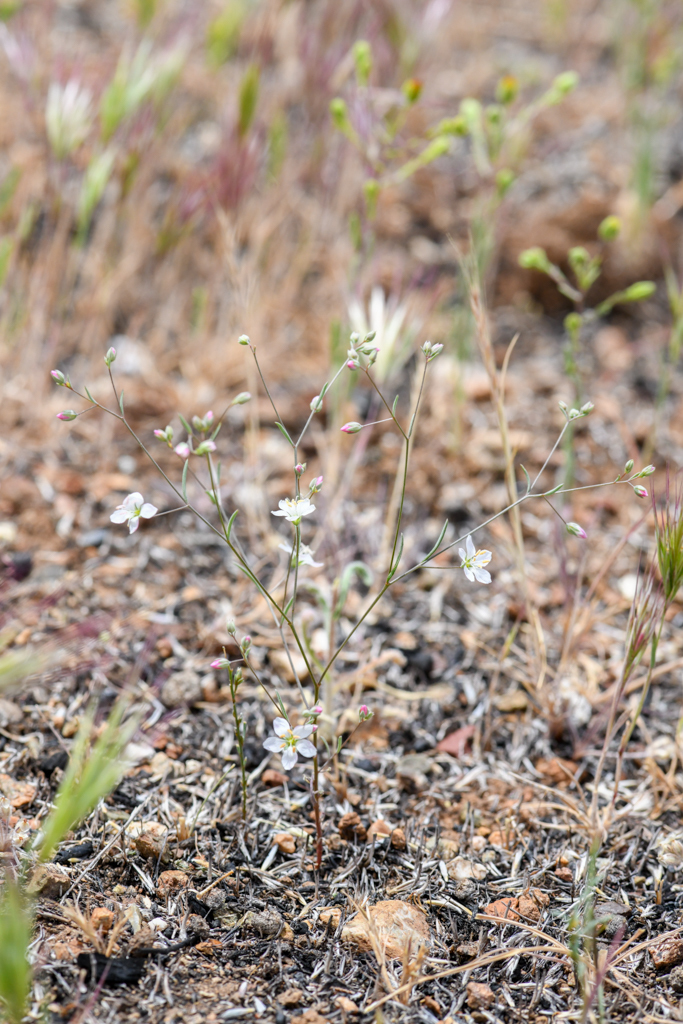
(c) Trevor Van Loon, some rights reserved (CC BY) · licence
Family: Linaceae · Type: Herb · Native
Hesperolinon disjunctum (Coast range dwarf flax) is a native California herb in the Linaceae family, recognized by stout habit and pink-margined white anthers.
Coast range dwarf flax is a California native annual found in northern coastal ranges, eastern San Francisco Bay Area, and southern coastal ranges in openings within chaparral and serpentine habitats at elevations of 100 to 1,000 meters. Flowering from April to July, this plant produces white flowers with pink veins and rose-colored anthers approximately 3 to 6 millimeters long. Growing as a compact plant 3 to 30 centimeters tall with stout stems, it displays delicate linear alternate leaves with minute stipule glands. Its leaves are distinctive, growing in slender alternate arrangement with small glandular features. The plant's flower structure is particularly notable, with white petals marked by pink veins and rose-tinted anthers creating a subtle, elegant appearance.
Identification and appearance
Key characters: 8 sympatric species; distinguished by stout habit and pink-margined white anthers
Habitat and range
Habitat: Openings in chaparral, serpentine, vertic clay
Elevation: 100-1000 m
California counties: Lake, Tehama, Colusa, Napa, Stanislaus, Glenn, San Benito, Butte, Fresno, Solano, Monterey, Alameda, San Mateo, Yolo, Santa Clara
Bloom period
Hesperolinon disjunctum blooms Apr-Jul.
How to tell it apart
vs Linum: Hesperolinon has 2-3 styles and whorled basal leaves; Linum has 5 styles and alternate leaves.; vs Gayophytum: Hesperolinon has whorled leaves and 2-3 styles; Gayophytum has alternate leaves and 4-parted flowers.; vs Eremogone: Hesperolinon has 2-3 styles; Eremogone has 3 styles and opposite leaves throughout.; vs Nemacladus: Hesperolinon has regular radial flowers; Nemacladus has strongly bilateral flowers.; vs Sclerolinon: Hesperolinon has 3 styles and stipule glands present; Sclerolinon has 2 club-shaped styles and no glands.
Frequently asked questions
Is Hesperolinon disjunctum native to California?
Yes. Hesperolinon disjunctum is native to California (recorded as native).
When does Hesperolinon disjunctum bloom?
Hesperolinon disjunctum blooms Apr-Jul.
Where in California does Hesperolinon disjunctum grow?
Hesperolinon disjunctum occurs in Lake, Tehama, Colusa, Napa, Stanislaus, Glenn, San Benito, Butte and other counties, at elevations of 100-1000 m.
What plant family does Hesperolinon disjunctum belong to?
Hesperolinon disjunctum is in the Linaceae family, genus Hesperolinon.
What habitat does Hesperolinon disjunctum grow in?
Hesperolinon disjunctum grows in Openings in chaparral, serpentine, vertic clay.
Related species
Other California species in the same genus, family, or bioregion.
Sources: Jepson eFlora · Index of California Plant Names · CalPhotos
Last updated 2026-10-07
Data from The California Species Project — 14,000+ California species with verified data from CNPS, CDFW, USFWS, Cal-IPC, and more.