Heterotheca sessiliflora subsp. echioides
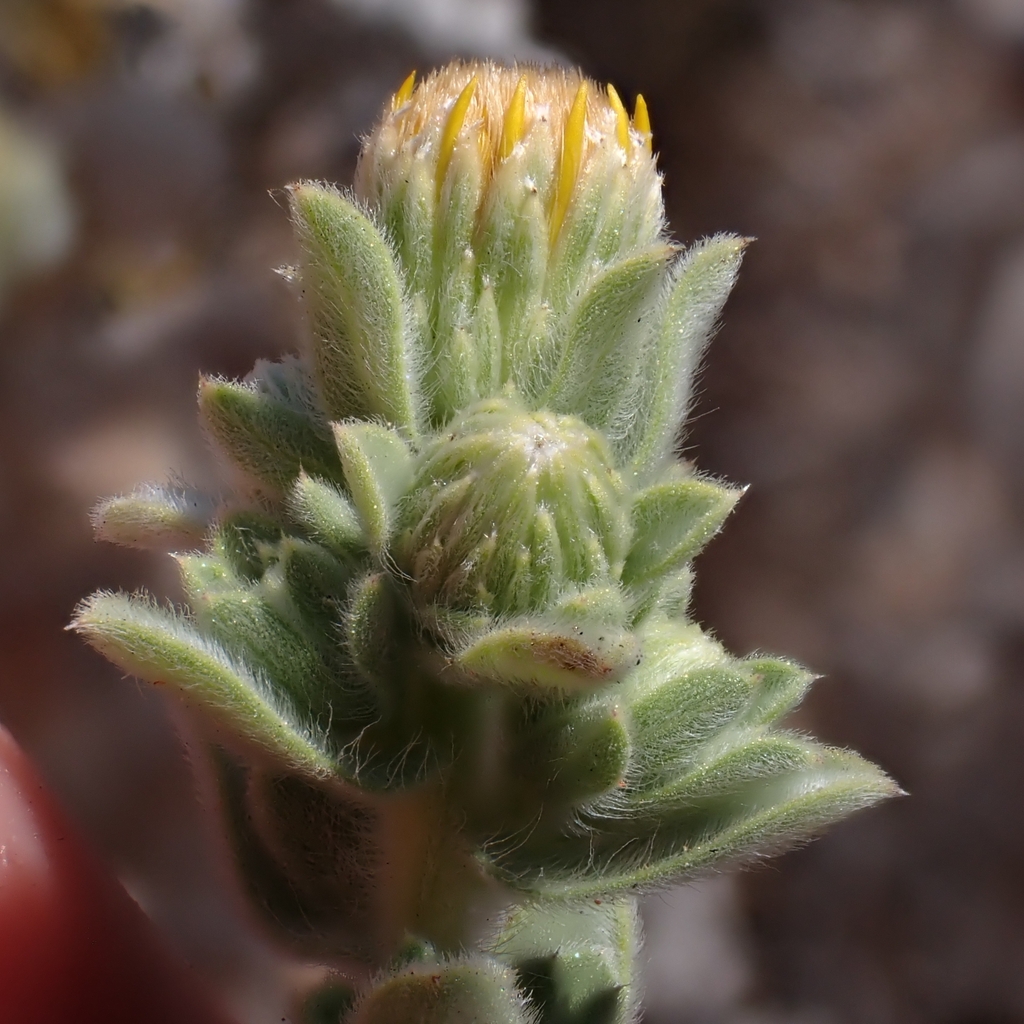
no rights reserved · CC0
Family: Asteraceae · Type: Herb · Native
Heterotheca sessiliflora subsp. echioides is a native California herb in the Asteraceae family, recognized by bristly base, stiff gray-green leaves, and many heads without bracts.
Heterotheca sessiliflora subspecies echioides is a California native perennial found in central Sierra Nevada foothills, Tehama County, San Joaquin Valley, central western California, southern California coastal areas, Transverse Ranges, and Peninsular Ranges in grassland, scrub, woodland, and open forest habitats at elevations to 2,100 meters. Flowering from July to October, this plant produces yellow flowers in numerous heads across tall plant structures. Growing with bristly stems 30 to 60 centimeters tall, it develops a stiff, gray-green appearance with distinctively rough texture. Its leaves are elliptic to lanceolate, flat or slightly wavy, covered in strigose hairs approximately 2 millimeters long, with distal leaves progressively smaller and stiffer. The plant's robust bristly character and dense hair coverage make it particularly distinctive in open grassland and scrub environments.
Identification and appearance
Key characters: 12 sympatric species; distinguished by bristly base, stiff gray-green leaves, and many heads without bracts
Habitat and range
Habitat: Grassland, scrub, woodland, open forest, disturbed sites
Elevation: < 2100 m
California counties: Kern, Riverside, Alameda, Contra Costa, Los Angeles, Marin, Monterey, Orange, San Benito, San Bernardino, San Diego, San Luis Obispo, San Mateo, Santa Barbara, Santa Clara, Santa Cruz, Sonoma, Tulare, Ventura, Fresno, Merced, Solano, Stanislaus, San Francisco, Madera, Napa
Bloom period
Heterotheca sessiliflora subsp. echioides blooms Jul-Oct.
How to tell it apart
vs Grindelia: Heterotheca has multi-layered bracts; Grindelia bracts curve backward and flower buds are sticky-resinous.; vs Isocoma: Heterotheca has conspicuous yellow ray petals; Isocoma has only disk flowers (no rays).; vs Erigeron: Heterotheca rays are yellow and 3-12mm; Erigeron rays are white/purple/pink and typically numerous.; vs Laennecia: Heterotheca has showy 3-12mm yellow rays; Laennecia has tiny inconspicuous white rays.; vs Verbascum: Heterotheca has composite flower heads with bracts; Verbascum has simple 5-petaled flowers on tall spikes.
Frequently asked questions
Is Heterotheca sessiliflora subsp. echioides native to California?
Yes. Heterotheca sessiliflora subsp. echioides is native to California (recorded as native).
When does Heterotheca sessiliflora subsp. echioides bloom?
Heterotheca sessiliflora subsp. echioides blooms Jul-Oct.
Where in California does Heterotheca sessiliflora subsp. echioides grow?
Heterotheca sessiliflora subsp. echioides occurs in Kern, Riverside, Alameda, Contra Costa, Los Angeles, Marin, Monterey, Orange and other counties, at elevations of < 2100 m.
What plant family does Heterotheca sessiliflora subsp. echioides belong to?
Heterotheca sessiliflora subsp. echioides is in the Asteraceae family, genus Heterotheca.
What habitat does Heterotheca sessiliflora subsp. echioides grow in?
Heterotheca sessiliflora subsp. echioides grows in Grassland, scrub, woodland, open forest, disturbed sites.
Related species
Other California species in the same genus, family, or bioregion.
Sources: Jepson eFlora · Index of California Plant Names · CalPhotos
Last updated 2026-10-07
Data from The California Species Project — 14,000+ California species with verified data from CNPS, CDFW, USFWS, Cal-IPC, and more.