Heterotheca subaxillaris subsp. latifolia
Camphor-weed, Camphor-Weed
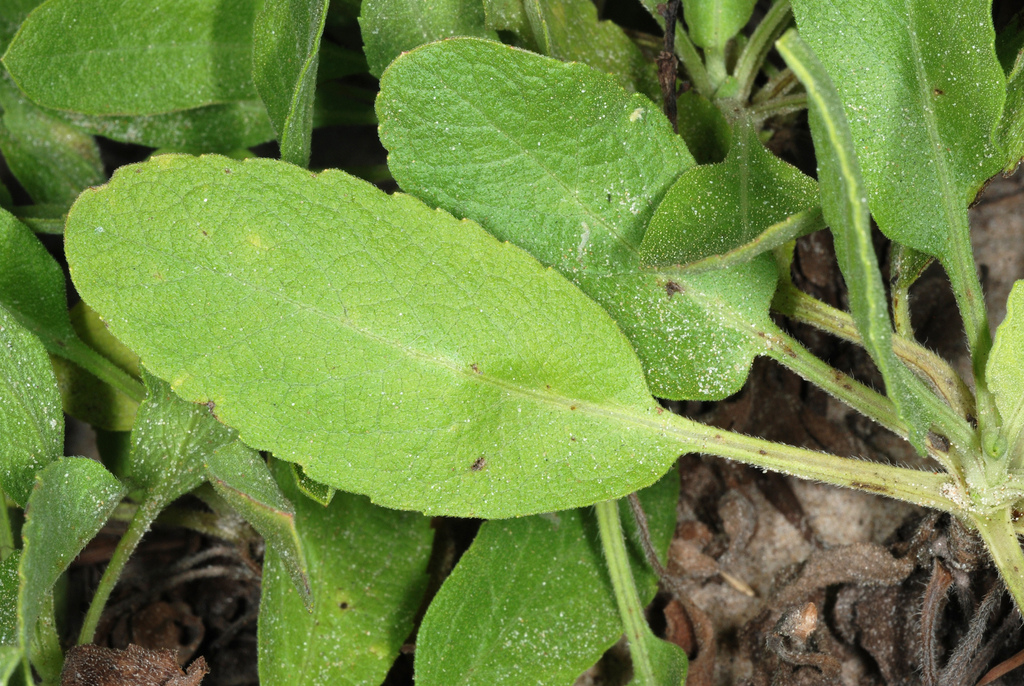
(c) Douglas Goldman, some rights reserved (CC BY-SA), uploaded by Douglas Goldman · licence
Family: Asteraceae · Type: Annual · Native
Heterotheca subaxillaris subsp. latifolia (Camphor-weed) is a native California annual in the Asteraceae family, recognized by annual habit, ear-like leaf lobes, ovate upper leaves, and ray pappus absence.
Camphor-weed is a California native annual found in the southern California coast, eastern San Diego, and Tehachapi bioregions in disturbed sandy soils and roadsides at elevations below 1,150 meters. Flowering from August to October, this plant produces yellow flowers in flat-topped or panicle-like clusters with ray flowers 4 to 10 millimeters long. Growing 30 to 150 centimeters tall with ascending to erect stems that become much-branched in large plants, it has a bristly and glandular appearance, especially toward the top of the plant. Its leaves vary from basal rosettes with wing-petioled bases to mid-stem leaves that are ovate and clasping, with some leaves having tooth-like edges while others remain entire. The fruits are small, with ray fruits nearly smooth and disk fruits densely hairy, bearing inner pappus 6 to 9 millimeters long.
Identification and appearance
Key characters: 6 sympatric species; distinguished by annual habit, ear-like leaf lobes, ovate upper leaves, and ray pappus absence
Habitat and range
Habitat: Uncommon. Disturbed sandy soils, roadsides
Elevation: < 1150 m
Outside California: southern United States, northern Mexico
Bloom period
Heterotheca subaxillaris subsp. latifolia blooms Aug-Oct.
How to tell it apart
vs Grindelia: Heterotheca has multi-layered bracts; Grindelia bracts curve backward and flower buds are sticky-resinous.; vs Isocoma: Heterotheca has conspicuous yellow ray petals; Isocoma has only disk flowers (no rays).; vs Erigeron: Heterotheca rays are yellow and 3-12mm; Erigeron rays are white/purple/pink and typically numerous.; vs Laennecia: Heterotheca has showy 3-12mm yellow rays; Laennecia has tiny inconspicuous white rays.; vs Verbascum: Heterotheca has composite flower heads with bracts; Verbascum has simple 5-petaled flowers on tall spikes.
Frequently asked questions
Is Heterotheca subaxillaris subsp. latifolia native to California?
Yes. Heterotheca subaxillaris subsp. latifolia is native to California (recorded as native).
When does Heterotheca subaxillaris subsp. latifolia bloom?
Heterotheca subaxillaris subsp. latifolia blooms Aug-Oct.
What plant family does Heterotheca subaxillaris subsp. latifolia belong to?
Heterotheca subaxillaris subsp. latifolia is in the Asteraceae family, genus Heterotheca.
What habitat does Heterotheca subaxillaris subsp. latifolia grow in?
Heterotheca subaxillaris subsp. latifolia grows in Uncommon. Disturbed sandy soils, roadsides.
Related species
Other California species in the same genus, family, or bioregion.
- Heterotheca villosa — Hairy goldenaster
- Heterotheca villosa var. minor — Hairy false goldenaster
- Heterotheca villosa var. scabra — Hairy false goldenaster
- Heterotheca grandiflora — Telegraph weed
- Heterotheca monarchensis — Monarch goldenaster
- Heterotheca oregona — Rayless goldenaster
- Hieracium albiflorum — White hawkweed
Sources: Jepson eFlora · CalPhotos
Last updated 2026-09-30
Data from The California Species Project — 14,000+ California species with verified data from CNPS, CDFW, USFWS, Cal-IPC, and more.