Hibiscus lasiocarpos var. occidentalis
Woolly rose-mallow
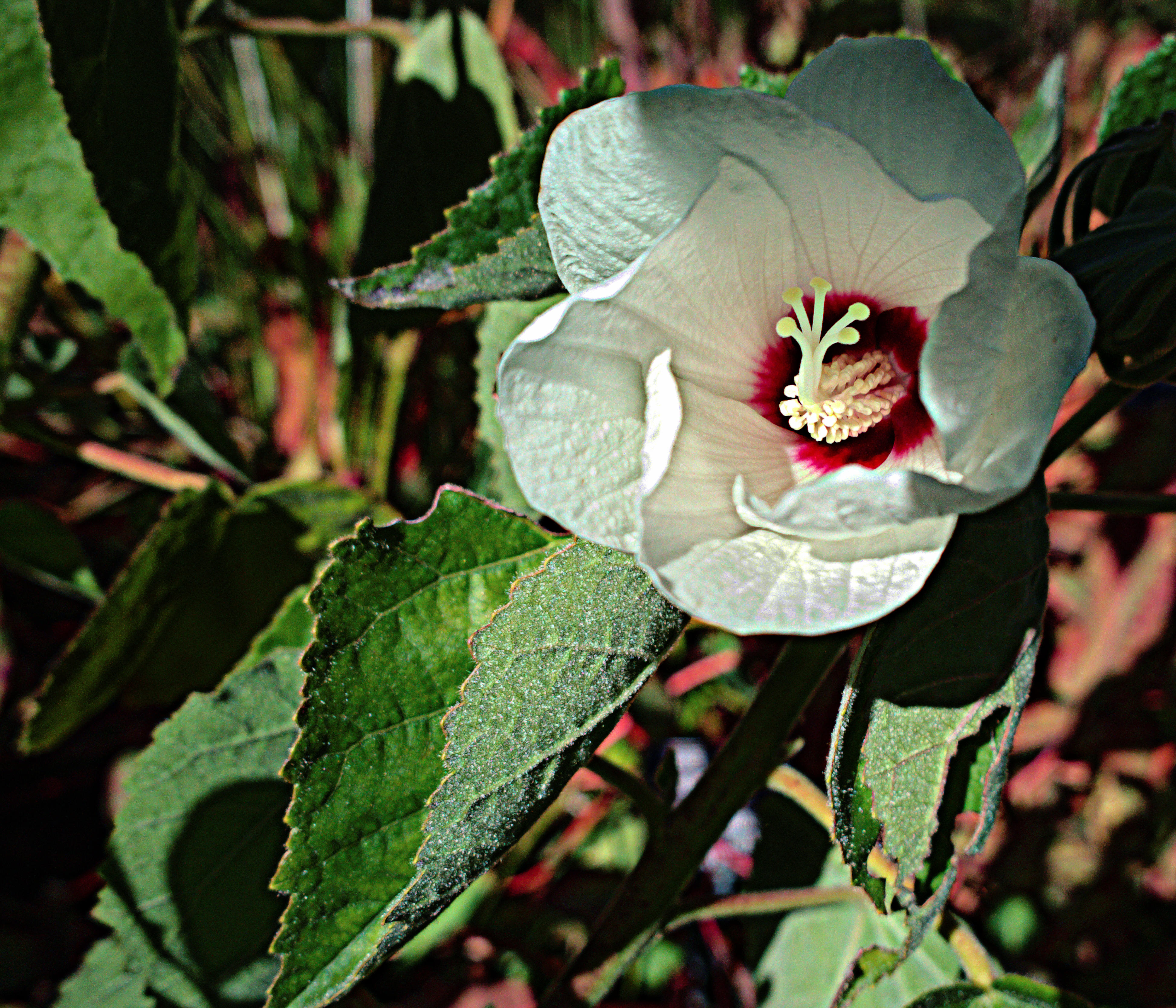
John Rusk from Berkeley, CA, United States of America (via Wikimedia Commons) · CC BY
Family: Malvaceae · Type: Perennial · Native
Conservation status: CNPS 1B.2
Hibiscus lasiocarpos var. occidentalis (Woolly rose-mallow) is a native California perennial in the Malvaceae family, recognized by size, habitat, and flower characteristics.
Woolly rose-mallow is a rare (CNPS 1B.2) California native perennial found in the Central Valley deltaic region, northern Sierra Nevada foothills, and Sacramento Valley in freshwater wetlands and marshy areas at elevations below 100 meters. Flowering from July to November, this plant produces large white flowers with a rose-red center, 6 to 10 centimeters wide, blooming individually in leaf axils. Growing with multiple stems from 1 to 2 meters tall, ranging from prostrate to erect and covered in dense stellate hairs, it forms a subshrub with rhizomatous growth. Its heart-shaped leaves are 6 to 10 centimeters long, shallowly 3 to 5-lobed, with dense stellate hairs on both surfaces and prominently toothed edges. The fruit is a hairy, nearly spherical capsule 2.5 to 3 centimeters long that completely fills the bell-shaped calyx.
Identification and appearance
Key characters: 1 sympatric species - distinguished by size, habitat, and flower characteristics
Habitat and range
Habitat: Freshwater wetlands, wet banks, marshes
Elevation: < 100 m
California counties: Colusa, Contra Costa, Riverside, San Joaquin, Solano, Butte, Sutter, Glenn, Yolo, Sacramento
Bloom period
Hibiscus lasiocarpos var. occidentalis blooms Jul-Nov.
Conservation status
CNPS 1B.2
How to tell it apart
vs Malva: Hibiscus has 5-12 bracts and 5-branched style; Malva has 3 bracts and numerous style branches (as many as fruit segments).; vs Rosa: Hibiscus has a central column of fused stamens and 5-branched style; Rosa has separate stamens radiating from center.; vs Rhododendron: Hibiscus has fused stamens forming a central tube; Rhododendron has 5-10 separate stamens and woody stems.; vs Alyogyne: Hibiscus has bracts separate to base; Alyogyne bracts are fused into a cup around the flower base.; vs Pandorea: Hibiscus has a column of fused stamens; Pandorea is a woody vine with tubular flowers and paired opposite leaves.
Frequently asked questions
Is Hibiscus lasiocarpos var. occidentalis native to California?
Yes. Hibiscus lasiocarpos var. occidentalis is native to California (recorded as native).
When does Hibiscus lasiocarpos var. occidentalis bloom?
Hibiscus lasiocarpos var. occidentalis blooms Jul-Nov.
Where in California does Hibiscus lasiocarpos var. occidentalis grow?
Hibiscus lasiocarpos var. occidentalis occurs in Colusa, Contra Costa, Riverside, San Joaquin, Solano, Butte, Sutter, Glenn and other counties, at elevations of < 100 m.
What plant family does Hibiscus lasiocarpos var. occidentalis belong to?
Hibiscus lasiocarpos var. occidentalis is in the Malvaceae family, genus Hibiscus.
Is Hibiscus lasiocarpos var. occidentalis rare or endangered?
Hibiscus lasiocarpos var. occidentalis carries California Rare Plant Rank 1B.2, state rank S3.
Related species
Other California species in the same genus, family, or bioregion.
Sources: Jepson eFlora · CNPS Rare Plant Inventory · Index of California Plant Names · CalPhotos · CDFW CNDDB
Last updated 2026-10-06
Data from The California Species Project — 14,000+ California species with verified data from CNPS, CDFW, USFWS, Cal-IPC, and more.