Hippuris vulgaris
Common mare's tail
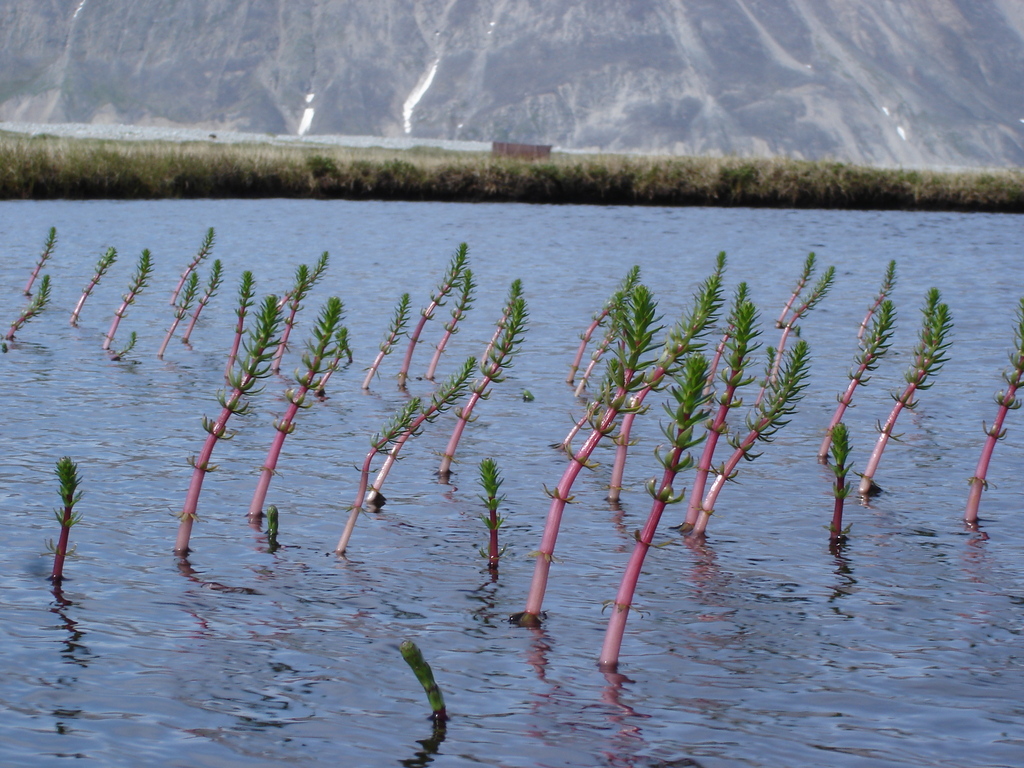
no rights reserved · CC0
Family: Plantaginaceae · Type: Herb · Native
Hippuris vulgaris (Common mare's tail) is a native California herb in the Plantaginaceae family, recognized by Circumboreal species representing an ancient lineage, now classified in the plantain family but morphologically distinct from all other….
Common mare's tail is a native perennial found in northwestern California, the high Cascade Range, Sierra Nevada, San Francisco Bay Area, Sierra Border, San Jacinto Mountains, and Modoc Plateau in marshy springs, shallow pond margins, and wet disturbed areas at elevations up to 2,700 meters. Flowering from May to August, this plant produces small white flowers along slender green stems that emerge partially from water. Growing 30 to 60 centimeters tall with an aquatic growth habit, it has distinctive whorled leaves arranged in tight circular clusters around the stem. Its leaves are relatively short, measuring 1 to 3.5 centimeters long, and densely clustered along the stem's length. This distinctive water-dwelling plant adapts well to wet, marshy environments, emerging partially above water surfaces with its characteristic linear stems and tightly arranged leaf whorls.
Identification and appearance
Key characters: Circumboreal species representing an ancient lineage, now classified in the plantain family but morphologically distinct from all other members
Habitat and range
Habitat: Margins of shallow ponds, springs, marshy, swampy, or wet disturbed areas
Elevation: < 2700 m
California counties: Del Norte, Plumas, Humboldt, Fresno, Tuolumne, El Dorado, San Mateo, Riverside, Colusa, Mono, Modoc, Mendocino, Sierra, Sonoma, San Bernardino, Tulare, Shasta, Alpine, Lassen, Siskiyou, San Joaquin, Placer, Madera, Inyo
Outside California: Arizona, New Mexico, southern South America, much of northern hemisphere
Bloom period
Hippuris vulgaris blooms May-Aug.
How to tell it apart
vs Equisetum: Equisetum has jointed hollow stems with toothed sheaths; Hippuris has solid stems with individual needle leaves.; vs Myriophyllum: Myriophyllum has feathery, divided leaves; Hippuris has entire, undivided needle-like leaves.; vs Spinulum: Spinulum has finely divided fronds; Hippuris has simple, entire leaves in whorls.; vs Nephrolepis: Nephrolepis is a fern with divided fronds; Hippuris has simple leaves in whorls around aquatic stems.; vs Bacopa: Bacopa has opposite leaves in pairs; Hippuris has 6-12 leaves per whorl in bottlebrush pattern.
Frequently asked questions
Is Hippuris vulgaris native to California?
Yes. Hippuris vulgaris is native to California (recorded as native).
When does Hippuris vulgaris bloom?
Hippuris vulgaris blooms May-Aug.
Where in California does Hippuris vulgaris grow?
Hippuris vulgaris occurs in Del Norte, Plumas, Humboldt, Fresno, Tuolumne, El Dorado, San Mateo, Riverside and other counties, at elevations of < 2700 m.
What plant family does Hippuris vulgaris belong to?
Hippuris vulgaris is in the Plantaginaceae family, genus Hippuris.
What habitat does Hippuris vulgaris grow in?
Hippuris vulgaris grows in Margins of shallow ponds, springs, marshy, swampy, or wet disturbed areas.
Related species
Other California species in the same genus, family, or bioregion.
Sources: Jepson eFlora · Index of California Plant Names · CalPhotos
Last updated 2026-10-07
Data from The California Species Project — 14,000+ California species with verified data from CNPS, CDFW, USFWS, Cal-IPC, and more.