Hoita orbicularis
Creeping leather root
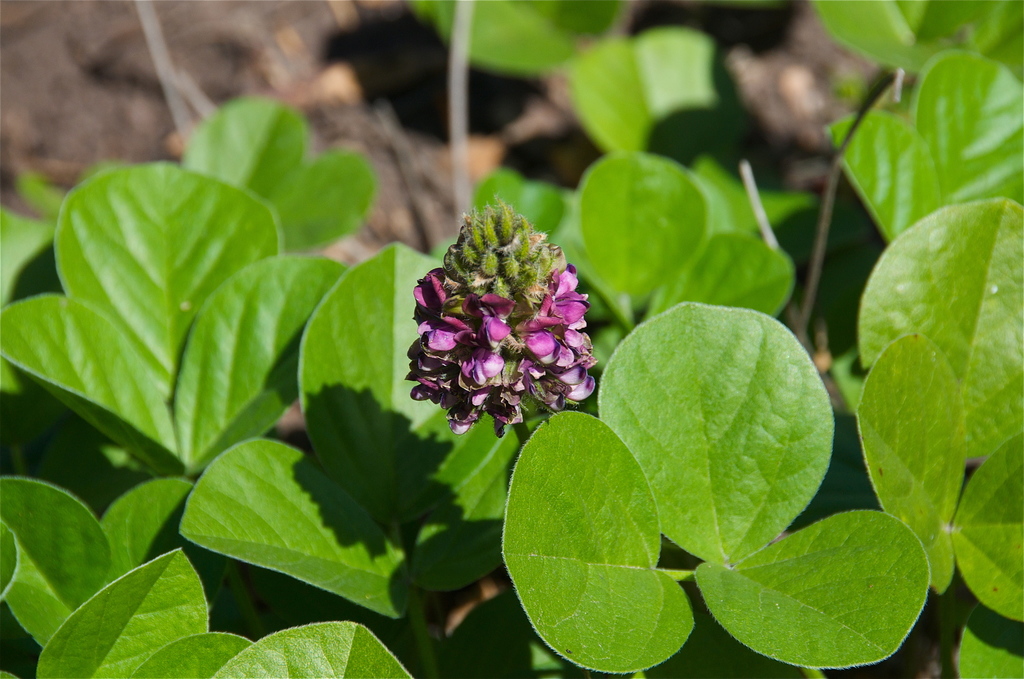
(c) Jerry Kirkhart, some rights reserved (CC BY) · licence
Family: Fabaceae · Type: Herb · Native
Hoita orbicularis (Creeping leather root) is a native California herb in the Fabaceae family, recognized by prostrate habit, long petioles, and largest flowers.
Creeping leather root is a California native perennial found in the California Floristic Province (except the Great Valley) in meadows, streamsides, and moist hillsides at elevations below 2,250 meters. Flowering from April to August, this plant produces brown-glandular flowers 12 to 23 millimeters long with distinctive obovate to round leaflets. Growing with prostrate to decumbent stems 10 to 60 centimeters long, it spreads across the ground with a distinctive creeping habit. Its leaves feature 3 to 11 centimeter leaflets that are obovate to round, covered in brown glandular hairs on both surfaces. The fruit is 6 to 9 millimeters long with obvious veins, bearing seeds 4 to 5 millimeters in size.
Identification and appearance
Key characters: 2 sympatric species; distinguished by prostrate habit, long petioles, and largest flowers
Habitat and range
Habitat: Meadows, streamsides, moist hillsides
Elevation: < 2250 m
California counties: Butte, San Bernardino, Riverside, Santa Barbara, Los Angeles, Ventura, San Diego, San Benito, San Luis Obispo, Tulare, Sonoma, San Francisco, San Mateo, Santa Cruz, Amador, Marin, Calaveras, Monterey, Nevada, Yuba, Mariposa, Napa, El Dorado, Contra Costa, Madera, Fresno, Shasta, Tuolumne, Santa Clara, Alameda, Orange, Placer
Outside California: Baja California
Bloom period
Hoita orbicularis blooms Apr-Aug.
How to tell it apart
vs Rupertia: Hoita flowers are blue-purple; Rupertia flowers are cream to yellow.; vs Salvia: Hoita has pea-shaped flowers and compound leaves; Salvia has tubular two-lipped flowers and simple or pinnate leaves.; vs Pueraria: Hoita has glandular dots and grows as erect perennial; kudzu (Pueraria) is a massive climbing vine without glands.; vs Bituminaria: Hoita has separate bracts at flower nodes; Bituminaria has distinctive fan-shaped united bracts.; vs Acmispon: Hoita has flowers in elongated spikes; Acmispon has flowers in umbrella-like umbels.
Frequently asked questions
Is Hoita orbicularis native to California?
Yes. Hoita orbicularis is native to California (recorded as native).
When does Hoita orbicularis bloom?
Hoita orbicularis blooms Apr-Aug.
Where in California does Hoita orbicularis grow?
Hoita orbicularis occurs in Butte, San Bernardino, Riverside, Santa Barbara, Los Angeles, Ventura, San Diego, San Benito and other counties, at elevations of < 2250 m.
What plant family does Hoita orbicularis belong to?
Hoita orbicularis is in the Fabaceae family, genus Hoita.
What habitat does Hoita orbicularis grow in?
Hoita orbicularis grows in Meadows, streamsides, moist hillsides.
Related species
Other California species in the same genus, family, or bioregion.
Sources: Jepson eFlora · Index of California Plant Names · CalPhotos
Last updated 2026-10-07
Data from The California Species Project — 14,000+ California species with verified data from CNPS, CDFW, USFWS, Cal-IPC, and more.