Holocarpha macradenia
Santa cruz tarplant, Santa Cruz Tarplant
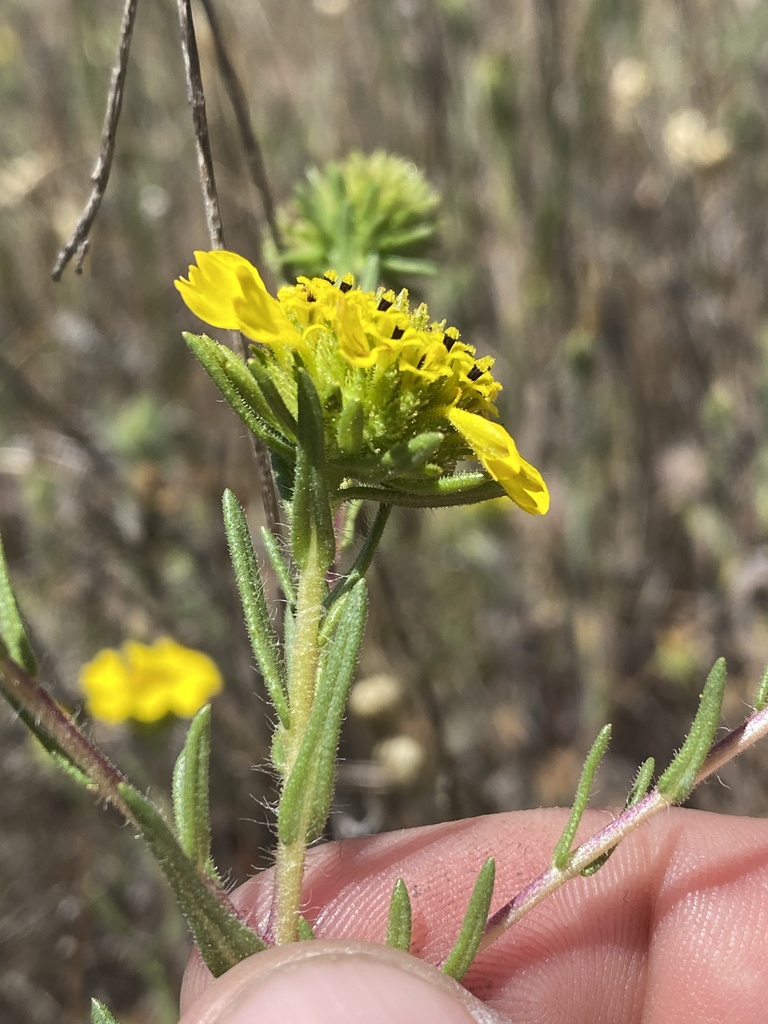
no rights reserved · CC0
Family: Asteraceae · Type: Herb · Native
Conservation status: CNPS 1B.1 · Threatened
Holocarpha macradenia (Santa cruz tarplant) is a native California herb in the Asteraceae family, recognized by distinctive red to dark purple anthers and spherical flower heads.
Santa cruz tarplant is a rare (CNPS 1B.1) California native annual found in central coastal Monterey Bay and southwestern San Francisco Bay regions in grassy areas with clay soil at elevations below 200 meters. Flowering from June to November, this plant produces yellow flowers with 8 to 16 ray flowers and 40 to 90 disk flowers with distinctive red to dark purple anthers. Growing 10 to 50 centimeters tall with notably stalked-glandular stems that form tight or spike-like clusters of flower heads, it has a distinctive glandular appearance. Its leaves are arranged along the stem, contributing to the plant's delicate and intricate structure. The flower heads are nearly spherical, with phyllaries featuring approximately 25 pit-gland-tipped outgrowths that give the plant a unique textural quality.
Identification and appearance
Key characters: Geographically isolated; distinctive red to dark purple anthers and spherical flower heads
Habitat and range
Habitat: Grassy areas, clay soil
Elevation: < 200 m
Bloom period
Holocarpha macradenia blooms Jun-Nov.
Conservation status
CNPS 1B.1 · Threatened
How to tell it apart
vs Deinandra: Holocarpha has pit-gland-tipped stalk bracts; Deinandra stalk bracts lack pit glands.; vs Madia: Holocarpha has pit glands on stalk bracts; Madia lacks these distinctive pit glands.; vs Hemizonia: Holocarpha has pit-gland-tipped stalk bracts; Hemizonia stalk bracts lack pit glands.; vs Heterotheca: Holocarpha has yellow rays and pit-gland bracts; Heterotheca lacks pit glands, different flower structure.; vs Centromadia: Holocarpha has pit-gland-tipped stalk bracts; Centromadia lacks pit glands on bracts.
Frequently asked questions
Is Holocarpha macradenia native to California?
Yes. Holocarpha macradenia is native to California (recorded as native).
When does Holocarpha macradenia bloom?
Holocarpha macradenia blooms Jun-Nov.
What plant family does Holocarpha macradenia belong to?
Holocarpha macradenia is in the Asteraceae family, genus Holocarpha.
Is Holocarpha macradenia rare or endangered?
Holocarpha macradenia carries California Rare Plant Rank 1B.1, state rank S1.
What habitat does Holocarpha macradenia grow in?
Holocarpha macradenia grows in Grassy areas, clay soil.
Related species
Other California species in the same genus, family, or bioregion.
Sources: Jepson eFlora · CNPS Rare Plant Inventory · Index of California Plant Names · CalPhotos · CDFW CNDDB
Last updated 2026-10-07
Data from The California Species Project — 14,000+ California species with verified data from CNPS, CDFW, USFWS, Cal-IPC, and more.