Holodiscus discolor var. glabrescens
Rock spiraea
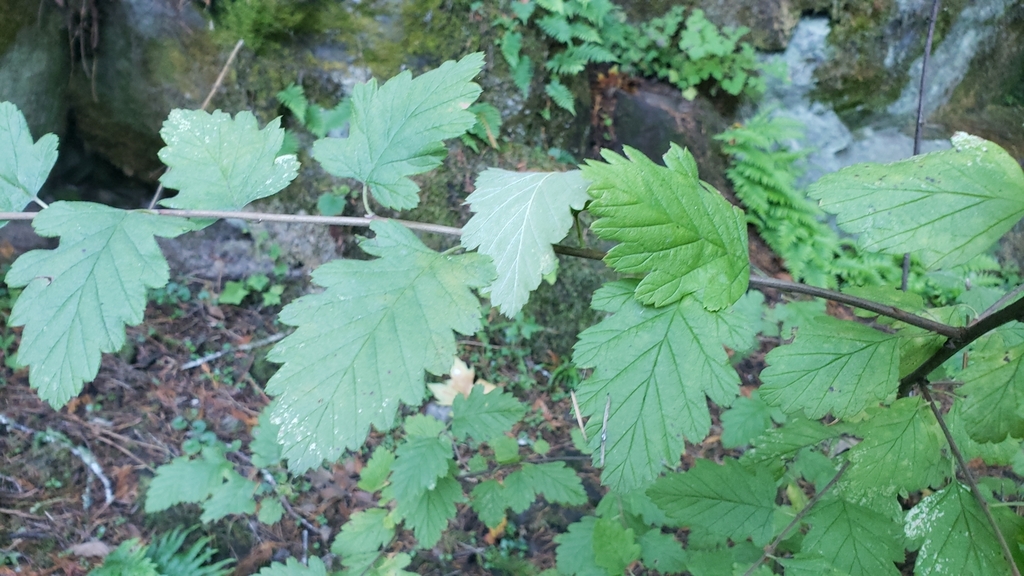
Photo: parent species Holodiscus discolor · (c) Gavin Slater, some rights reserved (CC BY) · licence
Family: Rosaceae · Type: Shrub · Native
Holodiscus discolor var. glabrescens (Rock spiraea) is a native California shrub in the Rosaceae family, recognized by 3 sympatric varieties; distinguished by small size, rocky habitat, and nearly hairless leaves.
Rock spiraea is a California native shrub found in the high Cascade Range, northern Coast Ranges, and Mendocino County in rocky places and outcrops at elevations of 600 to 3,020 meters. Flowering from June to August, this plant produces small white flowers in dense clusters 2 to 8 centimeters long. Growing 0.3 to 1 meter tall with a dense, compact form, it has twigs that are glabrous to slightly hairy. Its leaves are round to obovate, 0.3 to 3 centimeters long, with wedge-shaped bases and entire teeth near the leaf tip, and slightly visible veins on both surfaces. The plant's delicate branching and small leaves give it a fine-textured, compact appearance in rocky mountain habitats.
Identification and appearance
Key characters: 3 sympatric varieties; distinguished by small size, rocky habitat, and nearly hairless leaves
Habitat and range
Habitat: Rocky places, outcrops
Elevation: 600-3020 m
Outside California: to Oregon, Utah
Bloom period
Holodiscus discolor var. glabrescens blooms Jun-Aug.
How to tell it apart
vs Cercocarpus: Holodiscus has large foamy flower panicles with tiny petals; Cercocarpus has inconspicuous flowers with no petals.; vs Ribes: Holodiscus has pyramidal flower clusters; currants have drooping or upright racemes with distinctive tubular flowers.; vs Ceanothus: Holodiscus has pyramidal panicles of saucer-shaped flowers; Ceanothus has rounded clusters of tiny cupped flowers.; vs Rubus: Holodiscus has tiny flowers in foam-like masses; Rubus has larger individual flowers with prominent petals.; vs Corylus: Holodiscus has showy white flower panicles; hazelnut has inconspicuous catkins and large nuts.
Frequently asked questions
Is Holodiscus discolor var. glabrescens native to California?
Yes. Holodiscus discolor var. glabrescens is native to California (recorded as native).
When does Holodiscus discolor var. glabrescens bloom?
Holodiscus discolor var. glabrescens blooms Jun-Aug.
What plant family does Holodiscus discolor var. glabrescens belong to?
Holodiscus discolor var. glabrescens is in the Rosaceae family, genus Holodiscus.
What habitat does Holodiscus discolor var. glabrescens grow in?
Holodiscus discolor var. glabrescens grows in Rocky places, outcrops.
Related species
Other California species in the same genus, family, or bioregion.
Sources: Jepson eFlora · Index of California Plant Names · CalPhotos
Last updated 2026-10-06
Data from The California Species Project — 14,000+ California species with verified data from CNPS, CDFW, USFWS, Cal-IPC, and more.