Hordeum intercedens
Bobtail barley
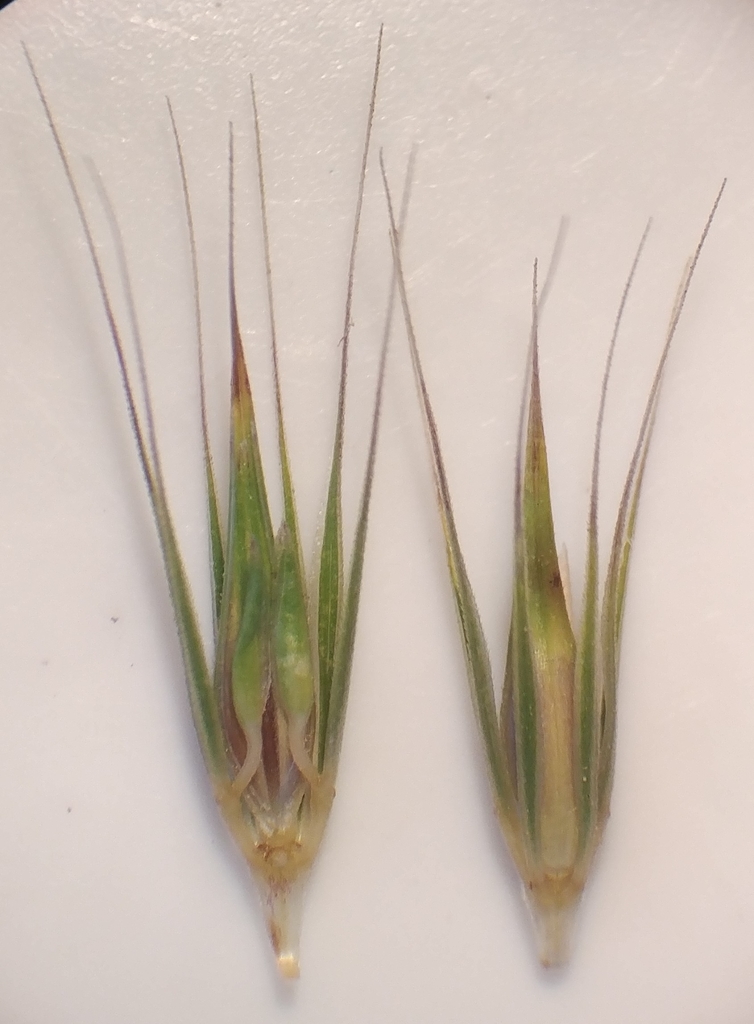
no rights reserved · CC0
Family: Poaceae · Type: Grass · Native
Conservation status: CNPS 3.2
Hordeum intercedens (Bobtail barley) is a native California grass in the Poaceae family, recognized by low elevation southern range, hairy nodes, and sheath hair arrangement.
Bobtail barley is a native annual grass found in southern San Joaquin Valley, southern Coastal Ranges, southern California, Channel Islands, and Peninsular Ranges in vernal pools, dry saline streambeds, and alkaline flats at elevations below 500 meters. Flowering from March to June, this plant produces pale green flowers in compact inflorescences 2.5 to 6.5 centimeters long. Growing with stems 5 to 40 centimeters tall that are loosely tufted and often bent at the base, it has distinctively hairy stems with nodes generally covered in pubescent hairs. Its leaves are 9 centimeters long, up to 4 millimeters wide, and sparsely to densely covered in long spreading hairs on both surfaces. The central spikelet features glumes 9 to 17 millimeters long with a lemma awn 5.5 to 10 millimeters long that slightly spreads with age.
Identification and appearance
Key characters: 9 sympatric species; key features are low elevation southern range, hairy nodes, and sheath hair arrangement
Habitat and range
Habitat: Vernal pools, dry, saline streambeds, alkaline flats
Elevation: < 500 m
California counties: Riverside, Orange, Tulare, Santa Barbara, San Diego, Los Angeles, Nevada, Ventura, Kern, Kings, Mono, San Benito, Merced, San Luis Obispo, Fresno
Outside California: northwestern Baja California
Bloom period
Hordeum intercedens blooms Mar-Jun.
Conservation status
CNPS 3.2
How to tell it apart
vs Bromus: Hordeum has three spikelets per node in a spike; Bromus has separate spikelets in loose clusters.; vs Triticum: Hordeum has three spikelets per node; Triticum has one spikelet per node.; vs Taeniatherum: Hordeum has the central spikelet stalkless; check if side spikelets are stalked.; vs Setaria: Hordeum has three grouped spikelets per node; Setaria has dense bristly single spikelets.; vs Elymus: Hordeum has hollow stems; Elymus has solid stems between nodes.
Frequently asked questions
Is Hordeum intercedens native to California?
Yes. Hordeum intercedens is native to California (recorded as native).
When does Hordeum intercedens bloom?
Hordeum intercedens blooms Mar-Jun.
Where in California does Hordeum intercedens grow?
Hordeum intercedens occurs in Riverside, Orange, Tulare, Santa Barbara, San Diego, Los Angeles, Nevada, Ventura and other counties, at elevations of < 500 m.
What plant family does Hordeum intercedens belong to?
Hordeum intercedens is in the Poaceae family, genus Hordeum.
Is Hordeum intercedens rare or endangered?
Hordeum intercedens carries California Rare Plant Rank 3.2, state rank S3S4.
Related species
Other California species in the same genus, family, or bioregion.
Sources: Jepson eFlora · CNPS Rare Plant Inventory · Index of California Plant Names · CalPhotos · CDFW CNDDB
Last updated 2026-10-07
Data from The California Species Project — 14,000+ California species with verified data from CNPS, CDFW, USFWS, Cal-IPC, and more.