Hordeum vulgare
Barley, Barley
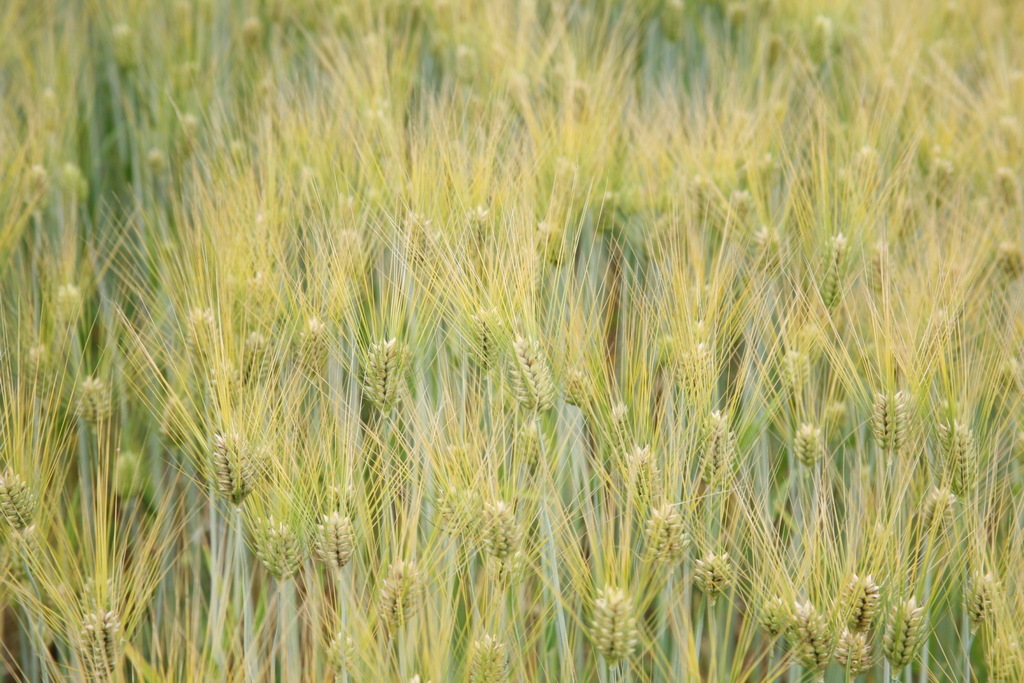
(c) Cliff, some rights reserved (CC BY) · licence
Family: Poaceae · Type: Grass · Not Native
Hordeum vulgare (Barley) is a non-native California grass in the Poaceae family, recognized by distinctive large size, wide leaves, intact inflorescence, and cultivated origin.
Barley is a naturalized annual found in the California Floristic Province in disturbed areas as an escape from cultivation, at elevations below 3,100 meters. Flowering throughout the year, this plant produces green to purple or nearly black flowers in dense, erect to nodding inflorescences 5 to 10 centimeters long. Growing with stout, erect stems 50 to 140 centimeters tall, it has smooth nodes and leaf blades up to 30 centimeters long and 5 to 15 millimeters wide. Its leaves have glabrous sheaths with tiny auricles and a short ligule less than 3 millimeters long. The plant can develop awns 30 to 180 millimeters long on its lemmas, giving the mature plant a distinctive appearance.
Identification and appearance
Key characters: 10 sympatric species; distinctive large size, wide leaves, intact inflorescence, and cultivated origin
Habitat and range
Habitat: Disturbed areas as an escape from cultivation, not persisting
Elevation: < 3100 m
California counties: Los Angeles, Tulare, Santa Cruz, Ventura, Monterey, Santa Clara, Sonoma, San Bernardino, Riverside, San Luis Obispo, San Diego, Santa Barbara, Madera, San Mateo, Orange, Sacramento, Calaveras, Kern, El Dorado, Inyo, Mariposa, Merced, Napa, Plumas, Siskiyou, Sutter, Tuolumne, Alameda, San Francisco, Marin, Butte, Fresno, Colusa, Alpine, Mendocino, Lake, Shasta, Humboldt, Yolo, Del Norte, Mono, Solano, San Joaquin, Placer, Imperial
Outside California: North America, native to Eurasia
Bloom period
Hordeum vulgare blooms All year.
How to tell it apart
vs Bromus: Hordeum has three spikelets per node in a spike; Bromus has separate spikelets in loose clusters.; vs Triticum: Hordeum has three spikelets per node; Triticum has one spikelet per node.; vs Taeniatherum: Hordeum has the central spikelet stalkless; check if side spikelets are stalked.; vs Setaria: Hordeum has three grouped spikelets per node; Setaria has dense bristly single spikelets.; vs Elymus: Hordeum has hollow stems; Elymus has solid stems between nodes.
Frequently asked questions
Is Hordeum vulgare native to California?
No. Hordeum vulgare is not native to California (recorded as not native).
When does Hordeum vulgare bloom?
Hordeum vulgare blooms All year.
Where in California does Hordeum vulgare grow?
Hordeum vulgare occurs in Los Angeles, Tulare, Santa Cruz, Ventura, Monterey, Santa Clara, Sonoma, San Bernardino and other counties, at elevations of < 3100 m.
What plant family does Hordeum vulgare belong to?
Hordeum vulgare is in the Poaceae family, genus Hordeum.
What habitat does Hordeum vulgare grow in?
Hordeum vulgare grows in Disturbed areas as an escape from cultivation, not persisting.
Related species
Other California species in the same genus, family, or bioregion.
- Hordeum arizonicum — Arizona barley
- Hordeum brachyantherum — Meadow barley
- Hordeum brachyantherum subsp. brachyantherum — Northern barley
- Hordeum brachyantherum subsp. californicum — California barley
- Hordeum depressum — Low barley
- Hordeum intercedens — Bobtail barley
- Hyparrhenia hirta — Thatching grass
- Hyparrhenia sp.
- Imperata brevifolia — California satintail
- Imperata sp.
Sources: Jepson eFlora · Index of California Plant Names · CalPhotos
Last updated 2026-10-07
Data from The California Species Project — 14,000+ California species with verified data from CNPS, CDFW, USFWS, Cal-IPC, and more.