Horkelia fusca var. parviflora
Tawny horkelia
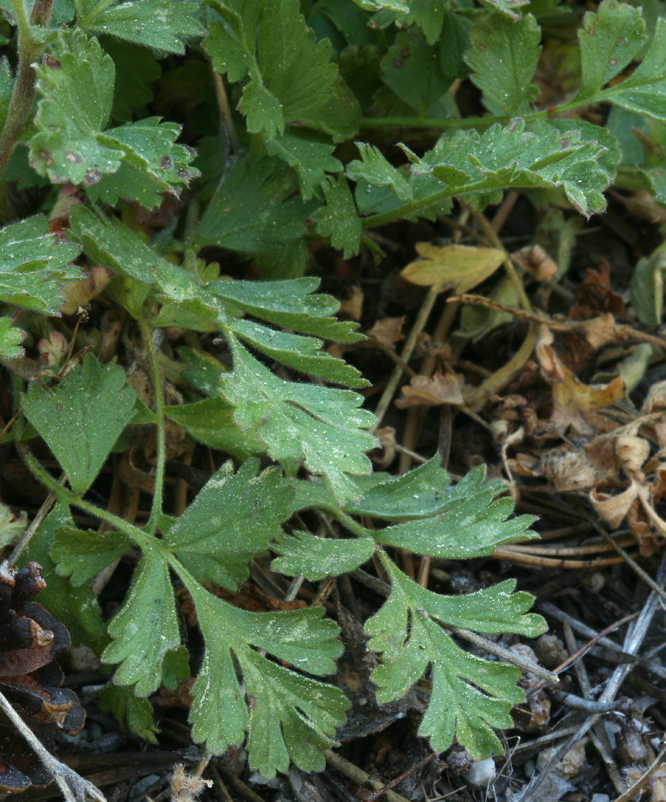
(c) Steve Matson, some rights reserved (CC BY), uploaded by Steve Matson · licence
Family: Rosaceae · Type: Herb · Native
Horkelia fusca var. parviflora (Tawny horkelia) is a native California herb in the Rosaceae family, recognized by separated green leaflets at high elevation.
Tawny horkelia is a California native perennial found in the eastern Klamath Ranges, Sierra Nevada, and northern eastern Sierra Nevada in dry meadow edges and open forest on volcanic or granitic soils at elevations of 1,400 to 3,300 meters. Flowering from June to September, this plant produces white to pale pink flowers in small clusters with 5 to 20 blooms. Growing with slender stems 15 to 45 centimeters tall, it forms delicate clusters with sparse to dense green foliage. Its compound leaves typically have 4 to 8 leaflets on each side, each wedge-shaped leaflet 5 to 15 millimeters long with 5 to 7 teeth along the upper half. The small petals are 2 to 4 millimeters long, with delicate filaments and compact anthers that give the flower clusters a subtle, intricate appearance.
Identification and appearance
Key characters: 8 sympatric species; key features are separated green leaflets at high elevation
Habitat and range
Habitat: dry meadow edges, open forest, volcanic or granitic soils
Elevation: 1400-3300 m
California counties: El Dorado, Fresno, Trinity, Plumas, Placer, Mono, Nevada, Alpine, Amador, Butte, Calaveras, Del Norte, Lassen, Shasta, Sierra, Madera, Mariposa, Siskiyou, Tulare, Tuolumne
Outside California: to Oregon, Wyoming
Bloom period
Horkelia fusca var. parviflora blooms Jun-Sep.
How to tell it apart
vs Drymocallis: Horkelia has exactly 10 stamens and white-pink flowers; Drymocallis has 20+ stamens and yellow-white flowers.; vs Erodium: Horkelia has pinnate leaves and rose-family flowers; Erodium has lobed/divided leaves and long-beaked fruits.; vs Phacelia: Horkelia has rose-family flowers with separate petals; Phacelia has bell-shaped fused corollas with protruding stamens.; vs Potentilla: Horkelia has exactly 10 stamens and flattened filaments; Potentilla has 20+ stamens and thread-like filaments.; vs Ivesia: Horkelia has flat leaves with 2-15 separated leaflets; Ivesia has cylindrical bottlebrush leaves with overlapping leaflets.
Frequently asked questions
Is Horkelia fusca var. parviflora native to California?
Yes. Horkelia fusca var. parviflora is native to California (recorded as native).
When does Horkelia fusca var. parviflora bloom?
Horkelia fusca var. parviflora blooms Jun-Sep.
Where in California does Horkelia fusca var. parviflora grow?
Horkelia fusca var. parviflora occurs in El Dorado, Fresno, Trinity, Plumas, Placer, Mono, Nevada, Alpine and other counties, at elevations of 1400-3300 m.
What plant family does Horkelia fusca var. parviflora belong to?
Horkelia fusca var. parviflora is in the Rosaceae family, genus Horkelia.
What habitat does Horkelia fusca var. parviflora grow in?
Horkelia fusca var. parviflora grows in dry meadow edges, open forest, volcanic or granitic soils.
Related species
Other California species in the same genus, family, or bioregion.
Sources: Jepson eFlora · Index of California Plant Names · CalPhotos
Last updated 2026-10-07
Data from The California Species Project — 14,000+ California species with verified data from CNPS, CDFW, USFWS, Cal-IPC, and more.