Hornungia procumbens
Prostrate hutchinsia
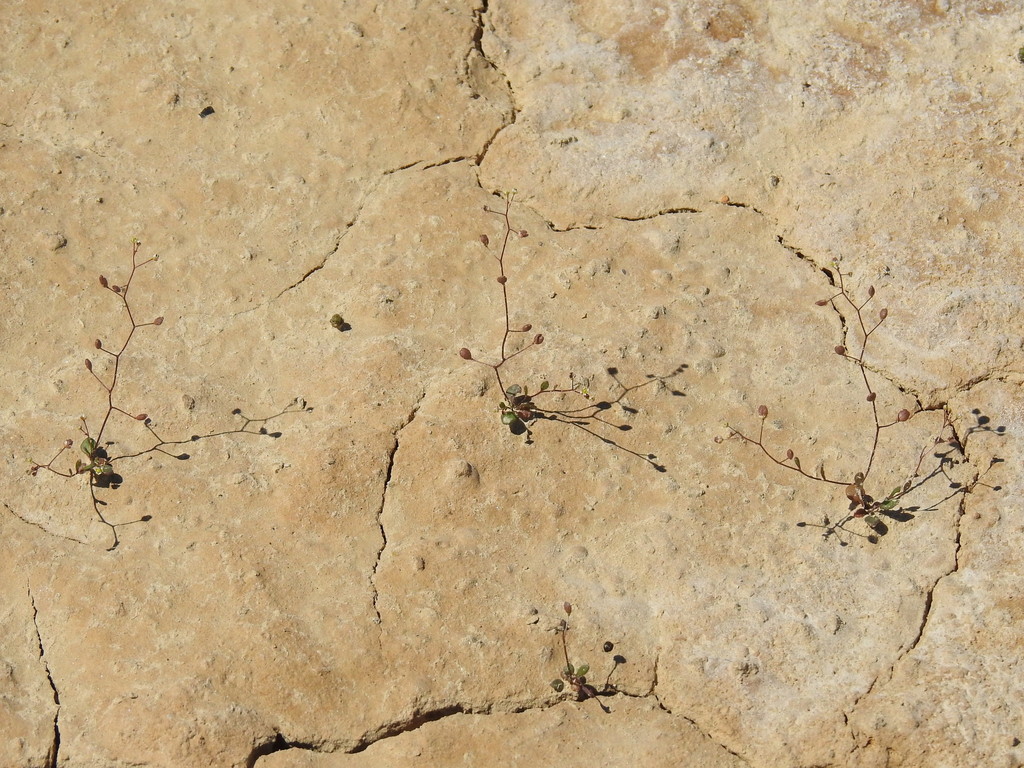
(c) Konstantin Grebennikov, some rights reserved (CC BY) · licence
Family: Brassicaceae · Type: Herb · Not Native
Hornungia procumbens (Prostrate hutchinsia) is a non-native California herb in the Brassicaceae family, recognized by European genus with limited New World naturalization; recently segregated from Hutchinsia.
Prostrate hutchinsia is a naturalized annual found in California's saline flats, woodlands, deserts, meadows, salt marshes, and sagebrush scrub at elevations up to 2,900 meters. Flowering from February to July, this plant produces small white, spoon-shaped flowers with delicate petals. Growing with decumbent to erect branched stems 5 to 22 centimeters tall, it spreads low across the ground. Its leaves range from obovate to oblanceolate, with basal leaves up to 1.5 centimeters long that may be entire or lightly toothed. The tiny fruit is elliptic to obovate, measuring 3 to 4 millimeters long with seeds clustered in groups of 10 to 24.
Identification and appearance
Key characters: European genus with limited New World naturalization; recently segregated from Hutchinsia
Habitat and range
Habitat: Saline flats, shaded sites, woodland, desert, meadows, salt marshes, sagebrush scrub
Elevation: < 2900 m
California counties: San Bernardino, Lassen, Santa Barbara, Riverside, San Diego, Kern, Orange, Inyo, Tulare, Mono, San Luis Obispo, Monterey, Contra Costa, Ventura, Sonoma, San Joaquin, Santa Clara, Modoc, Tuolumne, Alameda, Madera, Stanislaus, Siskiyou, Los Angeles, Kings, Merced, Glenn, Colusa, Napa, Plumas, Yolo, Fresno
Outside California: to British Columbia, eastern Canada, Colorado, native to Eurasia
Bloom period
Hornungia procumbens blooms Feb-Jul.
How to tell it apart
vs Cardamine: Hornungia has broad pods with 10-24 seeds and prostrate growth, Cardamine has narrower pods with fewer seeds.; vs Lepidium: Both have broad pods, but Hornungia packs 10-24 seeds per pod while Lepidium has only 2-4.; vs Lyrocarpa: Hornungia has small flattened pods with many seeds, Lyrocarpa has distinctive heart-shaped pods.; vs Polyctenium: Hornungia is a tiny prostrate mat with 10-24 seeds per pod, Polyctenium is taller with fewer seeds.; vs Smelowskia: Hornungia grows as a prostrate mat at low to mid elevations, Smelowskia forms cushions in alpine areas.
Frequently asked questions
Is Hornungia procumbens native to California?
No. Hornungia procumbens is not native to California (recorded as not native).
When does Hornungia procumbens bloom?
Hornungia procumbens blooms Feb-Jul.
Where in California does Hornungia procumbens grow?
Hornungia procumbens occurs in San Bernardino, Lassen, Santa Barbara, Riverside, San Diego, Kern, Orange, Inyo and other counties, at elevations of < 2900 m.
What plant family does Hornungia procumbens belong to?
Hornungia procumbens is in the Brassicaceae family, genus Hornungia.
What habitat does Hornungia procumbens grow in?
Hornungia procumbens grows in Saline flats, shaded sites, woodland, desert, meadows, salt marshes, sagebrush scrub.
Related species
Other California species in the same genus, family, or bioregion.
Sources: Jepson eFlora · Index of California Plant Names · CalPhotos
Last updated 2026-10-07
Data from The California Species Project — 14,000+ California species with verified data from CNPS, CDFW, USFWS, Cal-IPC, and more.