Horsfordia newberryi
Newberry's velvet-mallow
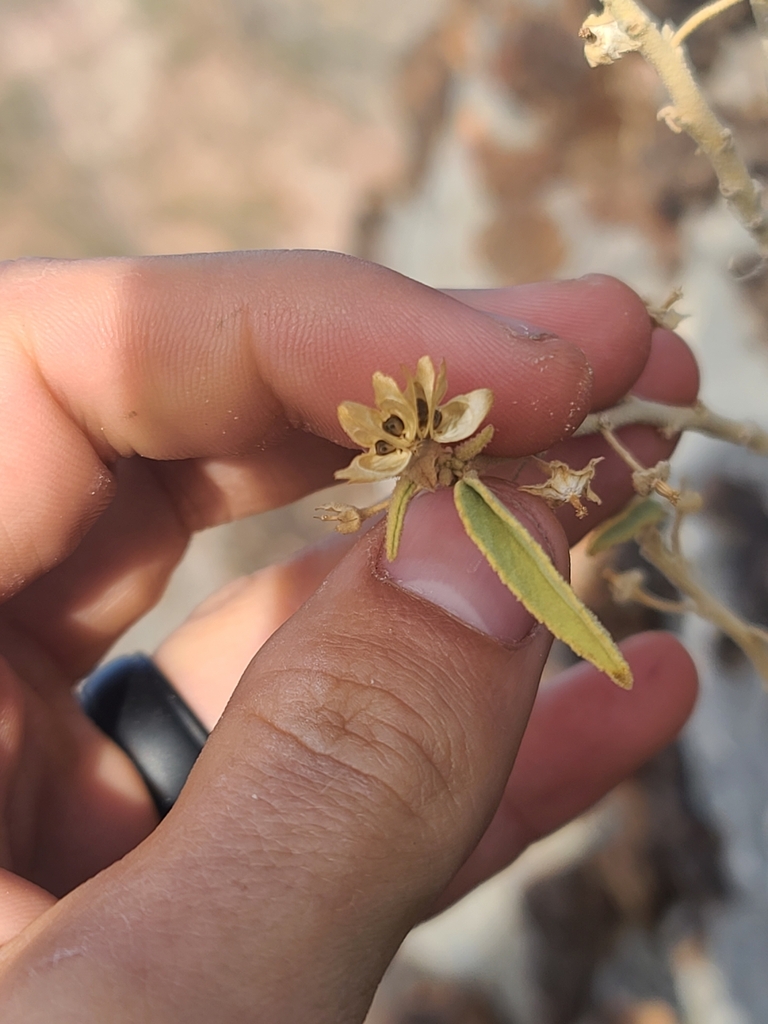
no rights reserved · CC0
Family: Malvaceae · Type: Shrub · Native
Conservation status: CNPS 4.3
Horsfordia newberryi (Newberry's velvet-mallow) is a native California shrub in the Malvaceae family, recognized by key differences in stem color, leaf shape, and fruit wing dimensions.
Newberry's velvet-mallow is a California native shrub found in the western Sonoran Desert and Peninsular Ranges in creosote-bush scrub at elevations of 100 to 800 meters. Flowering from March to April and November to December, this plant produces pale yellow flowers with styles around 10 millimeters long. Growing to 2 to 3 meters tall with a distinctive yellow stem, it has narrowly ovate leaves 4 to 10 centimeters long with fine teeth and a truncate to slightly heart-shaped base. Its leaves have petioles significantly shorter than the leaf blade, with leaf tips ranging from obtuse to acute. The fruit is approximately 7 to 9 millimeters in diameter, generally purple on top with about 10 segments that are partially filled with seeds.
Identification and appearance
Key characters: 1 sympatric species; key differences in stem color, leaf shape, and fruit wing dimensions
Habitat and range
Habitat: Creosote-bush scrub
Elevation: generally 100-800 m
California counties: Riverside, San Diego, Imperial, San Benito
Outside California: to southwestern Arizona, northern Mexico
Bloom period
Horsfordia newberryi blooms Mar-Apr, Nov--Dec.
Conservation status
CNPS 4.3
How to tell it apart
vs Abutilon: Horsfordia mericarps are winged in their upper half (samara-like) and often purple-tipped; Abutilon mericarps are wingless, beaked, and awned.; vs Sphaeralcea: Horsfordia is a tall wand-like shrub with winged mericarps; Sphaeralcea (globemallow) is lower and herbaceous-based with orange-red flowers and wingless kidney-shaped mericarps.; vs Malacothamnus: Horsfordia has 1-2-seeded winged mericarps on a slender yellowish stem; Malacothamnus (bushmallow) has crowded pink flowers in interrupted spikes and unwinged 1-seeded mericarps.; vs Sida: Horsfordia is a tall (2-3 m) shrub with mericarps winged above; Sida is a low stiff subshrub with small wingless, often 2-awned mericarps.; vs Herissantia: Horsfordia has firm, winged, purple-topped mericarps in a persistent fruit; Herissantia has a papery inflated schizocarp whose mericarps fall away separately.
Frequently asked questions
Is Horsfordia newberryi native to California?
Yes. Horsfordia newberryi is native to California (recorded as native).
When does Horsfordia newberryi bloom?
Horsfordia newberryi blooms Mar-Apr, Nov--Dec.
Where in California does Horsfordia newberryi grow?
Horsfordia newberryi occurs in Riverside, San Diego, Imperial, San Benito, at elevations of generally 100-800 m.
What plant family does Horsfordia newberryi belong to?
Horsfordia newberryi is in the Malvaceae family, genus Horsfordia.
Is Horsfordia newberryi rare or endangered?
Horsfordia newberryi carries California Rare Plant Rank 4.3, state rank S4.
Related species
Other California species in the same genus, family, or bioregion.
Sources: Jepson eFlora · CNPS Rare Plant Inventory · Index of California Plant Names · CalPhotos · CDFW CNDDB
Last updated 2026-10-07
Data from The California Species Project — 14,000+ California species with verified data from CNPS, CDFW, USFWS, Cal-IPC, and more.