Hulsea vestita subsp. callicarpha
Beautiful hulsea, Beautiful Hulsea
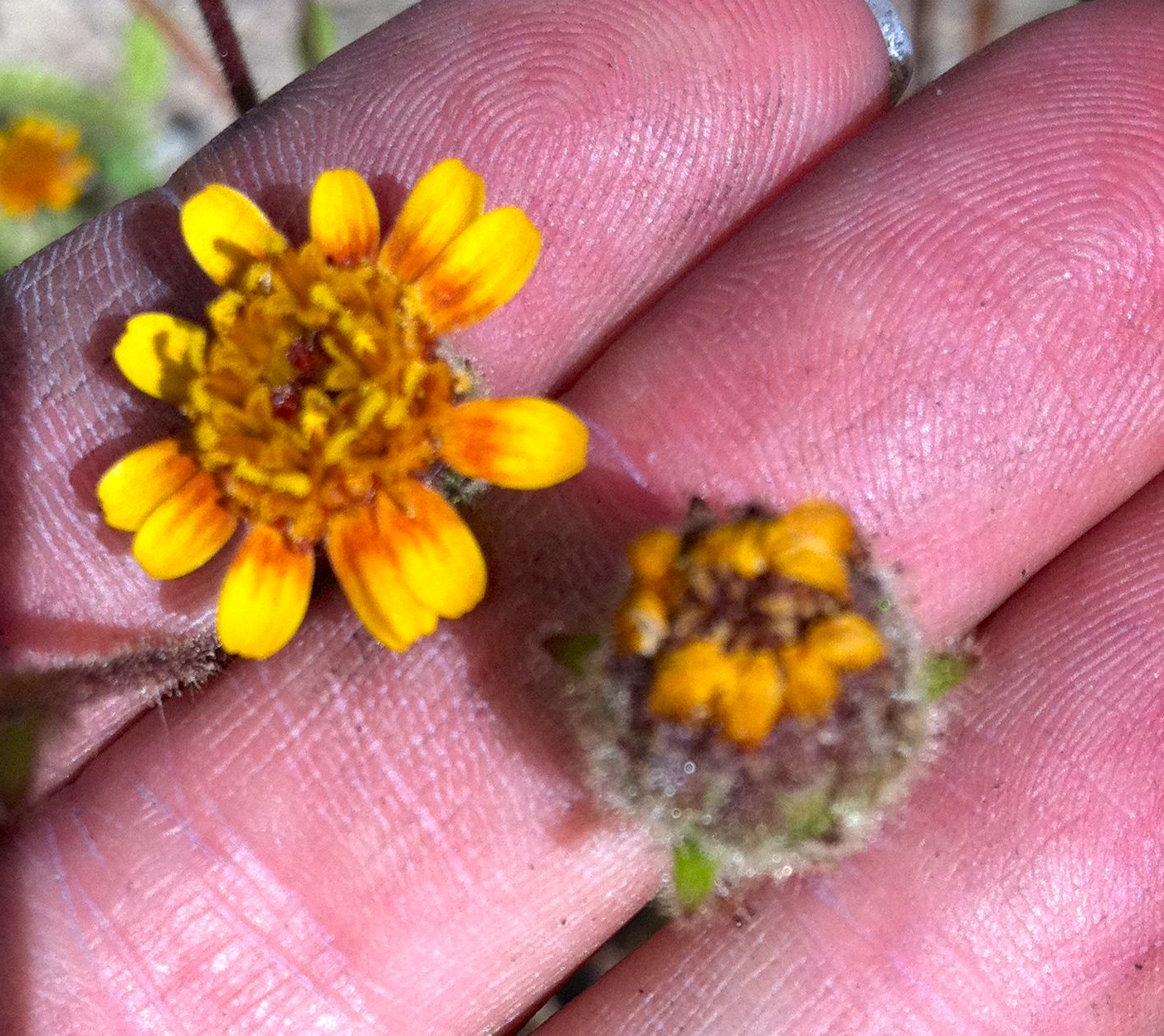
Photo: parent species Hulsea vestita · Photo by Chez Brungraber
Family: Asteraceae · Type: Herb · Native
Conservation status: CNPS 4.2
Hulsea vestita subsp. callicarpha (Beautiful hulsea) is a native California herb in the Asteraceae family, recognized by height and yellow/orange rays.
Beautiful hulsea is a rare (CNPS 4.2) California native perennial found in northern Peninsular Ranges (including San Jacinto Mountains) in open gravel, talus slopes, montane chaparral, and pine forest at elevations of 1,300 to 2,500 meters. Flowering from May to September, this plant produces yellow to orange ray flowers 6 to 10 millimeters long with distinctive green or red-tinged phyllary tips. Growing with stems generally over 50 centimeters tall, it develops a robust habit with prominent woolly foliage. Its basal leaves are entire to weakly scalloped, gradually tapered, and densely covered with white woolly hair on the underside. The plant's complex ray flowers, numbering 16 to 25 per head, create a striking display against its textured green foliage.
Identification and appearance
Key characters: 2 sympatric species; distinguished by height and yellow/orange rays
Habitat and range
Habitat: Open gravel, talus slopes, montane chaparral, pine forest
Elevation: 1300-2500 m
Bloom period
Hulsea vestita subsp. callicarpha blooms May-Sep.
Conservation status
CNPS 4.2
How to tell it apart
vs Bahiopsis: Hulsea leaves are never woody-based shrubs like Bahiopsis; check if plant is herbaceous and high-elevation.; vs Encelia: Hulsea is sticky-glandular throughout; Encelia has dry, often silvery leaves without glandular hairs.; vs Heterotheca: Hulsea has exactly 4 seed scales in unequal pairs; Heterotheca has numerous bristly pappus.; vs Gaillardia: Hulsea leaves are entire to shallowly lobed; Gaillardia has deeply divided, dissected leaves.; vs Hymenoxys: Hulsea leaves are entire to shallowly lobed; Hymenoxys has deeply dissected, feathery leaves.
Frequently asked questions
Is Hulsea vestita subsp. callicarpha native to California?
Yes. Hulsea vestita subsp. callicarpha is native to California (recorded as native).
When does Hulsea vestita subsp. callicarpha bloom?
Hulsea vestita subsp. callicarpha blooms May-Sep.
What plant family does Hulsea vestita subsp. callicarpha belong to?
Hulsea vestita subsp. callicarpha is in the Asteraceae family, genus Hulsea.
Is Hulsea vestita subsp. callicarpha rare or endangered?
Hulsea vestita subsp. callicarpha carries California Rare Plant Rank 4.2, state rank S4.
What habitat does Hulsea vestita subsp. callicarpha grow in?
Hulsea vestita subsp. callicarpha grows in Open gravel, talus slopes, montane chaparral, pine forest.
Related species
Other California species in the same genus, family, or bioregion.
Sources: Jepson eFlora · CNPS Rare Plant Inventory · Index of California Plant Names · CalPhotos · CDFW CNDDB
Last updated 2026-10-07
Data from The California Species Project — 14,000+ California species with verified data from CNPS, CDFW, USFWS, Cal-IPC, and more.